
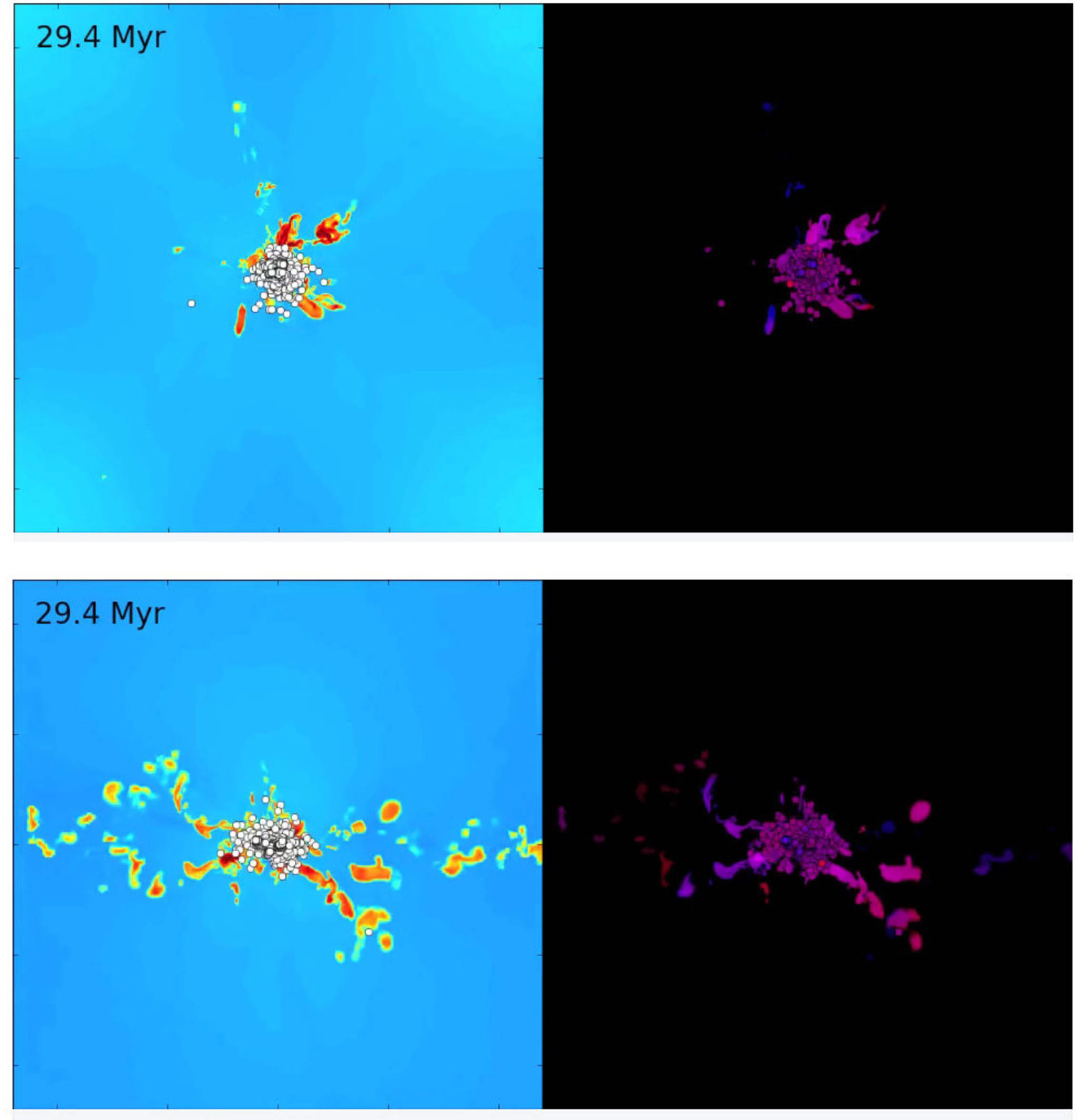
A newly published study details how astronomers from UC Santa Cruz used supercomputer simulations to trace the mixing of chemical elements in star-forming clouds, finding that stars formed from a single cloud bear the same unique chemical fingerprint.
Early, fast, turbulent mixing of gas within giant molecular clouds—the birthplaces of stars — means all stars formed from a single cloud bear the same unique chemical “tag” or “DNA fingerprint,” finds computational astronomers at University of California, Santa Cruz. Could such chemical tags identify our own Sun’s long-lost sibling stars? The findings were published in the journal Nature online on August 31, 2014.
Stars are made mostly of hydrogen and helium, but they also contain trace amounts of other elements, such as carbon, oxygen, iron, and even more exotic substances. By carefully measuring the wavelengths (colors) of light coming from a star, astronomers can determine how abundant each of these trace elements is. For any two stars at random, the abundances of their trace elements will slightly differ: one star may have a bit more iron, the other a bit more carbon, etc.
However, astronomers have known for more than a decade that any two stars within the same gravitationally bound star cluster always show the same abundances. “The pattern of abundances is like a DNA fingerprint, where all the members of a family share a common set of genes,” said Mark Krumholz, associate professor of astronomy and astrophysics at University of California, Santa Cruz (UCSC).
Being able to measure this “fingerprint” is potentially very useful, because stellar families usually do not stay together. Most stars are born as members of star cluster, but over time they drift apart and migrate across the galaxy. Their abundances, however, are set at birth. Thus, astronomers have long wondered if it might be possible to tell if two stars that are now on opposite sides of the galaxy were born billions of years ago from the same giant molecular cloud. In fact, they further wondered, might it be possible even to find our own Sun’s long-lost siblings?
Just one big problem: “Although stars that are part of the same long-lived star cluster today are chemically identical, we had no good reason to think that such family resemblance would hold true of stars that were born together but then dispersed immediately,” explained Krumholz. “The underlying problem was that we didn’t really know why stars are chemically homogeneous.” For example, in a cloud where stars formed rapidly, might the cloud not have had enough time to homogenize thoroughly, thus giving rise to stars born at the same time but not uniform in chemical composition? “Without a real understanding of the physical mechanism that produces uniformity, everything was at best a speculation,” he added.
Two 11-second movies shows a computational simulation of a collision of two converging streams of interstellar gas, leading to collapse and formation of a star cluster at the center. In both movies, the numbers rapidly increasing shows the passage of time in millions of years; left panel shows the density of interstellar gas (yellow and red are densest) and right panel shows red and blue “tracer dyes” added to watch how the gas mixes during the collapse. Credit: Mark Krumholz/University of California, Santa Cruz
Surprising violence
So Krumholz and his graduate student Yi Feng turned to UCSC’s Hyades supercomputer to run a fluid dynamics simulation. They simulated two streams of interstellar gas coming together to form a cloud that, over a few million years, collapsed under its own gravity to make a cluster of stars. “We added tracer dyes to the two streams in the simulations, which let us watch how the gas mixed together during this process,” Krumholz recounted. They put red dye in one stream and blue dye in the other, but by the time the cloud started to collapse and form stars, everything was purple—and the resulting stars were purple as well. “We found that, as the streams came together, they became extremely turbulent, and the turbulence very effectively mixed together the tracer dyes,” he said.
“The simulation revealed exactly why stars that are born together end up having the same trace element abundances: as the cloud that forms them is assembled, it gets thoroughly mixed very fast,” Krumholz said. “This was actually a surprise: I didn’t expect the turbulence to be as violent as it was, and so I didn’t expect the mixing to be as rapid or efficient. I thought we’d get some blue stars and some red stars, instead of getting all purple stars.”
In other runs of the simulation, Krumholz and Feng observed that even clouds that do not turn much of their gas into stars—as the Sun’s parent cloud probably didn’t—still produce stars with nearly-identical abundances. “We’ve provided the missing physical explanation of how and why chemical mixing works, and shown convincingly that the chemical mixing process is very general and rapid even in an environment which did not yield a star cluster, like the one where the Sun must have formed,” said Krumholz.
The finding puts the idea of chemical tagging on much firmer footing. “This is good news for prospects for finding the Sun’s long-lost siblings,” Krumholz stated.
Reference: “Early turbulent mixing as the origin of chemical homogeneity in open star clusters” by Yi Feng and Mark R. Krumholz, 31 August 2014, Nature.
DOI: 10.1038/nature13662
arXiv:1408.6543
This work was supported by the National Science Foundation and the National Aeronautics and Space Administration; the Hyades supercomputer was obtained in part through funding from the University of California High-Performance AstroComputing (UC-HiPACC).
Never miss a breakthrough: Join the SciTechDaily newsletter.
Follow us on Google and Google News.