
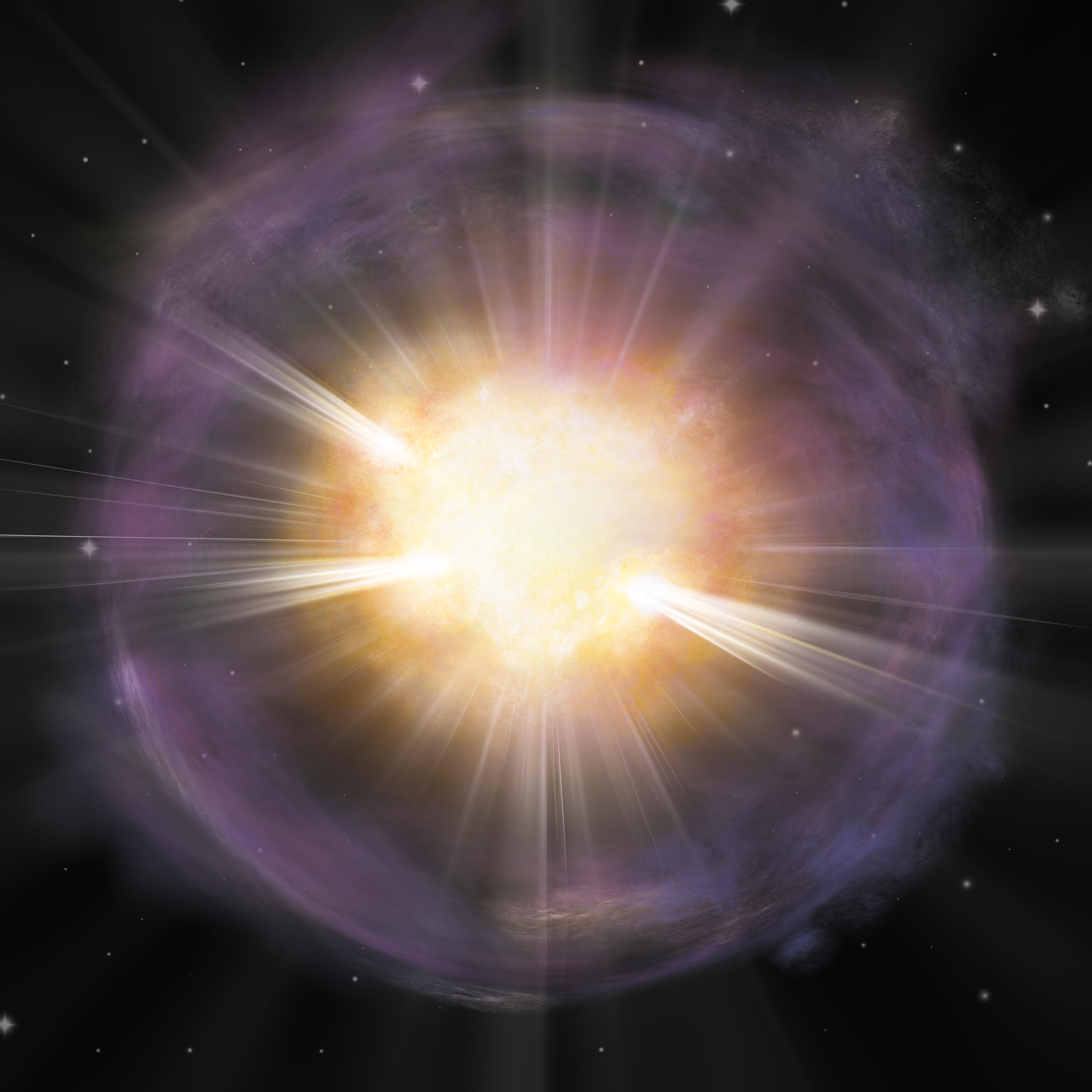
Called “calcium-rich supernovae,” these stellar explosions are so rare that astrophysicists have struggled to find and subsequently study them. The nature of these supernovae and their mechanism for creating calcium, therefore, have remained elusive.
Now a Northwestern University-led team has potentially uncovered the true nature of these rare, mysterious events. For the first time ever, the researchers examined a calcium-rich supernova, dubbed SN 2019ehk, with X-ray imaging, providing an unprecedented glimpse into the star during the last month of its life and ultimate explosion.
The study, which includes data from W. M. Keck Observatory on Maunakea in Hawaii, is published in the August 5, 2020 issue of The Astrophysical Journal.
The new findings revealed that a calcium-rich supernova is a compact star that sheds an outer layer of gas during the final stages of its life. When the star explodes, its matter collides with the loose material in that outer shell, emitting bright X-rays. The overall explosion causes intensely hot temperatures and high pressure, driving a chemical reaction that produces calcium.
“These events are so few in number that we have never known what produced calcium-rich supernova,” said lead author Wynn Jacobson-Galan, an NSF Graduate Research Fellow at Northwestern University. “By observing what this star did in its final month before it reached its critical, tumultuous end, we peered into a place previously unexplored, opening new avenues of study within transient science.”
“Before this event, we had indirect information about what calcium-rich supernovae might or might not be,” said senior author Raffaella Margutti, an assistant professor of physics and astronomy at Northwestern University and a member of CIERA (Center for Interdisciplinary Exploration and Research in Astrophysics). “Now, we can confidently rule out several possibilities.”
‘The Richest of the Rich’
While all calcium comes from stars, calcium-rich supernovae pack the most powerful punch. Typical stars create small amounts of calcium slowly through burning helium throughout their lives. Calcium-rich supernovae, on the other hand, produce massive amounts of calcium within seconds.
“The explosion is trying to cool down,” Margutti explained. “It wants to give away its energy, and calcium emission is an efficient way to do that.”
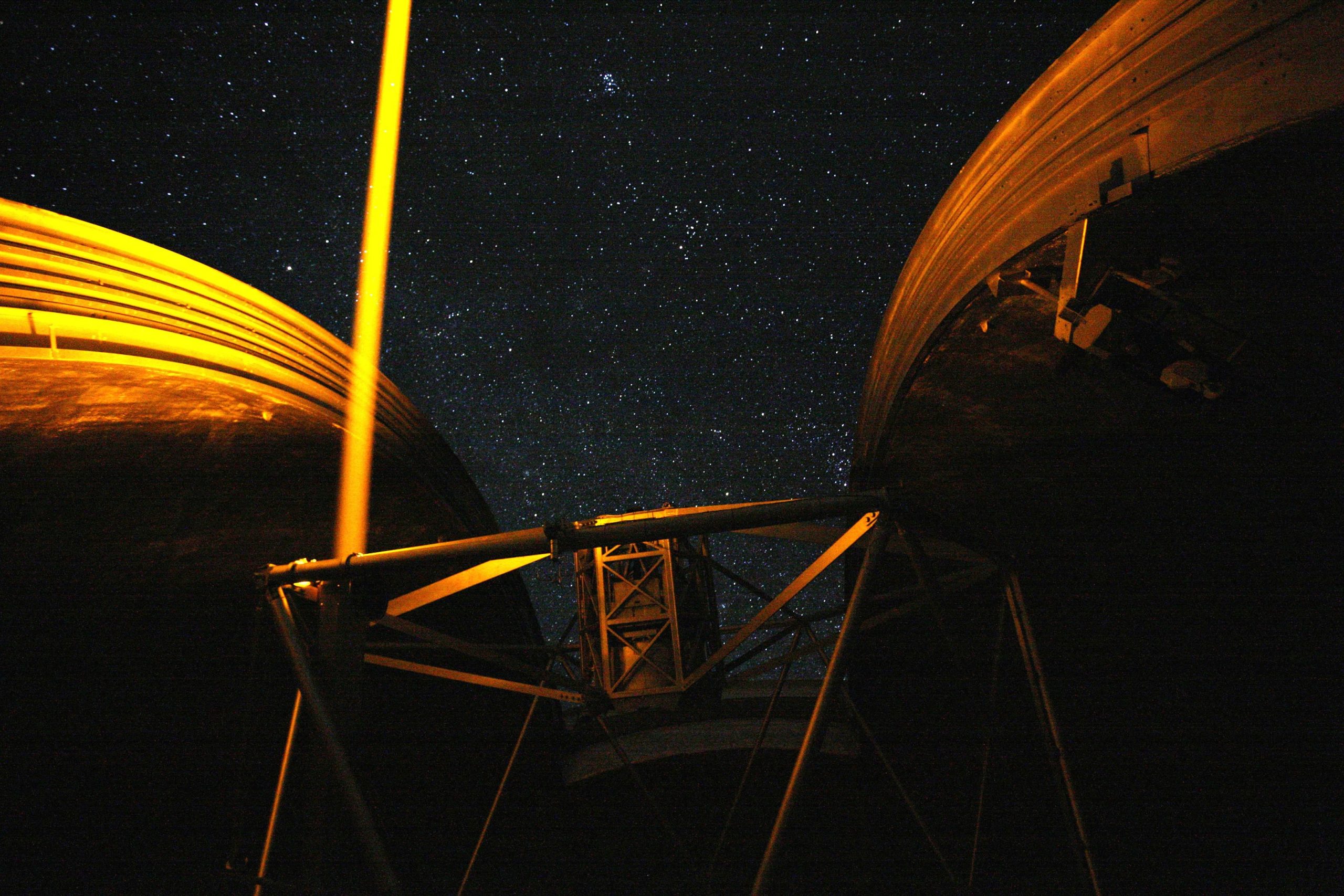
Using Keck Observatory’s Low Resolution Imaging Spectrometer (LRIS), the researchers discovered SN 2019ehk emitted the most calcium ever observed in a singular astrophysical event.
“The beautiful Keck spectrum revealed it wasn’t just calcium-rich,” Margutti said. “It was the richest of the rich.”
‘A Global Collaboration Was Ignited’
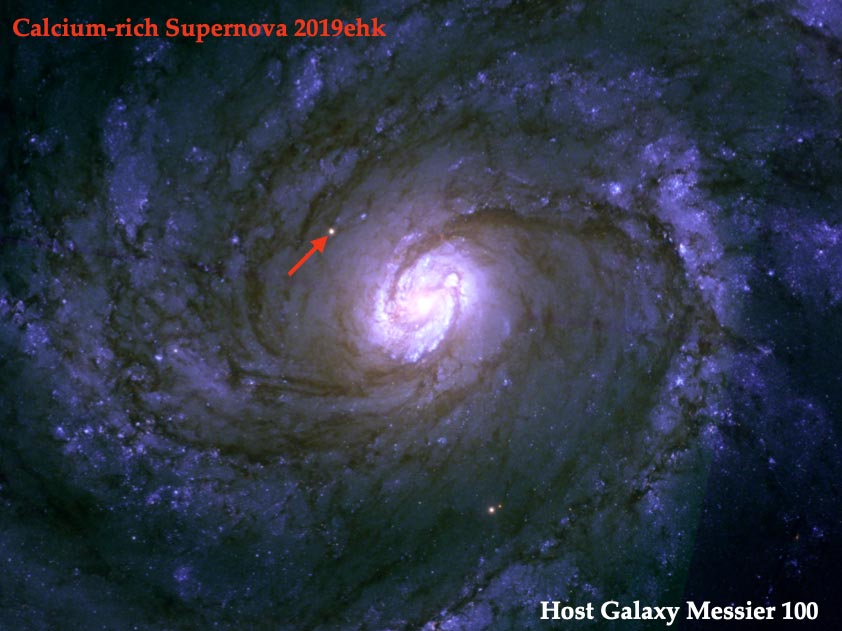
Amateur astronomer Joel Shepherd first spotted the bright burst in April 2019 while using his new telescope to view Messier 100 (M100), a spiral galaxy located 55 million light-years from Earth. After seeing a bright orange dot appear in the frame, he immediately reported the discovery to the astronomical community.
“As soon as the world knew that there was a potential supernova in M100, a global collaboration was ignited,” Jacobson-Galan said. “Every single country with a prominent telescope turned to look at this object.”
The worldwide follow-up operation moved so quickly, the supernova was observed just 10 hours after exploding. Leading observatories such as NASA’s Swift Satellite, Lick Observatory, and Keck Observatory were among the telescopes triggered to examine SN 2019ehk in optical wavelengths.
University of California Santa Barbara graduate student Daichi Hiramatsu was the first to trigger Swift to study SN 2019ehk in the X-ray and ultraviolet. The X-ray emission detected with Swift only lingered for five days before completely disappearing.
“In the world of transients, we have to discover things very, very fast before they fade,” Margutti said. “Initially, no one was looking for X-rays. Daichi noticed something and alerted us to the strange appearance of what looked like X-rays. We looked at the images and realized something was there. It was much more luminous than anybody would have ever thought. There were no preexisting theories that predicted calcium-rich transients would be so luminous in X-ray wavelengths.”
Uncovering New Clues
SN 2019ehk’s brief luminosity told another a story about its nature. The Northwestern researchers believe the star shed an outer layer of gas in its final days. When the star exploded, its material collided with this outer layer to produce a bright, energetic burst of X-rays.
“The luminosity tells us how much material the star shed and how close that material was to the star,” Jacobson-Galan said. “In this case, the star lost a very small amount of material right before it exploded. That material was still nearby.”
Although the Hubble Space Telescope had been observing M100 for the past 25 years, the powerful device never registered the star — which was experiencing its final evolution — responsible for SN 2019ehk. The researchers used the Hubble images to examine the supernova site before the explosion occurred and say this is yet another clue to the star’s true nature.
“It was likely a white dwarf or very low-mass massive star,” Jacobson-Galan said. “Both of those would be very faint.”
“Without this explosion, you wouldn’t know that anything was ever there,” Margutti added. “Not even Hubble could see it.”
More on this research:
- Unprecedented Observations Shine Light on a Dying Star’s Final Moments
- Astronomers Sink Their Teeth Into Special Supernova
Reference: “SN2019ehk: A double-peaked Ca-rich transient with luminous X-ray emission and shock-ionized spectral features” by Wynn V. Jacobson-Galán, Raffaella Margutti, Charles D. Kilpatrick, Daichi Hiramatsu, Hagai Perets, David Khatami, Ryan J. Foley, John Raymond, Sung-Chul Yoon, Alexey Bobrick, Yossef Zenati, Lluís Galbany, Jennifer Andrews, Peter J. Brown, Régis Cartier, Deanne L. Coppejans, Georgios Dimitriadis, Matthew Dobson, Aprajita Hajela, D. Andrew Howell, Hanindyo Kuncarayakti, Danny Milisavljevic, Mohammed Rahman, César Rojas-Bravo, David J. Sand, Joel Shepherd, Stephen J. Smartt, Holland Stacey, Michael Stroh, Jonathan J. Swift, Giacomo Terreran, Jozsef Vinko, Xiaofeng Wang, Joseph P. Anderson, Edward A. Baron, Edo Berger, Peter K. Blanchard, Jamison Burke, David A. Coulter, Lindsay DeMarchi, James M. DerKacy, Christoffer Fremling, Sebastian Gomez, Mariusz Gromadzki, Griffin Hosseinzadeh, Daniel Kasen, Levente Kriskovics, Curtis McCully, Tomás E. Müller-Bravo, Matt Nicholl, András Ordasi, Craig Pellegrino, Anthony L. Piro, András Pál, Juanjuan Ren, Armin Rest, R. Michael Rich, Hanna Sai, Krisztián Sárneczky, Ken J. Shen, Philip Short, Matthew R. Siebert, Candice Stauffer, Róbert Szakáts, Xinhan Zhang, Jujia Zhang and Kaicheng Zhang, 5 August 2020, The Astrophysical Journal.
DOI: 10.3847/1538-4357/ab9e66
About LRIS
The Low Resolution Imaging Spectrometer (LRIS) is a very versatile and ultra-sensitive visible-wavelength imager and spectrograph built at the California Institute of Technology by a team led by Prof. Bev Oke and Prof. Judy Cohen and commissioned in 1993. Since then it has seen two major upgrades to further enhance its capabilities: the addition of a second, blue arm optimized for shorter wavelengths of light and the installation of detectors that are much more sensitive at the longest (red) wavelengths. Each arm is optimized for the wavelengths it covers. This large range of wavelength coverage, combined with the instrument’s high sensitivity, allows the study of everything from comets (which have interesting features in the ultraviolet part of the spectrum), to the blue light from star formation, to the red light of very distant objects. LRIS also records the spectra of up to 50 objects simultaneously, especially useful for studies of clusters of galaxies in the most distant reaches, and earliest times, of the universe. LRIS was used in observing distant supernovae by astronomers who received the Nobel Prize in Physics in 2011 for research determining that the universe was speeding up in its expansion.
About W. M. Keck Observatory
The W. M. Keck Observatory telescopes are among the most scientifically productive on Earth. The two 10-meter optical/infrared telescopes on the summit of Maunakea on the Island of Hawaii feature a suite of advanced instruments including imagers, multi-object spectrographs, high-resolution spectrographs, integral-field spectrometers, and world-leading laser guide star adaptive optics systems.
Never miss a breakthrough: Join the SciTechDaily newsletter.
Follow us on Google and Google News.
2 Comments
Amateur astronomer Joel Shepherd first spotted the bright burst in April 2019..lol IT was Jarosław Grzegorzek
In the 4th paragraph, “chemical reaction” should be “nuclear reaction”.