
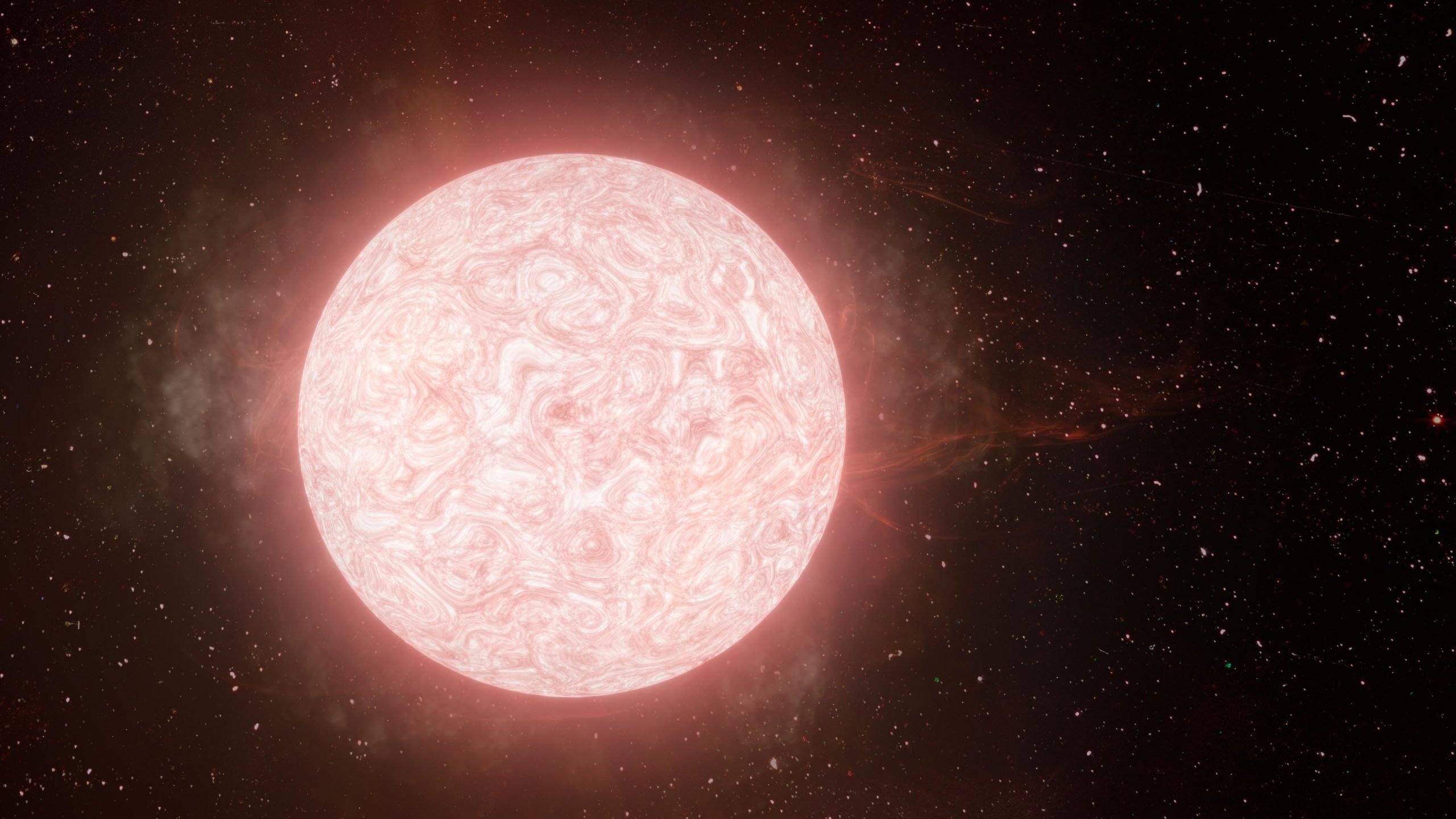
For the first time, the last days of a red supergiant star were directly observed as it transitioned into a supernova, challenging prior assumptions about the quiescent nature of such stars before their catastrophic end.
Using a University of Hawaiʻi telescope on Haleakala and another on Maunakea, astronomers, for the very first time, imaged the dramatic end to a red supergiant star’s life as it was happening. The massive star’s rapid self-destruction and final death throes were captured before it collapsed into a Type II supernova.
A team of researchers used the UH Institute for Astronomy-operated Panoramic Survey Telescope and Rapid Response System (Pan-STARRS) on Maui and W. M. Keck Observatory on Hawaiʻi Island to observe the red supergiant during its last 130 days leading up to its deadly detonation. The observations were part of their ongoing Young Supernova Experiment (YSE) transient survey.
Breakthrough in Pre-Supernova Monitoring
“This is a breakthrough in our understanding of what massive stars do moments before they die,” said Wynn Jacobson-Galán, a National Science Foundation Graduate Research Fellow at the University of California, Berkeley and lead author of the study. “Direct detection of pre-supernova activity in a red supergiant star has never been observed before in an ordinary Type II supernova. For the first time, we watched a red supergiant star explode!”
The discovery was recently published in The Astrophysical Journal.
Monitoring and Aftermath of the Supernova
Pan-STARRS first detected the doomed massive star in the summer of 2020 via the huge amount of light radiating from the red supergiant. A few months later, in the fall of 2020, a supernova lit the sky.
“This is an example of how repeatedly surveying the sky with Pan-STARRS brings new discoveries,” said Ken Chambers, IfA astronomer and principal investigator of Pan-STARRS. “Without the constant monitoring of the night sky with Pan-STARRS, this kind of discovery would not be possible.”
Analysis of Supernova Progenitor
Researchers compared the celestial event to watching a ticking time bomb. The team continued to monitor SN 2020tlf after the explosion; based on data obtained from Keck Observatory’s Deep Imaging and Multi-Object Spectrograph (DEIMOS) and Near Infrared Echellette Spectrograph (NIRES), they determined that SN 2020tlf’s progenitor red supergiant star, located in the NGC 5731 galaxy about 120 million light-years away as seen from Earth, was 10 times more massive than the Sun.
Implications for Red Supergiant Evolution
The discovery defies previous ideas of how red supergiant stars evolve right before blowing up. Prior to this, all red supergiants observed before exploding were relatively quiescent: they showed no evidence of violent eruptions or luminous emission, as was observed prior to SN 2020tlf.
However, this novel detection of bright radiation coming from a red supergiant in the final year before exploding suggests that at least some of these stars must undergo significant changes in their internal structure that then results in the tumultuous ejection of gas moments before they collapse.
For more on this research:
- Astronomers Capture Red Supergiant Star Exploding in Massive Supernova – For the Very First Time
- Astronomers Witness a Massive Dying Star Reach Its Explosive End
Reference: “Final Moments. I. Precursor Emission, Envelope Inflation, and Enhanced Mass Loss Preceding the Luminous Type II Supernova 2020tlf” by W. V. Jacobson-Galán, L. Dessart, D. O. Jones, R. Margutti, D. L. Coppejans, G. Dimitriadis, R. J. Foley, C. D. Kilpatrick, D. J. Matthews, S. Rest, G. Terreran, P. D. Aleo, K. Auchettl, P. K. Blanchard, D. A. Coulter, K. W. Davis, T. J. L. de Boer, L. DeMarchi, M. R. Drout, N. Earl, A. Gagliano, C. Gall, J. Hjorth, M. E. Huber, A. L. Ibik, D. Milisavljevic, Y.-C. Pan, A. Rest, R. Ridden-Harper, C. Rojas-Bravo, M. R. Siebert, K. W. Smith, K. Taggart, S. Tinyanont, Q. Wang and Y. Zenati, 6 January 2022, The Astrophysical Journal.
DOI: 10.3847/1538-4357/ac3f3a
Never miss a breakthrough: Join the SciTechDaily newsletter.
Follow us on Google and Google News.
2 Comments
Actually they observed the event not while it was happening but as it happened 120 million years ago. Just sayin.
To Mark Laperle interesting comment!
I always wish they had real time video for these events. Shoutout to the artist who rendered this and I still wish I could see the real deal.
Although I don’t think we had the needed technology 120 million years ago.