

Research suggests the potential for creating a new medication that suppresses appetite without causing nausea.
The next chapter in the story of headline-making popular obesity drugs could focus on understanding the physical sensation of fullness after eating compared to the brain’s regulation of nausea. Researchers at the Monell Chemical Senses Center have identified a group of neurons in the brain that manage food consumption without inducing nausea in animal models, distinguishing the beneficial aspects of these drugs from their side effects.
The study, published in the journal Nature, describes two distinct neural circuits that govern different effects of the same drug. The drugs studied are among the most effective weight-loss drugs available — known as long-acting glucagon-like peptide-1 receptor (GLP1R) agonists — which initiate neurochemical responses via receptors expressed in the body.
One of the most effective and popular GLP1-based drugs — called semaglutide and marketed as Ozempic and Wegovy — produces impressive weight loss results in clinical trials. According to the World Health Organization, in 2022, 1 in 8 people globally were living with obesity, making the development of drugs like these of dire importance.
Overcoming Side Effects in Obesity Treatment
“One of the barriers to drug treatments for obesity is side effects such as nausea and vomiting,” said senior author Amber L. Alhadeff, PhD, Monell Assistant Member. “We did not have a good idea of whether these unpleasant side effects are related or necessary for the weight-loss effects.”
To find out, the Monell team investigated the brain circuits that link feeling full after ingesting a meal to those causing food avoidance due to feeling nauseated. The researchers found that neurons in the hindbrain mediate both effects of these obesity drugs, and unexpectedly also discovered that the individual neurons mediating satiety and nausea are different.
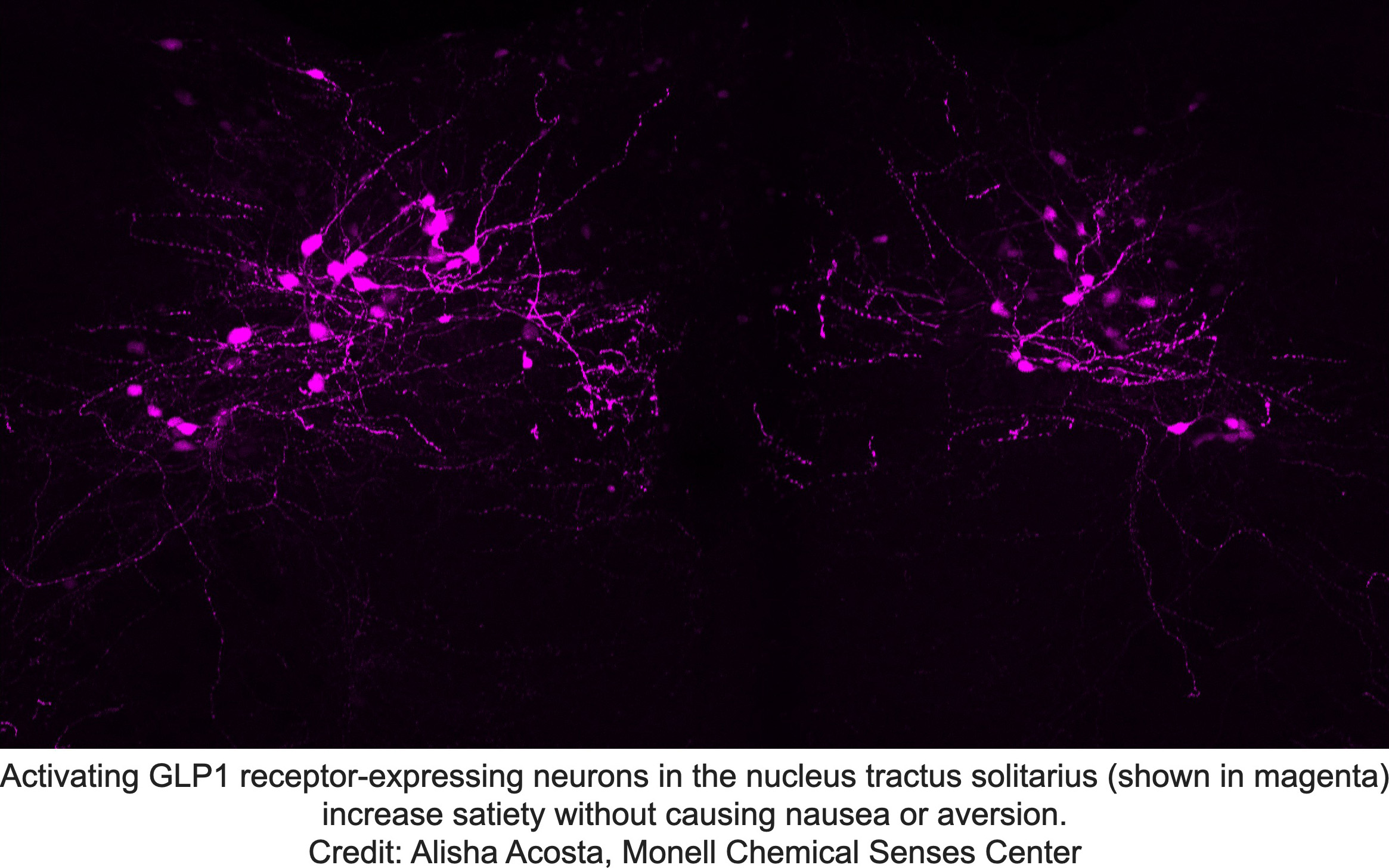
Two-photon imaging of hindbrain GLP1R neurons in live mice showed that most individual neurons are tuned to react to stimuli that are either nutritive or aversive, but not both. What’s more, the study revealed that GLP1R neurons in one part of the hindbrain called the area postrema respond more to aversive stimuli, whereas GLP1R neurons in another area called the nucleus tractus solitarius lean toward nutritive stimuli.
Semaglutide is a medication used primarily for the treatment of type 2 diabetes and obesity. It works as a glucagon-like peptide-1 (GLP-1) receptor agonist, which helps to lower blood sugar levels by increasing insulin production and reducing the amount of glucose released by the liver. In terms of obesity management, semaglutide aids in weight loss by reducing appetite and caloric intake. It is administered via injection or as an oral formulation.
Next, the team separately manipulated the two groups of GLP1R neurons to understand their effects on behavior. They found that activating neurons in the nucleus tractus solitarius triggers satiety, with no aversion behavior; whereas, activating neurons in the area postrema trigger a strong aversion reaction. Importantly, the obesity drugs reduced food intake even when the aversion pathway was inhibited. These surprising findings highlight the population of neurons in the nucleus tractus solitarius as a target for future obesity drugs to reduce food intake without making individuals feel sick.
“Developing experimental obesity drugs that selectively activate this population may promote weight loss while avoiding aversive side effects,” said Alhadeff. In fact, say the authors, the concept of separating therapeutic and side effects at the level of neural circuits could, in theory, be applied to any drug with side effects.
Reference: “Dissociable hindbrain GLP1R circuits for satiety and aversion” by Kuei-Pin Huang, Alisha A. Acosta, Misgana Y. Ghidewon, Aaron D. McKnight, Milena S. Almeida, Nathaniel T. Nyema, Nicholas D. Hanchak, Nisha Patel, Yenoukoume S. K. Gbenou, Alice E. Adriaenssens, Kevin A. Bolding and Amber L. Alhadeff, 10 July 2024, Nature.
DOI: 10.1038/s41586-024-07685-6
This work was supported by the National Institutes of Health (R00DK119574 and DP2AT011965), the American Heart Association, New York Stem Cell Foundation, Klingenstein Fund and Simons Foundation, Pew Charitable Trusts, National Science Foundation (Grant2236662), the Penn Institute for Diabetes, Obesity, and Metabolism, and the Monell Chemical Senses Center. The confocal microscope used in these studies was purchased with an NIH instrumentation grant (S10OD030354). Alhadeff is a New York Stem Cell Foundation Robertson investigator and a Pew biomedical scholar.
Never miss a breakthrough: Join the SciTechDaily newsletter.
Follow us on Google and Google News.