

Close Menu
    Facebook X (Twitter) Instagram
    SciTechDaily
    • Biology
    • Chemistry
    • Earth
    • Health
    • Physics
    • Science
    • Space
    • Technology
    Facebook X (Twitter) Pinterest YouTube RSS
    SciTechDaily
    Home»Chemistry»Hydrogen Fuel Cells Improved With Coordination Polymer Glass
    Chemistry

    Hydrogen Fuel Cells Improved With Coordination Polymer Glass

    By Kyoto UniversityMay 13, 2020No Comments3 Mins Read
    Facebook Twitter Pinterest Telegram LinkedIn WhatsApp Email Reddit
    Share
    Facebook Twitter LinkedIn Pinterest Telegram Email Reddit
    New Polymer Glass Molecular Structure
    The molecular structure of the new polymer glass facilitated the movement of protons (H+) across it under dry conditions at 120°C. Credit: Mindy Takamiya/Kyoto University iCeMS

    Hydrogen fuel cells made with coordination polymer glass membranes could produce as much energy as their liquid-based counterparts while adding strength and flexibility.

    Scientists at Japan’s Institute for Integrated Cell-Material Sciences (iCeMS) are leading efforts to synthesize stronger and efficient materials for hydrogen fuel cell membranes. Most fuel cells currently on the market employ liquid membranes. A new coordination polymer glass membrane, reported in the journal Chemical Science, works just as well as its liquid counterparts with added strength and flexibility.

    Hydrogen fuel cells are fed hydrogen and oxygen to produce electricity, with water as their only by-product. These fuel cells contain ‘proton conducting membranes’ that facilitate the separation of hydrogen’s positive and negative particles, protons, and electrons, a process that ultimately leads to the production of electricity.
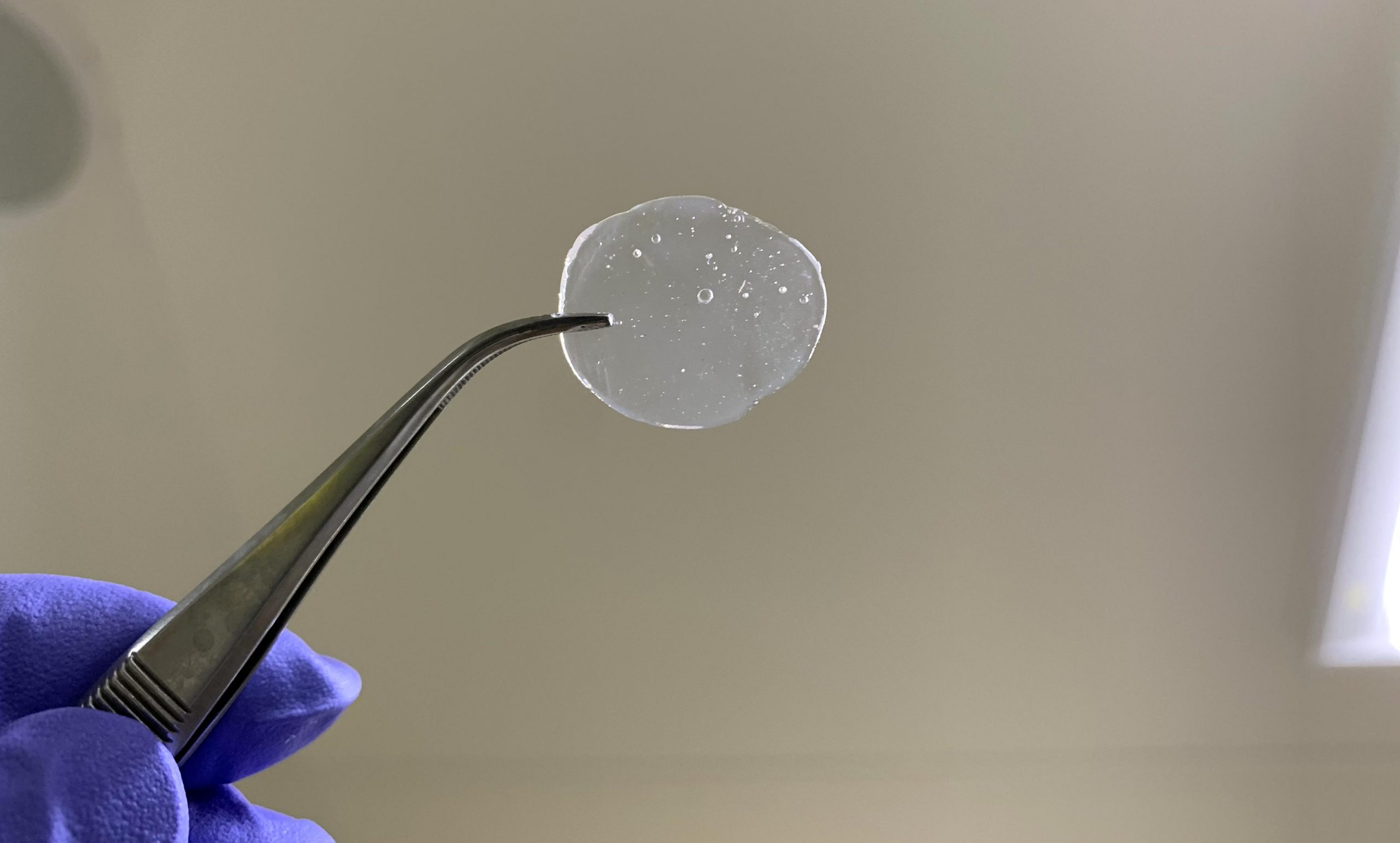
    Glass Polymer Membrane
    The newly developed glass polymer membrane. Credit: Kyoto University iCeMS

    Protons need to easily move across these membranes for the process to be efficient. Current proton conducting membranes are made from liquids and cannot operate effectively under dry conditions, making their fabrication complicated and expensive. Scientists are looking for ways to fabricate solid membranes made from water-free electrolytes that provide better mechanical and thermal stability than their liquid counterparts, but are also cost-effective and still conduct protons well.

    “Our coordination polymer glass performed better than recently reported ionic liquids and crystalline coordination polymers,” says Satoshi Horike, a materials scientist at Kyoto University’s Institute for Integrated Cell-Material Sciences (iCeMS) who led the research.

    Horike, Tomohiro Ogawa, and colleagues in Japan fabricated their coordination polymer glass membrane by mixing a ‘protic ionic liquid’ with zinc ions. Protic ionic liquids are liquid salts made by mixing an acid and a base. The team used a protic ionic liquid called diethylmethylammonium dihydrogen phosphate. Adding zinc to this liquid led to the formation of a solid, elastic polymer glass.

    The molecular structure of the coordination polymer glass facilitated the movement of protons across it under dry conditions at 120°C (248°F). When tested in a hydrogen fuel cell, it produced high voltage (0.96 volts), well within the range of typical polymer electrolyte membranes. Its power output was also similar to commonly used Nafion membranes.

    Ogawa believes their findings offer an interesting approach for using glass polymers in fuel cell applications. The team plans to continue their work with the aim of achieving fuel cell membranes with higher performance and long-term stability.

    Reference: “Coordination polymer glass from a protic ionic liquid: proton conductivity and mechanical properties as an electrolyte” by Tomohiro Ogawa, Kazuki Takahashi, Sanjog S. Nagarkar, Koji Ohara,d You-lee Hong, Yusuke Nishiyama and Satoshi Horike, 17 April 2020, Chemical Science.
    DOI: 10.1039/d0sc01737j

    About Kyoto University’s Institute for Integrated Cell-Material Sciences (iCeMS):

    At iCeMS, our mission is to explore the secrets of life by creating compounds to control cells, and further down the road to create life-inspired materials.

    Never miss a breakthrough: Join the SciTechDaily newsletter.
    Follow us on Google and Google News.

    Energy Kyoto University Polymers
    Share. Facebook Twitter Pinterest LinkedIn Email Reddit

    Related Articles

    Artificial Photosynthesis Makes Biodegradable Plastic Using Sunlight

    Producing Clean Hydrogen From Solar Power and Wood Chips

    New Catalyst Promises Lighter, Cheaper, Higher-Capacity, Next-Generation Rechargeable Batteries

    A Chance Discovery Leads to a Simple Process That Can Control Perovskite Oxynitride Properties

    Exciting Molecular Tweaks Could Improve the Efficiency of Organic Solar Cells

    Safe and Environmentally-Friendly Hydrogen Gas On-Demand Could Be on the Horizon

    Turning Waste Heat Into Hydrogen Fuel Using Reverse Electrodialysis

    Turning Plastic Trash Into Treasure: Upcycling Plastic Into High-Quality Liquid Products

    New Material Captures Carbon Dioxide and Efficiently Converts It to Useful Organic Materials

    Leave A Reply Cancel Reply

    • Facebook
    • Twitter
    • Pinterest
    • YouTube

    Don't Miss a Discovery

    Subscribe for the Latest in Science & Tech!

    Trending News

    Breakthrough Bowel Cancer Trial Leaves Patients Cancer-Free for Nearly 3 Years

    Natural Compound Shows Powerful Potential Against Rheumatoid Arthritis

    100,000-Year-Old Neanderthal Fossils in Poland Reveal Unexpected Genetic Connections

    Simple “Gut Reset” May Prevent Weight Gain After Ozempic or Wegovy

    2.8 Days to Disaster: Scientists Warn Low Earth Orbit Could Suddenly Collapse

    Common Food Compound Shows Surprising Power Against Superbugs

    5 Simple Ways To Remember More and Forget Less

    The Atomic Gap That Could Cost the Semiconductor Industry Billions

    Follow SciTechDaily
    • Facebook
    • Twitter
    • YouTube
    • Pinterest
    • Newsletter
    • RSS
    SciTech News
    • Biology News
    • Chemistry News
    • Earth News
    • Health News
    • Physics News
    • Science News
    • Space News
    • Technology News
    Recent Posts
    • Scientists Print Artificial Neurons That Can Talk to the Brain
    • Bowel and Ovarian Cancers Are Dramatically Rising in Young Adults and Scientists Aren’t Sure Why
    • Alzheimer’s May Begin Decades Earlier Than You Think, New Mayo Clinic Study Finds
    • The Hidden Risk of Taking Breaks From Weight-Loss Drugs Like Ozempic
    • Total Solar Eclipse Made Cities Go Eerily Quiet Beneath the Surface
    Copyright © 1998 - 2026 SciTechDaily. All Rights Reserved.
    • Science News
    • About
    • Contact
    • Editorial Board
    • Privacy Policy
    • Terms of Use

    Type above and press Enter to search. Press Esc to cancel.