
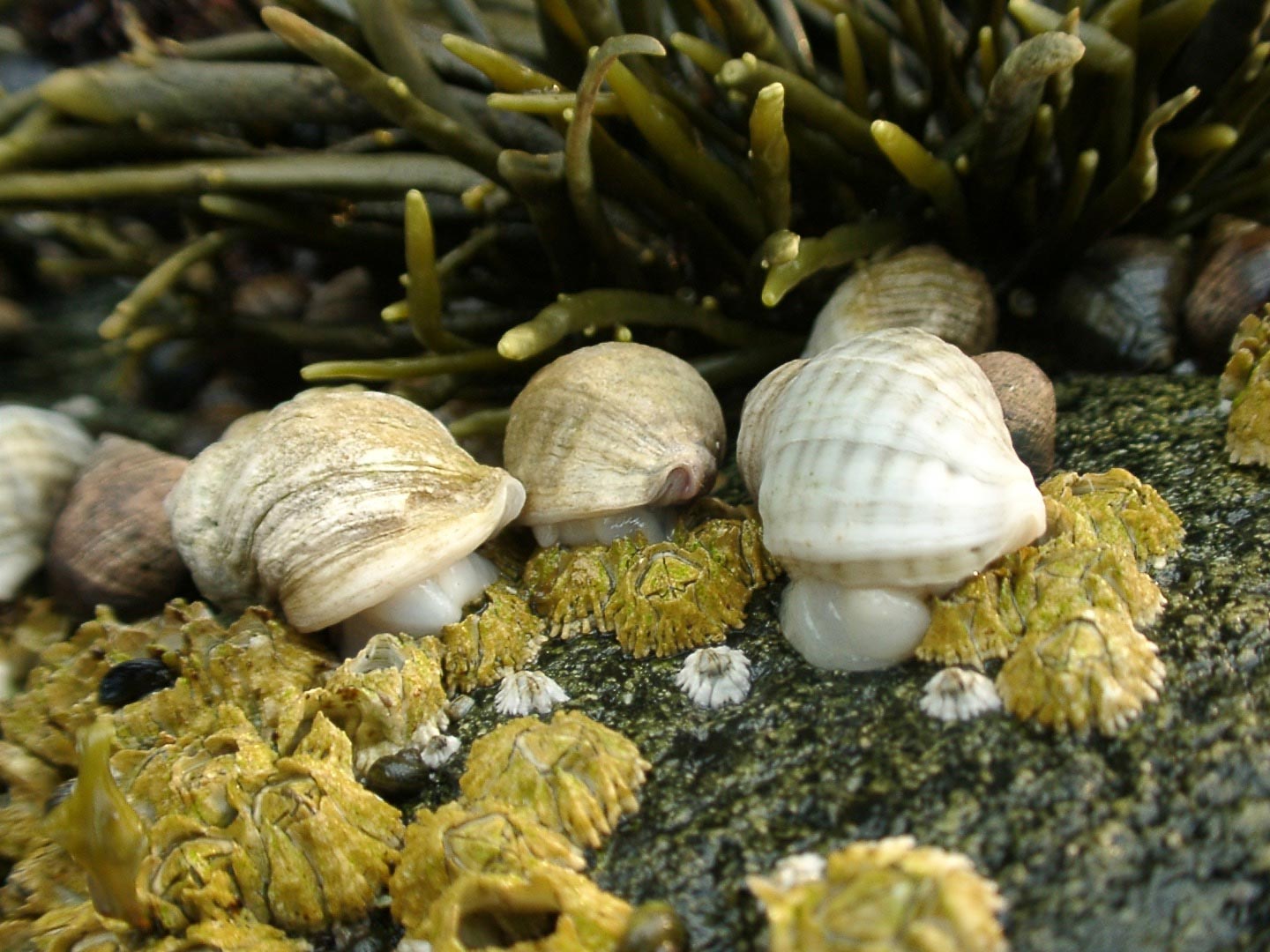
Declines in shellfish species on rocky seashores match climate-driven changes.
Two decades of data from a study of Maine’s Swan’s Island document a slow and steady dwindling of mussels, barnacles, and snails.
The waters of the Gulf of Maine are warming faster than oceans almost anywhere on Earth. And as the level of carbon dioxide rises in the atmosphere, it’s absorbed by the oceans, causing pH levels to fall. Ocean acidification makes it difficult for shellfish to thicken their shells — their primary defense against predators.
In a new study in the journal Communications Biology, researchers Peter Petraitis, a retired professor of biology in Penn’s School of Arts & Sciences, and Steve Dudgeon, a biology professor at California State University, Northridge, who completed a postdoctoral fellowship with Petraitis at Penn in the 1990s, show that the changing climate is taking a toll on Maine’s sea life. A dataset collected over two decades, including numbers of five species of mussels, barnacles, and snails, shows that all have been experiencing declines — some slow, some more rapid — in part owing to climate change.
“These species are often overlooked because of how common they are,” Petraitis says. “They’re just everywhere across the rocky shores. People don’t think anything is going to happen to them. If they decline by about 3% a year that’s a relatively small change so you might not notice it for a while. But one year, people are going to suddenly look around and say, ‘Where are all the snails, mussels, and barnacles?'”
These species “form the core of an iconic food web” in the Gulf of Maine, says Dudgeon. “Concurrent declines of five species, including both native and non-native, is proportionally large, and may cause profound changes in the ecology of coastal oceans in the region.”
In 1997, Petraitis and Dudgeon set up a long-term experiment on the Gulf of Maine’s Swan’s Island to study the ecological principles of multiple stable states. A focus of Petraitis’s research and the subject of his 2013 book, “Multiple Stable States in Natural Ecosystems,” the concept encapsulates the idea that an ecosystem can switch quickly between entirely different compositions of organisms, given the right environmental perturbations.
For shellfish on Swan’s Island, one such perturbation occurs when periodic powerful winter storms cause sea ice to scrape off all the organisms attached to rocks on the shore, forcing the communities to rebuild from scratch the next year.
In 1996, Petraitis and Dudgeon simulated a single massive ice-scouring event by scraping the rocks to see what would happen as the shore recolonized. Since then the researchers have been making an annual trip to their 60 study plots on Swan’s Island, counting the incidence of organisms living not only in the scraped areas but also in areas left in their natural state, the control plots.
The current work took advantage of these control plot counts, looking at five common shellfish species: the tortoiseshell limpet (Testudinalia testudinalis), the common periwinkle (Littorina littorea), the dogwhelk (Nucella lapillus), the blue mussel (Mytilus edulis), and the barnacle (Semibalanus balanoides).
“We didn’t expect to see much change in the control plots,” says Petraitis, “but we were surprised to see these populations declining.”
Using abundance data from 1997 to 2018, the researchers found that very young mussels were in the sharpest free fall, declining almost 16% a year, while the other four species were dwindling by 3 to 5% each year. Over that time period, limpets, periwinkles, and dogwhelks declined in total number by 50%, contractions the researchers describe as “sobering.”
To get at the question of why, the researchers looked to data on ocean temperature and chemistry. They found that the downward trajectory of mussels and common periwinkles matched up with increasing summer ocean temperatures collected from a nearby buoy.
Meanwhile declines in populations of limpets and dogwhelks corresponded with increases in the aragonite saturation state, a measurement that tracks with ocean pH. This was unexpected, since lower levels of aragonite saturation are associated with more acidic oceanwaters, which make it harder for shellfish to build up their shells. “This may be indicative of other conditions at nearshore areas that vary with aragonite saturation state,” Petraitis says.
Changes in barnacle numbers did not correspond with changes in ocean temperature, pH, or aragonite saturation state, suggesting other factors are at play in their decline.
All five of these species play critical ecological roles in the Gulf of Maine.
As filter feeders, mussels and barnacles remove phytoplankton from the water column, “digesting them, pooping them out, and fertilizing the shore,” Petraitis says. Limpets and periwinkles feed on algae and seaweed, so smaller numbers could lead to algal blooms and “greener” nearshore areas.
Since all five species serve as prey for a variety of animals, shrinking populations will reverberate up the food chain, affecting humans as well.
“Without animal consumption transferring organic matter up the food web,” says Dudgeon, “production in coastal oceans will be increasingly shunted directly through pathways of decomposition by microbial organisms, rather than to support populations of species that humans fish and on which coastal economies depend.”
Petraitis also notes the common periwinkle, now emblematic of the coast, was introduced to the Gulf of Maine from Europe sometime in the middle of the 19th century. “Now it’s the most common grazer on the shores — they feed like goats,” he says. “Before 1860, the shore without periwinkles probably looked a lot greener than it does now. As they decline we may see the shore revert back to its state in the 1850s.”
While presenting these findings at conferences in the last couple of years, Petraitis says he’s heard anecdotes from other scientists about similar disappearances of mussels across the North Atlantic, suggesting the phenomenon is not isolated to the Gulf of Maine.
Reference: “Declines over the last two decades of five intertidal invertebrate species in the western North Atlantic” by Peter S. Petraitis and S. R. Dudgeon, 20 October 2020, Communications Biology.
DOI: 10.1038/s42003-020-01326-0
Peter Petraitis is a professor of biology at the University of Pennsylvania in the School of Arts & Sciences’ Department of Biology.
Steve Dudgeon is a professor of biology at California State University, Northridge.
The study was supported by the National Science Foundation (grants OCE-9529564, DEB-0314980, DEB-1020480, and DEB- 1555641).
Never miss a breakthrough: Join the SciTechDaily newsletter.
Follow us on Google and Google News.