
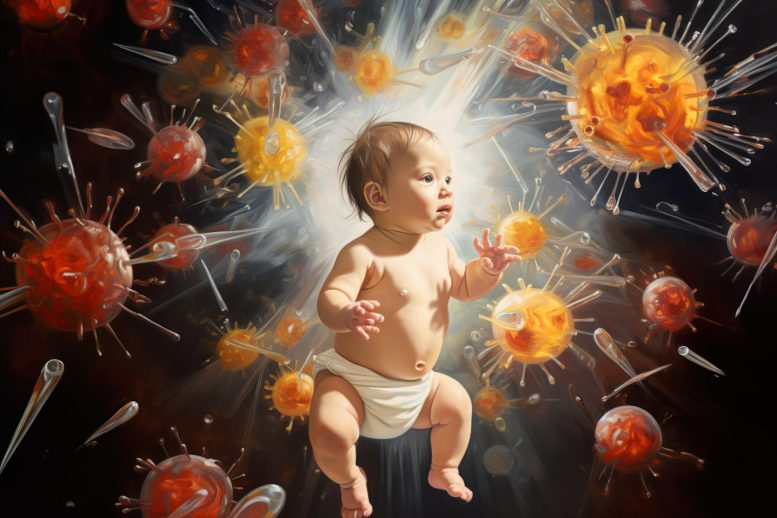
Two new studies led by researchers at Columbia University explain why babies get so many common respiratory infections and identify a specialized cluster of immune cells found only in babies that help them better cope with new pathogens.
“We know little about how the immune system develops throughout life, and most of what we know about immune system development in children comes from animal studies,” says Donna Farber, Ph.D., an expert in immune system development at Columbia University Vagelos College of Physicians and Surgeons who led the research. “But mice develop much more quickly than humans and their immune systems are a bit different than ours.”
Using a trove of tissue samples from deceased pediatric organ donors, Farber’s team was able to pinpoint aspects of immune system development that distinguish babies from adults.
Immune Cells in the Lungs and Gut Take Time To Mature
One study, published in Immunity, found that specialized immune cells called memory T cells—formed after first exposure to a pathogen—accumulate rapidly in the lungs and intestines through age 3 and more gradually in blood and lymph tissues. These cells enable older children and adults to mount an immediate and specific immune response during the next encounter with a pathogen.
But there’s a hitch.
“We found that memory T cells in young children are not functionally mature and only begin to have the capacity for protective immunity at around ages 4 to 6 years,” Farber says. “This explains why babies and young children are more vulnerable to recurrent respiratory infections and other infectious diseases compared with adults.”
The findings also may explain why introducing foods to children during the first year of life could prevent severe food allergies. “Early memory T cells are more tolerant than mature memory cells, so they’re not going to create an immune response against new foods,” Farber says.
‘Secret Weapon’ Protects Babies From New Pathogens
But while babies are highly susceptible to recurrent infections, a second study, published in Nature Immunology, found that babies have a unique way of coping with new pathogens. The researchers found clusters of antibody-producing B cells surrounded by T cells in the infants’ lungs. This bronchus-associated lymphoid tissue, or BALT, is formed between 6 and 12 months of age and disappears after age 3.
“BALT enables the lung to make antibodies to respiratory pathogens well before T cell memory has developed but fall apart in later childhood when they are no longer needed,” says Farber. “This mechanism helps young children respond to the many different respiratory pathogens they encounter early in life.”
It also may explain why young kids are more resilient to new respiratory infections compared to adults—including SARS-CoV-2.
“With SARS-CoV-2, a virus no one had ever encountered before, we saw that people in their 50s and 60s were very susceptible to severe COVID, but most kids exposed to SARS-CoV-2 were fine, and many didn’t even have symptoms,” Farber says. “That told us that the babies and young children must have some adaptations to respond to new pathogens that adults don’t have.”
BALT also may be a reason why some children develop chronic asthma and allergies. “It’s possible that these diseases may be caused in part by the abnormal persistence of BALT well into childhood, which could trigger an overreaction to certain antigens,” says Farber.
Farber adds that the study may provide clues about why early trials of intranasal COVID vaccines have not shown promise in adults, whereas intranasal influenza vaccine tends to work better in children. “It could be that this type of vaccine works better in children because they have BALT structures that can initiate new antibodies in the lungs.”
“BALT provides some protection but clearly does not protect young children from everything,” Farber continues. “We have to remember that before vaccines, a third of children died of infectious diseases during infancy. So childhood vaccines are really important for protecting us.”
References:
“Site-specific development and progressive maturation of human tissue-resident memory T cells over infancy and childhood” by Thomas J. Connors, Rei Matsumoto, Shivali Verma, Peter A. Szabo, Rebecca Guyer, Joshua Gray, Zicheng Wang, Puspa Thapa, Pranay Dogra, Maya M.L. Poon, Ksenia Rybkina, Marissa C. Bradley, Emma Idzikowski, James McNichols, Masaru Kubota, Kalpana Pethe, Yufeng Shen, Mark A. Atkinson, Maigan Brusko, Todd M. Brusko and Donna L. Farber, 7 July 2023, Immunity.
DOI: 10.1016/j.immuni.2023.06.008
“Induction of bronchus-associated lymphoid tissue is an early life adaptation for promoting human B cell immunity” by Rei Matsumoto, Joshua Gray, Ksenia Rybkina, Hanna Oppenheimer, Lior Levy, Lilach M. Friedman, Muhammad Khamaisi, Wenzhao Meng, Aaron M. Rosenfeld, Rebecca S. Guyer, Marissa C. Bradley, David Chen, Mark A. Atkinson, Todd M. Brusko, Maigan Brusko, Thomas J. Connors, Eline T. Luning Prak, Uri Hershberg, Peter A. Sims, Tomer Hertz and Donna L. Farber, 17 July 2023, Nature Immunology.
DOI: 10.1038/s41590-023-01557-3
The study was supported by grants from the National Institutes of Health and the Helmsley Charitable Trust.
Never miss a breakthrough: Join the SciTechDaily newsletter.
Follow us on Google and Google News.