
Close Menu
    Facebook X (Twitter) Instagram
    SciTechDaily
    • Biology
    • Chemistry
    • Earth
    • Health
    • Physics
    • Science
    • Space
    • Technology
    Facebook X (Twitter) Pinterest YouTube RSS
    SciTechDaily
    Home»Space»Hubble Image of the Week: Infant Star’s Artistic Outburst
    Space

    Hubble Image of the Week: Infant Star’s Artistic Outburst

    By SciTechDailyDecember 21, 2015No Comments2 Mins Read
    Facebook Twitter Pinterest Telegram LinkedIn WhatsApp Email Reddit
    Share
    Facebook Twitter LinkedIn Pinterest Telegram Email Reddit
    Hubble Views the Outburst of an Extremely Young Star
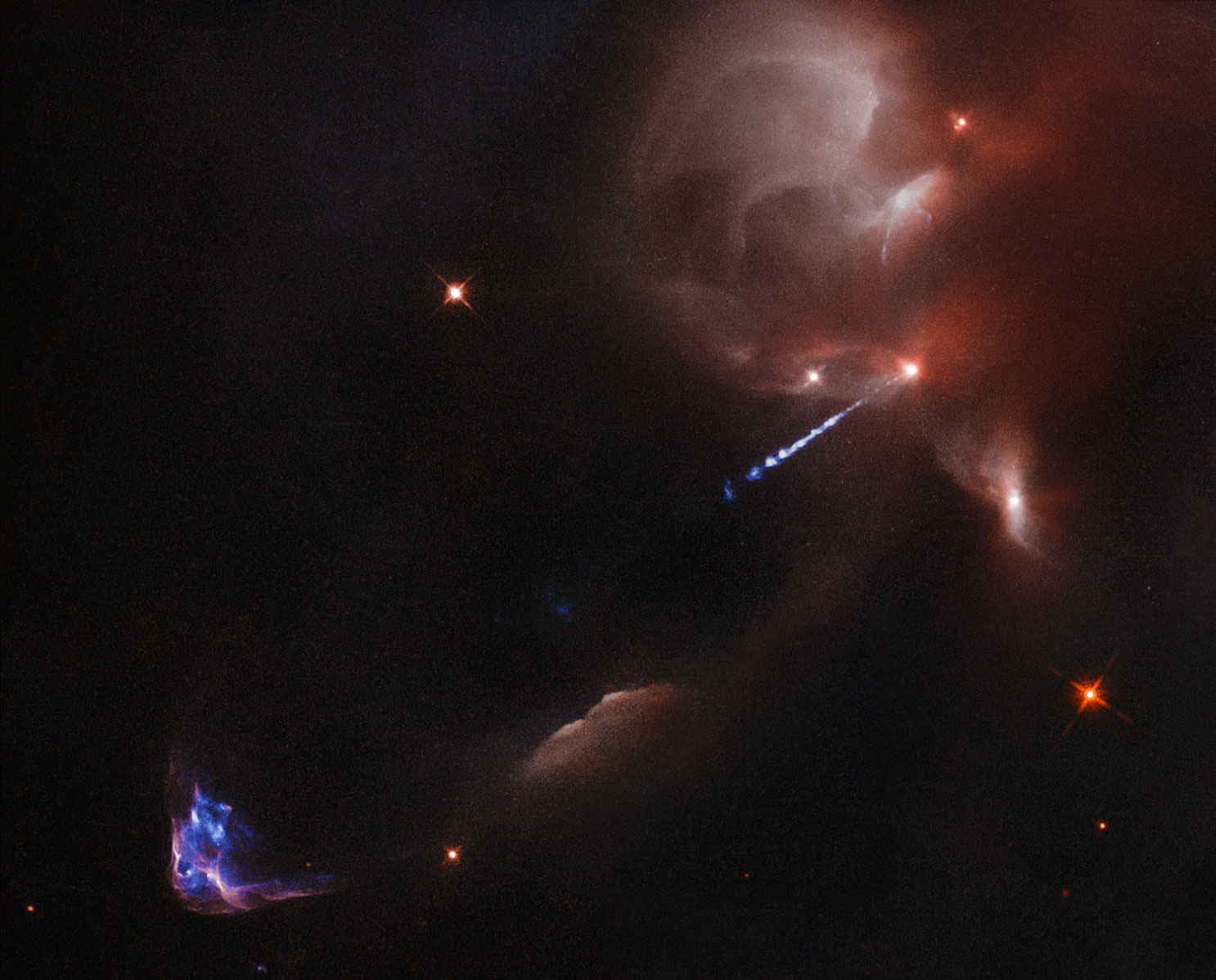
    HH34 resides approximately 1,400 light-years away near the Orion Nebula. Credit: ESA/Hubble & NASA

    This newly released Hubble image shows HH34, which resides approximately 1,400 light-years away near the Orion Nebula.

    The artistic outburst of an extremely young star, in the earliest phase of formation, is captured in this spectacular image from the NASA/ESA Hubble Space Telescope. The colorful wisps, found in the lower left of the image, are painted onto the sky by a young star cocooned in the partially illuminated cloud of obscuring dust seen to the upper right.

    Pictured punching through the enshrouding dust is an extremely hot, blue jet of gas released by the young star. As this jet speeds through space, it collides with cooler surrounding material. The result is the colorful object to the lower left, produced as the cooler material is heated by the jet.

    This wispy object is known as HH34 and it is an example of a Herbig–Haro (HH) object. It resides approximately 1400 light-years away near the Orion Nebula, a large star formation region within the Milky Way. HH objects exist for a cosmically brief time — typically thousands of years — with changes seen in observations taken only a few years apart.

    Although the jet extends the entire length between the infant star and HH34, only a fraction of it appears visible. This part of the jet possesses an intricate structure of knots and ripples, thought to be caused by the different outbursts catching up and ramming into each other over time.

    Never miss a breakthrough: Join the SciTechDaily newsletter.
    Follow us on Google and Google News.

    Astronomy Cosmology Hubble Space Telescope NASA
    Share. Facebook Twitter Pinterest LinkedIn Email Reddit

    Related Articles

    Astronomers Discover a 17 Billion Solar-Mass Black Hole in an Unlikely Place

    Hubble Image of the Week – Dwarf Galaxy Leo A

    Hubble Image of the Week – Swimming in Sculptor

    Astronomers Measure the Farthest Galaxy Ever Seen in the Universe

    Hubble Image of the Week – Peculiar Galaxy NGC 1487

    Hubble Views Turbulent Birthing Ground Orion B Molecular Cloud Complex

    Magnified Image Reveals the Faintest Known Galaxy from the Early Universe

    Hubble Image of the Week: Quadruple Star System DI Cha

    Hubble Image of the Week – Evolution in Slow Motion

    Leave A Reply Cancel Reply

    • Facebook
    • Twitter
    • Pinterest
    • YouTube

    Don't Miss a Discovery

    Subscribe for the Latest in Science & Tech!

    Trending News

    Scientists Discover Cheap, Natural Remedy for High Blood Pressure

    Earth’s Upper Atmosphere Is Cooling Fast and Scientists Finally Know Why

    32,000 Olympic Pools of Magma Nearly Erupted Beneath Atlantic Island

    Exercise Changes the Heart in a Way Researchers Never Expected

    Too Much Sleep May Age Your Body Faster, New Study Warns

    Scientists Uncover Promising New Strategy To Stop Parkinson’s in Its Tracks

    Experts Reveal the Surprising Cancer Link Behind a Common Vitamin

    This Strange “Golden Orb” Found 2 Miles Deep Stumped Scientists for Years

    Follow SciTechDaily
    • Facebook
    • Twitter
    • YouTube
    • Pinterest
    • Newsletter
    • RSS
    SciTech News
    • Biology News
    • Chemistry News
    • Earth News
    • Health News
    • Physics News
    • Science News
    • Space News
    • Technology News
    Recent Posts
    • Breakthrough Parkinson’s Drug Targets Disease at Its Genetic Roots
    • 10-Cent Pill Could Transform Heart Failure Treatment Worldwide
    • Just 4 Weeks of Simple Diet Changes Reversed Signs of Aging in Older Adults
    • Scientists May Have Finally Solved Why Humans Are Right-Handed
    • Physicists Found String Theory Without Even Looking for It
    Copyright © 1998 - 2026 SciTechDaily. All Rights Reserved.
    • Science News
    • About
    • Contact
    • Editorial Board
    • Privacy Policy
    • Terms of Use

    Type above and press Enter to search. Press Esc to cancel.