

Close Menu
    Facebook X (Twitter) Instagram
    SciTechDaily
    • Biology
    • Chemistry
    • Earth
    • Health
    • Physics
    • Science
    • Space
    • Technology
    Facebook X (Twitter) Pinterest YouTube RSS
    SciTechDaily
    Home»Technology»Innovative Method to Efficiently Harvest Low-Grade Heat for Energy
    Technology

    Innovative Method to Efficiently Harvest Low-Grade Heat for Energy

    By Ulsan National Institute of Science and Technology (UNIST)November 28, 2023No Comments5 Mins Read
    Facebook Twitter Pinterest Telegram LinkedIn WhatsApp Email Reddit
    Share
    Facebook Twitter LinkedIn Pinterest Telegram Email Reddit
    Efficient Heat Energy Conversion Art Concept Illustration
    Researchers from UNIST and Nanyang Technological University have developed a Thermally Regenerative Electrochemical Cycle (TREC) system, offering a novel approach to convert low-grade heat into usable energy. This system, enhanced by understanding the role of structural vibration modes, particularly in water molecules, shows potential in improving energy conversion from small temperature differences. Such advancements in TREC systems could revolutionize the use of low-grade heat in wearable technologies and secondary batteries.

    A groundbreaking TREC system developed by a team of researchers efficiently converts low-grade heat into energy, leveraging structural vibration modes. This advancement could transform energy conversion in wearable technologies and secondary batteries.

    A team of researchers, jointly led by Professor Hyun-Wook Lee and Professor Dong-Hwa Seo from the School of Energy and Chemical Engineering at the Ulsan National Institute of Science and Technology (UNIST), in collaboration with Professor Seok Woo Lee from Nanyang Technological University in Singapore, has achieved significant breakthroughs in harnessing low-grade heat sources (<100 °C) for efficient energy conversion. Their groundbreaking work focuses on developing a highly efficient Thermally Regenerative Electrochemical Cycle (TREC) system capable of converting small temperature differences into usable energy.
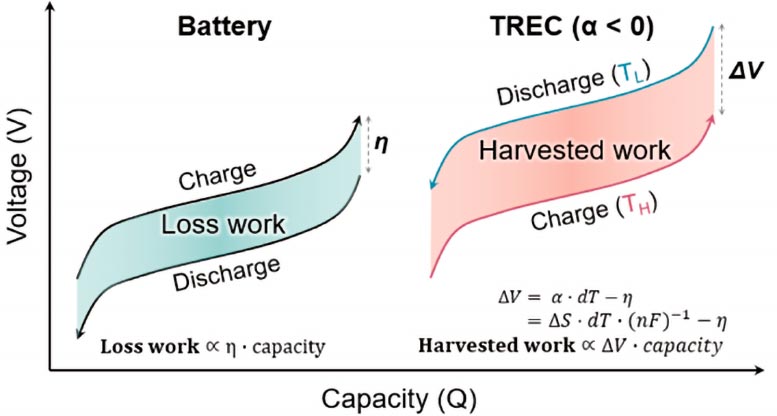
    Mechanisms of a Battery and TREC System
    Figure 1. Schematic showing the different mechanisms of a battery and TREC system. Whereas the battery system (left) loses some of the stored energy as unusable energy, the TREC system (right) can convert low-grade waste-heat energy into electrochemical energy during battery cycling. Credit: UNIST

    Conventional energy-harvesting systems face challenges when it comes to effectively utilizing low-grade heat sources. However, TREC systems offer an attractive solution as they integrate battery functionality with thermal-energy-harvesting capabilities. In this study, the research team delved into the role of structural vibration modes to enhance the efficacy of TREC systems.

    By analyzing how changes in covalent bonding influence vibration modes—specifically affecting structural water molecules—the researchers discovered that even minute amounts of water induce strong structural vibrations within cyanide ligands’ A1g stretching mode. These vibrations substantially contribute to a larger temperature coefficient (ɑ) within a TREC system. Based on these insights, the team designed and implemented a highly efficient TREC system using a sodium-ion-based aqueous electrolyte.
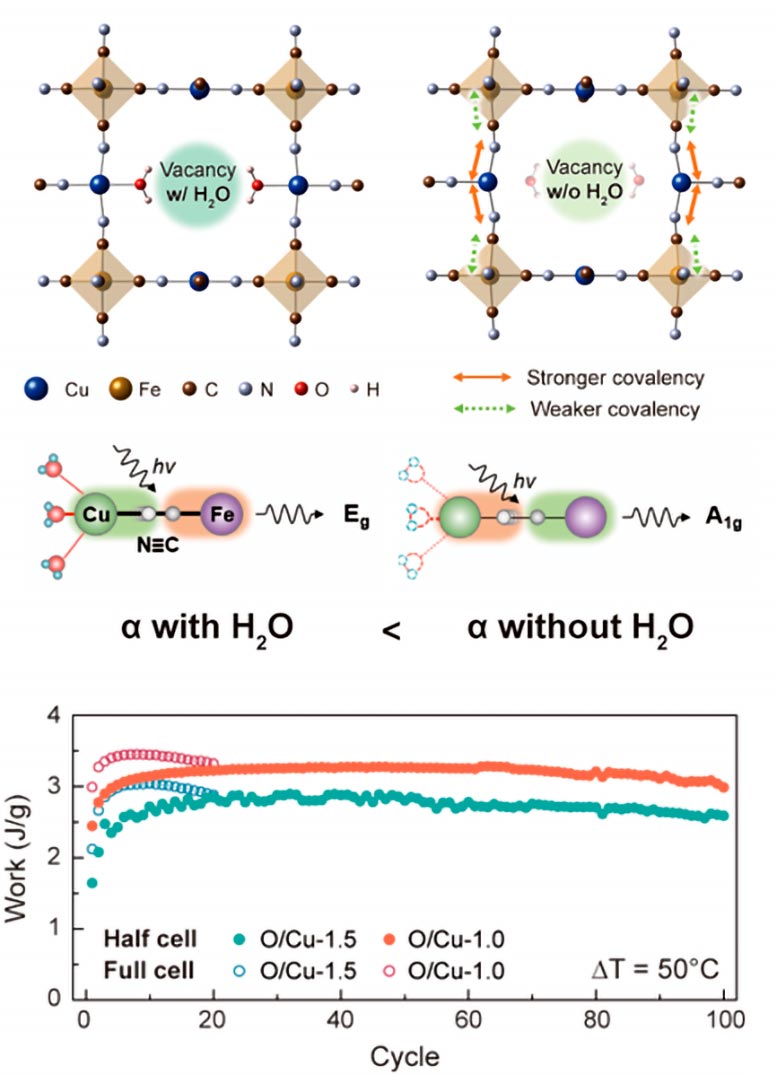
    TREC Principle Effect of Water Molecules in PBA Structure
    Figure 2. Principle of TREC and effect of water molecules in a PBA structure. (Top) Effect of removal of water molecules on the CuHCFe structure and covalency variation (-ICOHP/eV). The average -ICOHP values of Cu─N and Fe─C bonds and the SD of -ICOHP values of 6 Fe─C bonds are presented. (Center) Effect of water molecules on the stretching vibration mode of cyanide ligands. (Bottom) d) Amount of harvested work as a result of TREC full-cell and half-cell. The low and high temperatures are 10 and 60 °C, respectively. The current density of the full cell is set at 0.5 C (30 mA g−1) based on O/Cu-x. Credit: UNIST

    “This study provides valuable insights into how structural vibration modes can enhance the energy-harvesting capabilities of TREC systems,” explained Professor Hyun-Wook Lee. “Our findings deepen our understanding of Prussian Blue analogs’ intrinsic properties regulated by these vibration modes—opening up new possibilities for improved energy conversion.”

    The potential applications for TREC systems are vast, particularly in wearable technologies and other devices where small temperature differentials exist. By effectively capturing and converting low-grade heat into usable energy, TREC systems offer a promising pathway toward the development of next-generation secondary batteries.
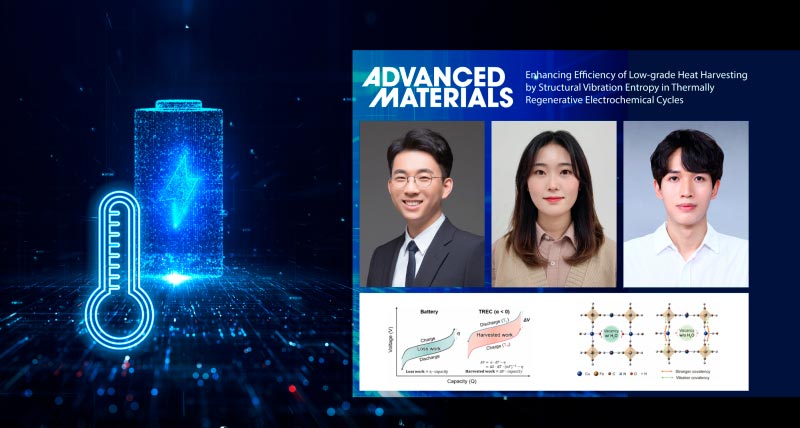
    Professor Hyun-wook Lee and His Research
    Professor Hyun-Wook Lee (left) and his research team in the School of Energy and Chemical Engineering at UNIST. Credit: UNIST

    Reference: “Enhancing Efficiency of Low-Grade Heat Harvesting by Structural Vibration Entropy in Thermally Regenerative Electrochemical Cycles” by Ahreum Choi, You-Yeob Song, Juyoung Kim, Donghyeon Kim, Min-Ho Kim, Seok Woo Lee, Dong-Hwa Seo and Hyun-Wook Lee, 3 July 2023, Advanced Materials.
    DOI: 10.1002/adma.202303199

    This research has received support from the 2023 Research Fund of UNIST, Individual Basic Science & Engineering Research Program, and the National Center for Materials Research Data through the National Research Foundation (NRF) of Korea, funded by the Ministry of Science and ICT (MSIT).

    Abstract

    The majority of waste-heat energy exists in the form of low-grade heat (<100 °C), which is immensely difficult to convert into usable energy using conventional energy-harvesting systems. Thermally regenerative electrochemical cycles (TREC), which integrate battery and thermal-energy-harvesting functionalities, are considered an attractive system for low-grade heat harvesting. Herein, the role of structural vibration modes in enhancing the efficacy of TREC systems is investigated. How changes in bonding covalency, influenced by the number of structural water molecules, impact the vibration modes is analyzed. It is discovered that even small amounts of water molecules can induce the A1g stretching mode of cyanide ligands with strong structural vibration energy, which significantly contributes to a larger temperature coefficient (ɑ) in a TREC system. Leveraging these insights, a highly efficient TREC system using a sodium-ion-based aqueous electrolyte is designed and implemented. This study provides valuable insights into the potential of TREC systems, offering a deeper understanding of the intrinsic properties of Prussian Blue analogs regulated by structural vibration modes. These insights open up new possibilities for enhancing the energy-harvesting capabilities of TREC systems.

    Never miss a breakthrough: Join the SciTechDaily newsletter.
    Follow us on Google and Google News.

    Battery Technology Energy Ulsan National Institute of Science and Technology
    Share. Facebook Twitter Pinterest LinkedIn Email Reddit

    Related Articles

    New Battery Can Self-Charge Without Losing Energy

    Next-Generation Energy Storage Breakthrough: Fast-Charging, Long-Running, Flexible

    New Aqueous Lithium-Ion Battery – Low Cost & Improved Safety

    Hybrid-Solid Electrolysis Cell System – A New Strategy for Efficient Hydrogen Production

    Iron-Air Batteries Promise Higher Energy Density Than Lithium-Ion Batteries

    New Aluminum Batteries Increase the Range of UUVs Tenfold

    MIT Engineers Look Toward All-Solid Lithium Batteries

    Engineers Design Calcium-Based Multi-Element for Liquid Batteries

    Power Conserving Chip May Increase Smartphone Battery Life

    Leave A Reply Cancel Reply

    • Facebook
    • Twitter
    • Pinterest
    • YouTube

    Don't Miss a Discovery

    Subscribe for the Latest in Science & Tech!

    Trending News

    Millions of People Have Osteopenia Without Realizing It – Here’s What You Need To Know

    Researchers Discover Boosting a Single Protein Helps the Brain Fight Alzheimer’s

    World-First Study Reveals Human Hearts Can Regenerate After a Heart Attack

    Why Your Dreams Feel So Real Sometimes and So Strange Other Times

    This Simple Home Device May Boost Brain Power in Adults Over 40

    Enormous Prehistoric Insects Puzzle Scientists

    Scientists Develop Bioengineered Chewing Gum That Could Help Fight Oral Cancer

    After 37 Years, the World’s Longest-Running Soil Warming Experiment Uncovers a Startling Climate Secret

    Follow SciTechDaily
    • Facebook
    • Twitter
    • YouTube
    • Pinterest
    • Newsletter
    • RSS
    SciTech News
    • Biology News
    • Chemistry News
    • Earth News
    • Health News
    • Physics News
    • Science News
    • Space News
    • Technology News
    Recent Posts
    • After 100 Years, Scientists Uncover Hidden Rule Governing Cosmic Rays
    • The Milky Way Has a Hidden Edge and Scientists Finally Mapped It
    • Scientists Stunned by New Organic Molecules Found on Mars
    • Scientists Discover Evolution’s 120-Million-Year-Old “Cheat Sheet”
    • This New “Sound Laser” Could Measure Gravity With Stunning Precision
    Copyright © 1998 - 2026 SciTechDaily. All Rights Reserved.
    • Science News
    • About
    • Contact
    • Editorial Board
    • Privacy Policy
    • Terms of Use

    Type above and press Enter to search. Press Esc to cancel.