

Close Menu
    Facebook X (Twitter) Instagram
    SciTechDaily
    • Biology
    • Chemistry
    • Earth
    • Health
    • Physics
    • Science
    • Space
    • Technology
    Facebook X (Twitter) Pinterest YouTube RSS
    SciTechDaily
    Home»Science»Unraveling the Secrets of Beer: New Study Debunks Age-Old Assumptions
    Science

    Unraveling the Secrets of Beer: New Study Debunks Age-Old Assumptions

    By Leibniz Institute for Food Systems Biology at the Technical University of MunichNovember 28, 2023No Comments4 Mins Read
    Facebook Twitter Pinterest Telegram LinkedIn WhatsApp Email Reddit
    Share
    Facebook Twitter LinkedIn Pinterest Telegram Email Reddit
    Beer Alcohol Toast
    A new study challenges existing assumptions about linalool, a key component influencing beer’s aroma. The research reveals that the odor threshold difference between linalool’s enantiomers is significantly less than previously thought, providing new insights into the development of beer’s aroma during the brewing process and storage.

    Hop-derived ingredients not only enhance the shelf-life and add a bitter taste to beer, but they also play a crucial role in affecting its aroma. An important hop odorant is linalool, characterized by its floral and citrusy fragrance.

    Under the leadership of the Leibniz Institute for Food Systems Biology at the Technical University of Munich, a team of scientists has now disproved a roughly 20-year-old assumption about this odorant. The new study contributes to a better understanding of changes in beer bouquets during the brewing process and beer aging.

    Two molecular variants of the odorant linalool are found in hops and beer: the enantiomers (R)- and (S)-linalool. Both molecules consist of the same number and type of atoms, and show the same connectivity. Nevertheless, they have different spatial structures and differ like an image from its mirror image. This “small” but nevertheless crucial difference is also reflected in the different odor intensities of the molecules.

    In addition, it has long been known that beer aroma changes during the brewing process and storage because, among other things, part of the (R)-linalool predominant in hops is converted to (S)-linalool.

    Previously, based on a 1999 paper, researchers assumed that the odor threshold concentration of (R)-linalool is about a factor of 80 lower than that of (S)-linalool. Put simply, they assumed that (R)-linalool has a much stronger influence on beer aroma than its mirror-image counterpart. However, reliable data on the odor thresholds of both substances were lacking.

    Preparative method optimized

    To close this knowledge gap and enable more precise predictions of changes in beer aroma, the team led by brewing and beverage technologist Klaas Reglitz and food chemist Martin Steinhaus from the Leibniz Institute first optimized a preparative method. In close cooperation with the Research Center Weihenstephan for Brewing and Food Quality, the researchers thus succeeded for the first time in isolating enantiomerically pure (S)-linalool.
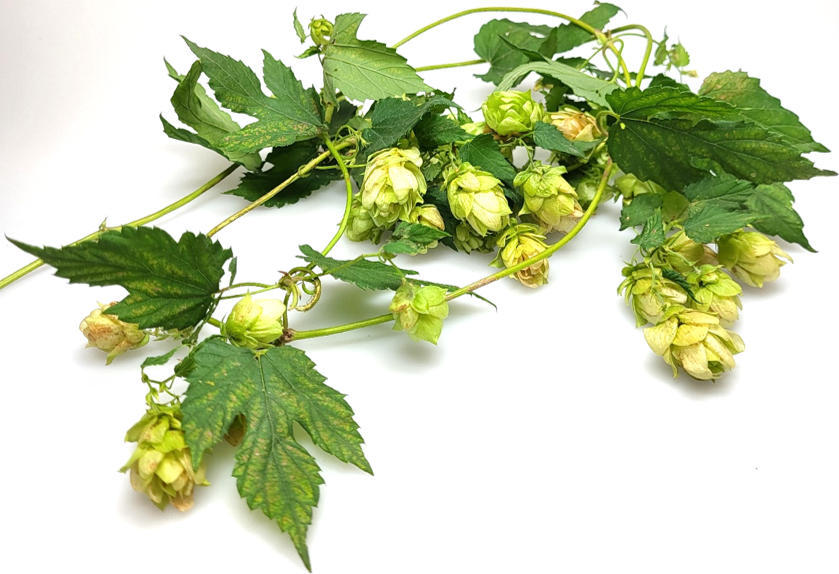
    Humulus lupulus
    Photo of common hop (Humulus lupulus) on white background. The common hop is mainly used for beer production. For brewing, the cones of the female hop plants are used. Credit: Gisela Olias / Leibniz-LSB@TUM

    Having the pure substance available in sufficient quantities was an indispensable prerequisite for determining the specific odor threshold concentrations of the two odorant variants in water and unhopped beer using a trained sensory panel. This was essential because only (R)-linalool is commercially available as a pure substance.

    As the team showed, the thresholds of (R)- and (S)-linalool in water were 0.82 and 8.3 micrograms per kilogram, respectively. In unhopped beer, the team determined thresholds of 6.5 micrograms per kilogram for (R)-linalool and 53 micrograms per kilogram for (S)-linalool.

    Influence of (R)-linalool overestimated

    “Our results thus confirm the previously postulated higher odor potency of (R)-linalool. However, they also refute the previous assumption that the odor threshold concentrations of the two enantiomers differ extremely. Instead, the study shows that the difference is only about eight to tenfold,” says Martin Steinhaus, head of Section I and the Food Metabolome Chemistry Research Group at the Leibniz Institute.

    First author Klaas Reglitz adds, “The conversion of (R)- to (S)-linalool thus does not have as great an influence on beer aroma as has long been assumed. Thanks to our study, we now better understand how and why the aroma changes during storage.”

    Reference: “Enantiospecific determination of the odour threshold concentrations of (R)- and (S)-linalool in water and beer” by K. Reglitz, J. Stein, J. Ackermann, V. Heigl, L. Brass, F. Ampenberger, M. Zarnkow and M. Steinhaus, July 2023, Brewing Science.
    DOI: 0.23763/BrSc23-07reglitz

    Never miss a breakthrough: Join the SciTechDaily newsletter.
    Follow us on Google and Google News.

    Beer Food Science Popular Technical University of Munich
    Share. Facebook Twitter Pinterest LinkedIn Email Reddit

    Related Articles

    Ancient Poop Shows People in Austria Drank Beer and Ate Blue Cheese 2,700 Years Ago

    Beer Byproduct Mixed With Manure Proves an Excellent Pesticide – Increases Crop Yields

    These Foods Contain Nutrients That Can Inhibit a Key SARS-CoV-2 Enzyme Needed for the COVID Virus to Replicate

    Researchers Say Breadfruit Could Be the Next Superfood

    Reconstructing the Meals That People Consumed in the Past From Chemical Residues on Ancient Cooking Pots

    Rice Genetically Altered to Contain Anti-Hypertensive Peptides – Eating a Spoonful Lowers Blood Pressure

    New Tomato Ideal for Urban Gardens and Even Outer Space Created Through Genetic Editing

    Genetically Modified Maize Study Faces Even More Scrutiny

    Intercontinental Crop Losses Caused by Ozone

    Leave A Reply Cancel Reply

    • Facebook
    • Twitter
    • Pinterest
    • YouTube

    Don't Miss a Discovery

    Subscribe for the Latest in Science & Tech!

    Trending News

    Scientists May Have Found the Key to Jupiter and Saturn’s Moon Mystery

    Scientists Uncover Brain Changes That Link Pain to Depression

    Saunas May Do More Than Raise Body Temperature – They Activate Your Immune System

    Exercise in a Pill? Metformin Shows Surprising Effects in Cancer Patients

    Hidden Oceans of Magma Could Be Protecting Alien Life

    New Study Challenges Alzheimer’s Theories: It’s Not Just About Plaques

    Artificial Sweeteners May Harm Future Generations, Study Suggests

    Splashdown! NASA Artemis II Returns From Record-Breaking Moon Mission

    Follow SciTechDaily
    • Facebook
    • Twitter
    • YouTube
    • Pinterest
    • Newsletter
    • RSS
    SciTech News
    • Biology News
    • Chemistry News
    • Earth News
    • Health News
    • Physics News
    • Science News
    • Space News
    • Technology News
    Recent Posts
    • Physicists Discover a Strange New Kind of One-Dimensional Particle
    • Scientists Discover Unexpected Climate Benefit Hidden in Forest Soils
    • The Grand Canyon’s “Swiss Cheese” Rocks Hold a Critical Secret
    • Scientists Discover 430,000-Year-Old Wooden Tools, Rewriting Human History
    • Scientists Make Breakthrough on 40-Year-Old 2D Physics Puzzle
    Copyright © 1998 - 2026 SciTechDaily. All Rights Reserved.
    • Science News
    • About
    • Contact
    • Editorial Board
    • Privacy Policy
    • Terms of Use

    Type above and press Enter to search. Press Esc to cancel.