

Scientists at MIT and elsewhere have analyzed data from K2, the follow-up mission to NASA’s Kepler Space Telescope, and have discovered a trove of possible exoplanets amid some 50,000 stars.
In a paper that appears online today in The Astronomical Journal, the scientists report the discovery of nearly 80 new planetary candidates, including a particular standout: a likely planet that orbits the star HD 73344, which would be the brightest planet host ever discovered by the K2 mission.
The planet appears to orbit HD 73344 every 15 days, and based on the amount of light that it blocks each time it passes in front of its star, scientists estimate that the planet is about 2.5 times the size of the Earth and 10 times as massive. It is also likely incredibly hot, with a temperature somewhere in the range of 1,200 to 1,300 degrees Celsius, or around 2,000 degrees Fahrenheit — about the temperature of lava from an erupting volcano.
The planet lies at a relatively close distance of 35 parsecs, or about 114 light years from Earth. Given its proximity and the fact that it orbits a very bright star, scientists believe the planet is an ideal candidate for follow-up studies to determine its atmospheric composition and other characteristics.
“We think it would probably be more like a smaller, hotter version of Uranus or Neptune,” says Ian Crossfield, an assistant professor of physics at MIT who co-led the study with graduate student Liang Yu.
The new analysis is also noteworthy for the speed with which it was performed. The researchers were able to use existing tools developed at MIT to rapidly search through graphs of light intensity called “lightcurves” from each of the 50,000 stars that K2 monitored in its two recent observing campaigns. They quickly identified the planetary candidates and released the information to the astronomy community just weeks after the K2 mission made the spacecraft’s raw data available. A typical analysis of this kind takes between several months and a year.
Crossfield says such a fast planet-search enables astronomers to follow up with ground-based telescopes much sooner than they otherwise would, giving them a chance to catch a glimpse of planetary candidates before the Earth passes by that particular patch of sky on its way around the sun.
Such speed will also be a necessity when scientists start receiving data from NASA’s Transiting Exoplanet Survey Satellite, TESS, which is designed to monitor nearby stars in 30-day swaths and will ultimately cover nearly the entire sky.
“When the TESS data come down, there’ll be a few months before all of the stars that TESS looked at for that month ‘set’ for the year,” Crossfield says. “If we get candidates out quickly to the community, everyone can start immediately observing systems discovered by TESS, and doing a lot of great planetary science. So this [analysis] was really a dress rehearsal for TESS.”
Speed dips
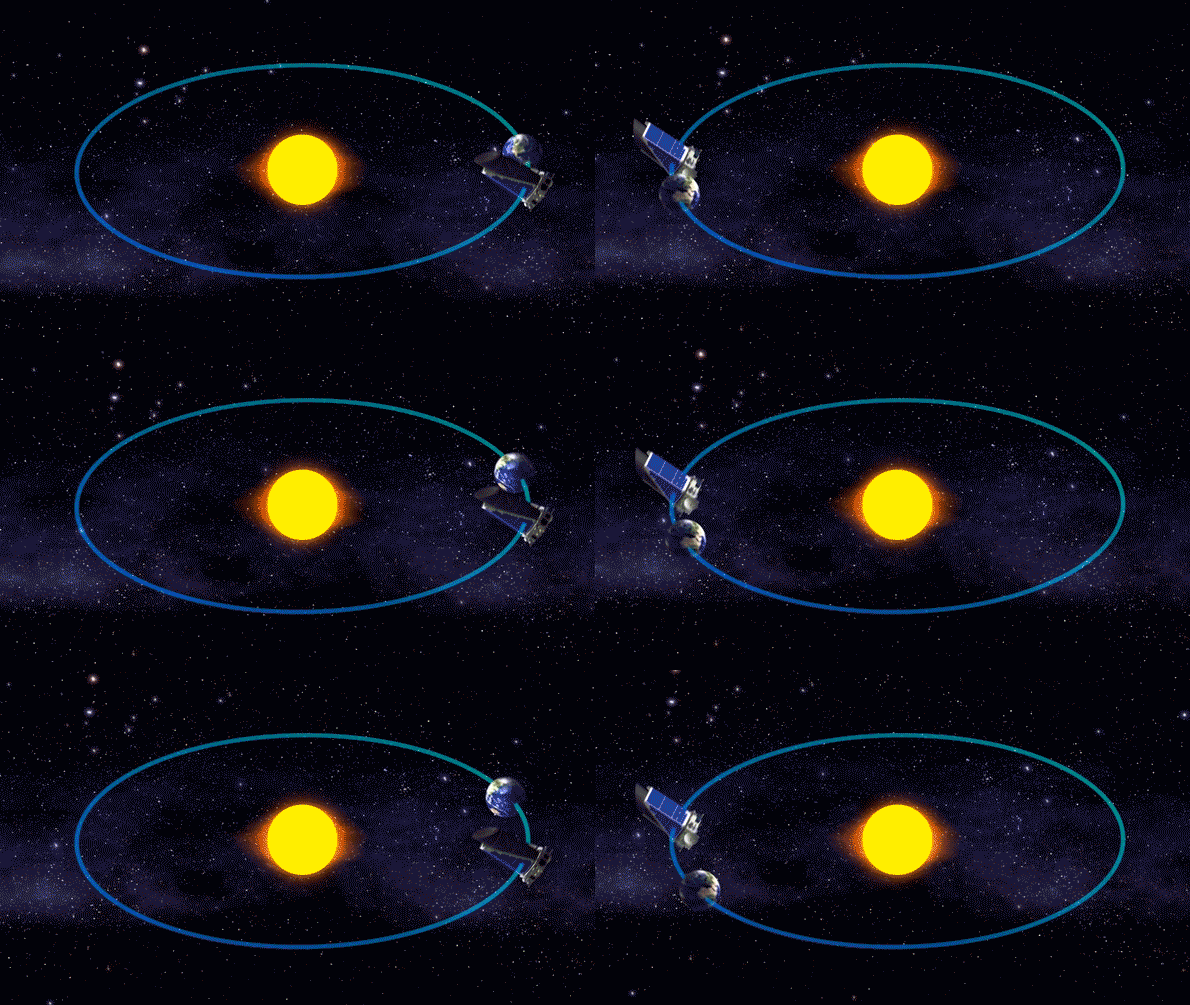
The team analyzed data from K2’s 16th and 17th observing campaigns, known as C16 and C17. During each campaign, K2 observes one patch of the sky for 80 days. The telescope is on an orbit that trails the Earth as it travels around the sun. For most other campaigns, K2 has been in a “rear-facing” orientation, in which the telescope observes those stars that are essentially in its rear-view mirror.
Since the telescope travels behind the Earth, those stars that it observes are typically not observable by scientists until the planet circles back around the sun to that particular patch of sky, nearly a year later. Thus, for rear-facing campaigns, Crossfield says there has been little motivation to analyze K2 data quickly.
The C16 and C17 campaigns, on the other hand, were forward-facing; K2 observed those stars that were in front of the telescope and within Earth’s field of view, at least for the next several months. Crossfield, Yu, and their colleagues took this as an opportunity to speed up the usual analysis of K2 data, to give astronomers a chance to quickly observe planetary candidates before the Earth passed them by.
During C16, K2 observed 20,647 stars over 80 days, between December 7, 2017, and February 25, 2018. On February 28, the mission released the data, in the form of pixel-level images, to the astronomy community. Yu and Crossfield immediately began to sift through the data, using algorithms developed at MIT to winnow down the field from 20,000-some stars to 1,000 stars of interest.
The team then worked around the clock, looking through these 1,000 stars by eye for signs of transits, or periodic dips in starlight that could signal a passing planet. In the end, they discovered 30 “highest-quality” planet candidates, whose periodic signatures are especially likely to be caused by transiting planets.
“Our experience with four years of K2 data leads us to believe that most of these are indeed real planets, ready to be confirmed or statistically validated,” the researchers write in their paper.
They also identified a similar number of planet candidates in the recent C17 analysis. In addition to these planetary candidates, the group also picked out hundreds of periodic signals that could be signatures of astrophysical phenomena, such as pulsating or rotating stars, and at least one supernova in another galaxy.
Stars in spades
While the nature of a star doesn’t typically change over the course of a year, Crossfield says the sooner researchers can follow up on a possible planetary transit, the better chance there is of confirming that a planet actually exists.
“You want to observe [candidates] again relatively soon so you don’t lose the transit altogether,” Crossfield says. “You might be able to say, ‘I know there’s a planet around that star, but I’m no longer at all certain when the transits will happen.’ That’s another motivation for following these things up more quickly.”
Since the team released its results, astronomers have validated four of the candidates as definite exoplanets. They have been observing other candidates that the study identified, including the possible planet orbiting HD 73344. Crossfield says the brightness of this star, combined with the speed with which its planetary candidate was identified, can help astronomers quickly zero in on even more specific features of this system.
“We found one of the most exciting planets that K2 has found in its entire mission, and we did it more rapidly than any effort has done before,” Crossfield says. “This is showing the path forward for how the TESS mission is going to do the same thing in spades, all over the entire sky, for the next several years.”
Reference: “Planetary Candidates from K2 Campaign 16” by Liang Yu, Ian J. M. Crossfield, Joshua E. Schlieder, Molly R. Kosiarek, Adina D. Feinstein, John H. Livingston, Andrew W. Howard, Björn Benneke, Erik A. Petigura, Makennah Bristow, Jessie L. Christiansen, David R. Ciardi, Justin R. Crepp, Courtney D. Dressing, Benjamin J. Fulton, Erica J. Gonzales, Kevin K. Hardegree-Ullman, Thomas Henning, Howard Isaacson, Sébastien Lépine, Arturo O. Martinez, Farisa Y. Morales and Evan Sinukoff, 21 June 2018, The Astrophysical Journal.
DOI: 10.3847/1538-3881/aac6e6
This research was supported, in part, by NASA and the National Science Foundation.
Never miss a breakthrough: Join the SciTechDaily newsletter.
Follow us on Google and Google News.