

From the intricate patterns of pollen grains to the logarithmic spirals of nautilus shells, biology is full of complex patterns, shapes, and geometries. Many of these intricate structures play important roles in biological function, but can be difficult to create in a lab without state-of-the-art equipment or expensive and energy-consuming processes and materials.
A new study describes how spheres can be transformed into twisted spindles thanks to insights from 16th-century navigational tools. Researchers show how polymers can contract into spiral structures, known as loxodromes, that have complex patterning ten times smaller than the width of a human hair. Published today (October 10, 2019) in Physical Review Letters, the research was conducted by University of Pennsylvania graduate student Helen Ansell, postdoc Daeseok Kim, and professors Randall Kamien and Eleni Katifori in the School of Arts and Sciences, in collaboration with Teresa Lopez-Leon of the École Supérieure de Physique et de Chimie Industrielles de la Ville de Paris (ESPCI).
Kim, who worked on this project at ESPCI before coming to Penn, was inspired by other studies showing that a mixture of polymer and liquid crystal took on a new shape when placed in a different solvent. It was a change that was also reversible and reproducible, with little to no energy required to cause the change in shape.
To understand the interesting conformational changes that Kim had seen in the lab, he sought out theorists who could help make sense of how the polymer’s geometry caused it to twist and contract. After seeing the microscopic images and data that were collected and analyzed by Kim, Ansell had an initial idea of what the spindle’s structure might be: a loxodrome.
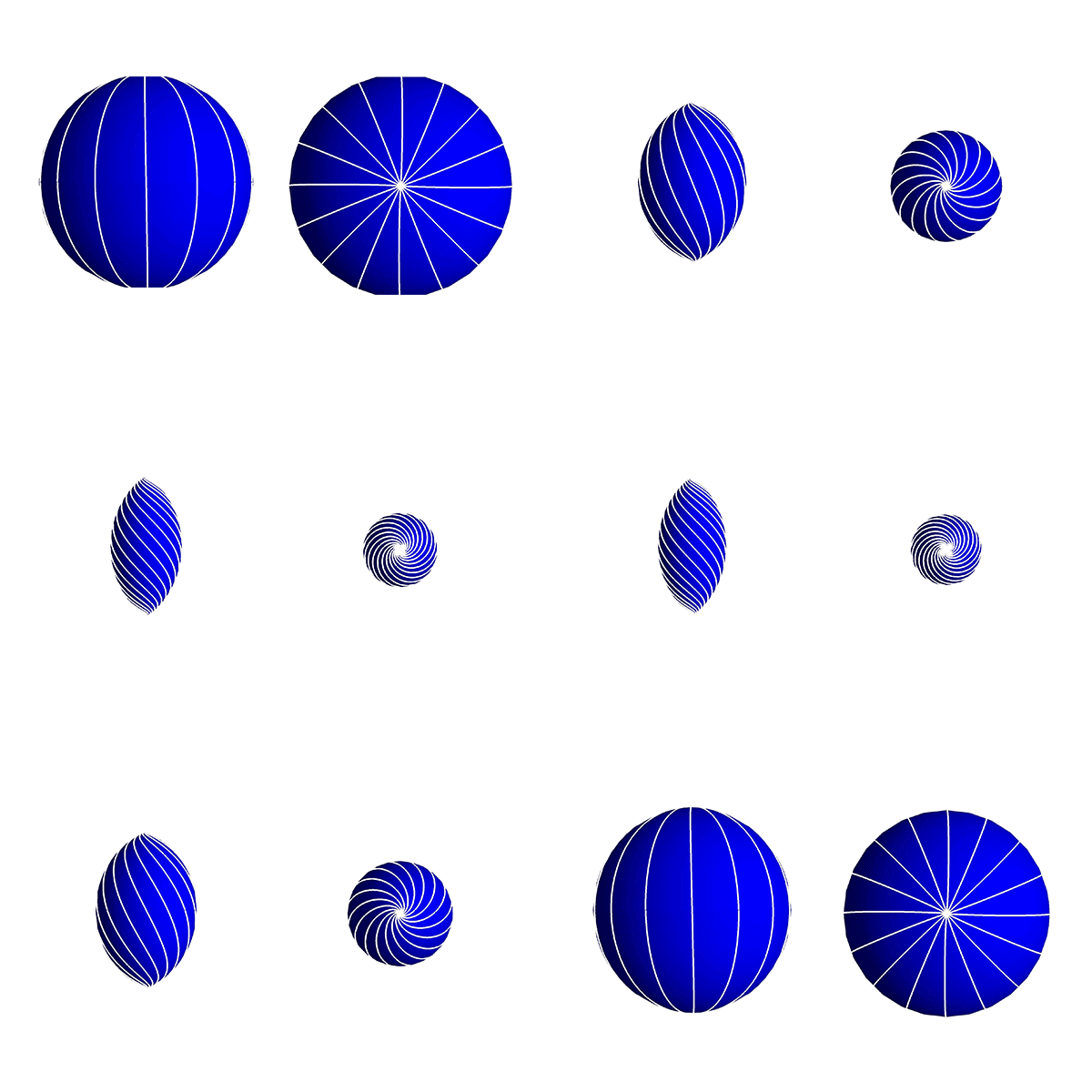
More commonly referred to as rhumb lines, a loxodrome is an arc that follows a constant angle as it cuts across a sphere. Sailors throughout the 16th-19th centuries used these lines to navigate, allowing them to set their compasses to a constant bearing so that their ships did not have to change their bearing.
“We tried to figure out if this was the case,” Ansell says about investigating if her hypothesis was correct. “We think we found these loxodromes, so we had to go about comparing what it looks like versus the data.”
Ansell then developed a mathematical model that describes how the spheres become elongated and twisted using the geometry of the loxodrome as a starting point. By comparing the results of her theory to the data generated by Kim, she was able to show that changing the solvent caused the polymers to shrink, which caused its shape to twist as the polymer chains along the sphere’s lines of longitude became shorter.
At the top of the spindles are one-micron spirals, nearly one hundred times smaller than the width of a human hair. Creating manmade patterns that are small usually requires costly methods and equipment, but this method of making self-assembled small-scale structures using coarse-scale starting materials is much simpler.
The polymer loxodrome is the latest finding that delves into the Kamien group’s interests in the crossover between chemistry and geometry. Kamien says that many interactions in biology, like protein folding, immune responses, and even smell, are usually depicted as a chemical bond, but emphasizes that geometry also drives much of what happens in biology.
“Think about proteins,” says Kamien, “You have these different amino acids, and they attract in different ways, but when you’re all done, you have this giant glob, and there’s this little pocket that grabs the residues, so you think of it geometrically. Helen’s explanation is completely geometrical: It doesn’t involve anything specific about how the binding works.”
For Kim, this research is an exciting first step in studying unique structures in other biological systems. By designing new types of polymer particles and testing them out in different conditions, he hopes to learn more about how shape drives function, especially in systems that twist and contract. “We could study some biological matter in nature by mimicking a similar topological model,” he says, “And we may solve or study some complex problem in nature.”
Now, entirely coincidentally, Ansell’s efforts have laid the groundwork for another unrelated project she had been stuck on for some time which also appears to have a loxodrome solution.
“They just appear,” she says about the twisted spindle shape.
“As Pasteur said, luck favors the prepared mind,” adds Kamien. “Now, we’re primed to look for them.”
Reference: “Threading the Spindle: A Geometric Study of Chiral Liquid Crystal Polymer Microparticles” by Helen S. Ansell, Dae Seok Kim, Randall D. Kamien, Eleni Katifori and Teresa Lopez-Leon, 10 October 2019, Physical Review Letters.
DOI: 10.1103/PhysRevLett.123.157801
Never miss a breakthrough: Join the SciTechDaily newsletter.
Follow us on Google and Google News.