

Close Menu
    Facebook X (Twitter) Instagram
    SciTechDaily
    • Biology
    • Chemistry
    • Earth
    • Health
    • Physics
    • Science
    • Space
    • Technology
    Facebook X (Twitter) Pinterest YouTube RSS
    SciTechDaily
    Home»Health»Brain Waves of Sleeping Sheep Maaay Offer Clues to Human Brain Disease
    Health

    Brain Waves of Sleeping Sheep Maaay Offer Clues to Human Brain Disease

    By Society for NeuroscienceMarch 2, 2020No Comments2 Mins Read
    Facebook Twitter Pinterest Telegram LinkedIn WhatsApp Email Reddit
    Share
    Facebook Twitter LinkedIn Pinterest Telegram Email Reddit
    Sleeping Sheep
    Monitoring how a sheep’s sleep changes during the progression of a brain disease may one day translate to sleep-based diagnosis in humans.

    A specific brain wave type shared by sheep and humans could help researchers study human brain disorders.

    People may count sheep when they cannot sleep, but when they do finally drift off their brains generate the same type of brain wave as their ovine counterparts, according to new research published in eNeuro. Monitoring how a sheep’s sleep changes during the progression of a brain disease may one day translate to sleep-based diagnosis in humans.

    Sleep is essential for consolidating memories and maintaining brain health. During sleep, a specific brain wave occurs – the sleep spindle. They are associated with converting short-term memories into long-term memories. Spindles may also predict brain health.
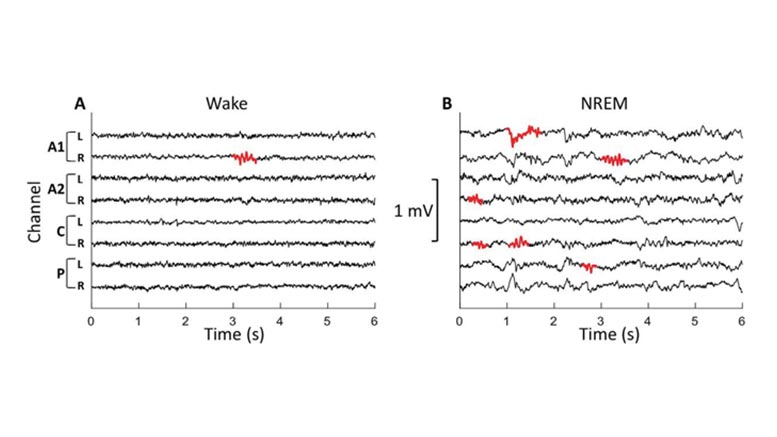
    Local Sleep Spindles During Wake
    Local sleep spindles present during wake (left). Credit: Schneider et al., eNeuro 2020

    Schneider et al. recorded the brain activity in sheep over one day and two nights using electroencephalography. The sheep generated sleep spindles falling within the frequency range typical of human sleep spindles. Like humans, each sheep maintained their own pattern of spindles that stayed consistent during both nights of sleep. During sleep, spindles occur all over the brain. However, a unique type of sleep spindle appeared in specific brain areas while the sheep were awake. These spindles may be connected to thinking and remembering during the day. Because they possess similar brain structure, sleep patterns, and even brain disorders, sheep are an excellent model for studying human sleep and brain disorders.

    Reference: “Characterising Sleep Spindles in Sheep” by Will T. Schneider, Szilvia Vas, Alister U. Nicol and A. Jennifer Morton, 2 March 2020, eNeuro.
    DOI: 10.1523/ENEURO.0410-19.2020

    Never miss a breakthrough: Join the SciTechDaily newsletter.
    Follow us on Google and Google News.

    Brain Neuroscience Sleep Science Society for Neuroscience
    Share. Facebook Twitter Pinterest LinkedIn Email Reddit

    Related Articles

    Practice Makes Perfect, but Sleep Helps, Too: Reactivating Memories During Sleep Improves Motor Skills

    Escape From Oblivion: Innovative Experiment Shows How the Brain Reboots After Deep Anesthesia

    Deep Sleep Takes Out the Trash: Waste Clearance Is Crucial for Brain Health

    Imaging the Twilight Zone: The Brain Network Driving Changes in Consciousness

    Too-Little Sleep Can Increase the Rewarding Properties of Cocaine, Paving Way to Addiction

    Scientists Uncover Brain Mechanism That May Explain Why Sleep Helps You Learn

    Lactation Changes Electrical Signaling in Mom’s Brain – But It’s Reversible

    New Research Shows the Brain May Need Iron for Healthy Cognitive Development

    Disrupted Sleep Patterns Linked to Alzheimer’s

    Leave A Reply Cancel Reply

    • Facebook
    • Twitter
    • Pinterest
    • YouTube

    Don't Miss a Discovery

    Subscribe for the Latest in Science & Tech!

    Trending News

    Just 10 Minutes a Day: Scientists Say This Ancient Chinese Practice Shows Powerful Blood Pressure Benefits

    Scientists Say This Popular Food Could Help Your Body Get Rid of Microplastics

    For the First Time, ChatGPT Has Solved an Unproven Math Problem in Geometry

    This Popular Supplement May Actually Slow Biological Aging, Scientists Reveal

    Can a Common Vitamin Fight the Most Aggressive Brain Cancer?

    Scientists Discover How to Stop Vision Loss Before It Starts

    The Mediterranean Isn’t Safe: Scientists Warn of Inevitable Tsunami

    Scientists Say Washing Dishes With a Sponge Has a Concerning Side Effect

    Follow SciTechDaily
    • Facebook
    • Twitter
    • YouTube
    • Pinterest
    • Newsletter
    • RSS
    SciTech News
    • Biology News
    • Chemistry News
    • Earth News
    • Health News
    • Physics News
    • Science News
    • Space News
    • Technology News
    Recent Posts
    • A 30-Year-Old Flu Shot Still Works Today With One Big Problem
    • Widely Available Drug Found To Ease One of Long COVID’s Most Stubborn Symptoms
    • New Study Finds Internalized Stress May Accelerate Cognitive Decline
    • Stopping Weight-Loss Drugs Like Ozempic Can Quickly Erase Heart Benefits
    • A 500-Million-Year-Old Surprise Is Forcing Scientists to Rethink Spider Evolution
    Copyright © 1998 - 2026 SciTechDaily. All Rights Reserved.
    • Science News
    • About
    • Contact
    • Editorial Board
    • Privacy Policy
    • Terms of Use

    Type above and press Enter to search. Press Esc to cancel.