
Close Menu
    Facebook X (Twitter) Instagram
    SciTechDaily
    • Biology
    • Chemistry
    • Earth
    • Health
    • Physics
    • Science
    • Space
    • Technology
    Facebook X (Twitter) Pinterest YouTube RSS
    SciTechDaily
    Home»Technology»Integrated Photonics Hits Milestone: High-Power Tunable Lasers Break New Ground
    Technology

    Integrated Photonics Hits Milestone: High-Power Tunable Lasers Break New Ground

    By Light Publishing Center, Changchun Institute of Optics, Fine Mechanics And Physics, CASJanuary 8, 2025No Comments3 Mins Read
    Facebook Twitter Pinterest Telegram LinkedIn WhatsApp Email Reddit
    Share
    Facebook Twitter LinkedIn Pinterest Telegram Email Reddit
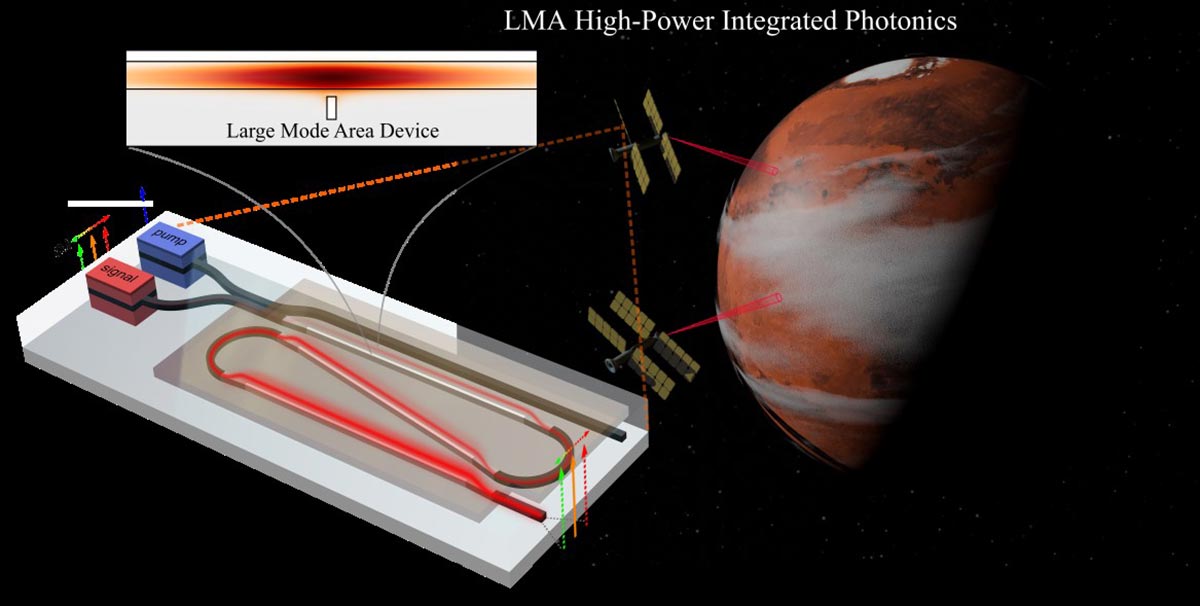
    Artistic Impression of a Potential Application of High Power Tunable Laser
    The integrated large-mode area-based amplifier amplifies a tunable seed source to a few watts level. In this scenario, the seed and the pump are fully integrated together with the amplifier onto a silicon photonics platform. The device is deployed on a satellite orbiting a planet in or outside our solar system and generates high-power light of around 1.9 μm to map out the chemical make up of the atmosphere of the planet. The inset shows a large mode region in the amplifier where the mode is 10s of μm2 which allows large energy extraction from the silicon photonics-based LMA amplifier. Credit: Neetesh Singh et al.

    Researchers have created a high-power tunable laser on silicon photonics, achieving nearly 2 watts using an LMA amplifier. This advancement could revolutionize integrated photonics, with potential applications in space exploration, reducing satellite costs while enhancing capabilities.

    In today’s world, the size of various systems continues to decrease, incorporating increasingly smaller components for applications like high-speed data centers and space exploration with compact satellites.

    However, this trend toward miniaturization and high-density integration—driven by advancements in integrated photonics—has significantly compromised the ability of these systems to generate high signal power. Traditionally, high-power output has been associated with larger systems, such as fiber and solid-state platforms, whose substantial physical dimensions allow for greater energy storage.

    In contrast, micron- to millimeter-scale systems, including those based on integrated photonics, possess far lower optical energy storage capacity than their larger, benchtop counterparts. As a result, their power generation capabilities remain inherently limited.

    Need for High-Power Signal Generation in Silicon Photonics

    In order to achieve large-scale deployment of highly functional, mass-producible silicon photonics systems and replace bulky benchtop system, it is imperative that silicon photonics-based lasers and amplifiers generate high power signal at a level comparable to benchtop systems.

    Recently, researchers in Germany, led by Dr. Neetesh Singh and Prof. Franz Kärtner, have demonstrated a very high-power tunable laser reaching close to 2 Watts of output power, thanks to the recently conceived large-mode-area (LMA) integrated waveguide amplifier on silicon photonics.

    The researchers envisage that such a device can have a disruptive impact in the field of photonics, and may allow integrated photonics devices to be implemented at a large scale across various fields.

    A potential application could be that, such a high-power tunable laser operating at long wavelength window is deployed in small-scale satellites to sense and map out ( with technologies such as LIDAR), molecules essential for life in outer space; for example, carbon dioxide, water and ammonia. The high-power tunable laser based on LMA silicon photonics will reduce the system size, weight, and cost by several orders of magnitude compared to the conventional fiber or solid state-based systems allowing multiple cost-effective space missions with highly enhanced capabilities not possible before.

    Reference: “Sub-2W tunable laser based on silicon photonics power amplifier” by Neetesh Singh, Jan Lorenzen, Muharrem Kilinc, Kai Wang, Milan Sinobad, Henry Francis, Jose Carreira, Michael Geiselmann, Umit Demirbas, Mikhail Pergament, Sonia M. Garcia-Blanco and Franz X. Kärtner, 2 January 2025, Light: Science & Applications.
    DOI: 10.1038/s41377-024-01681-1

    This research received funding from the EU Horizon 2020 Framework Programme and German Deutsche Forschungsgemeinschaft (SP2111) progam.

    Never miss a breakthrough: Join the SciTechDaily newsletter.
    Follow us on Google and Google News.

    Lasers Photonics
    Share. Facebook Twitter Pinterest LinkedIn Email Reddit

    Related Articles

    Advancements in Deep Ultraviolet Laser Technology

    The Fast and the Luminous: First Visible Wavelength Femtosecond Fiber Laser Developed

    Harnessing Chaos: A Revolutionary Approach to Laser Ranging

    Lighting the Way: The Quantum Quest for Superior On-Chip Lasers

    Smaller, Cheaper Lidar With New Chip-Based Beam Steering Device

    Ultrafast Computers Are Coming: Laser Bursts Drive Fastest-Ever Logic Gates

    A Laser Breakthrough: First Commercially Scalable Integrated Laser and Microcomb on a Single Chip

    Researchers Develop a Portable Terahertz Laser for Powerful Sensing and Imaging

    Breakthrough in the Creation of Electrically Driven Nanolasers for Integrated Circuits

    Leave A Reply Cancel Reply

    • Facebook
    • Twitter
    • Pinterest
    • YouTube

    Don't Miss a Discovery

    Subscribe for the Latest in Science & Tech!

    Trending News

    Millions Take These IBS Drugs, But a New Study Finds Serious Risks

    Scientists Unlock Hidden Secrets of 2,300-Year-Old Mummies Using Cutting-Edge CT Scanner

    Bread Might Be Making You Gain Weight Even Without Eating More Calories

    Scientists Discover Massive Magma Reservoir Beneath Tuscany

    Europe’s Most Active Volcano Just Got Stranger – Here’s Why Scientists Are Rethinking It

    Alzheimer’s Symptoms May Start Outside the Brain, Study Finds

    Millions Take This Popular Supplement – Scientists Discover a Concerning Link to Heart Failure

    The Universe Is Expanding Too Fast and Scientists Can’t Explain Why

    Follow SciTechDaily
    • Facebook
    • Twitter
    • YouTube
    • Pinterest
    • Newsletter
    • RSS
    SciTech News
    • Biology News
    • Chemistry News
    • Earth News
    • Health News
    • Physics News
    • Science News
    • Space News
    • Technology News
    Recent Posts
    • Doctors Surprised by the Power of a Simple Drug Against Colon Cancer
    • Why Popular Diabetes Drugs Like Ozempic Don’t Work for Everyone: The “Genetic Glitch”
    • Scientists Create Improved Insulin Cells That Reverse Diabetes in Mice
    • Scientists Stunned After Finding Plant Thought Extinct for 60 Years
    • A Common Diabetes Drug May Hold the Key to Stopping HIV From Coming Back
    Copyright © 1998 - 2026 SciTechDaily. All Rights Reserved.
    • Science News
    • About
    • Contact
    • Editorial Board
    • Privacy Policy
    • Terms of Use

    Type above and press Enter to search. Press Esc to cancel.