
Mechanical engineers put an Oreo’s cream filling through a battery of tests to understand what happens when two wafers are twisted apart.
When you twist an Oreo cookie open to get to the creamy center, you’re mimicking a basic rheological test. (Rheology is the study of how a non-Newtonian material flows when twisted, pressed, or otherwise strained.) MIT engineers have now subjected the famous sandwich cookie to rigorous materials testing in order to answer a vexing question: why does the cookie’s cream stick to only one wafer when twisted apart?
“There’s the fascinating problem of trying to get the cream to distribute evenly between the two wafers, which turns out to be really hard,” says Max Fan, an undergraduate in MIT’s Department of Mechanical Engineering.
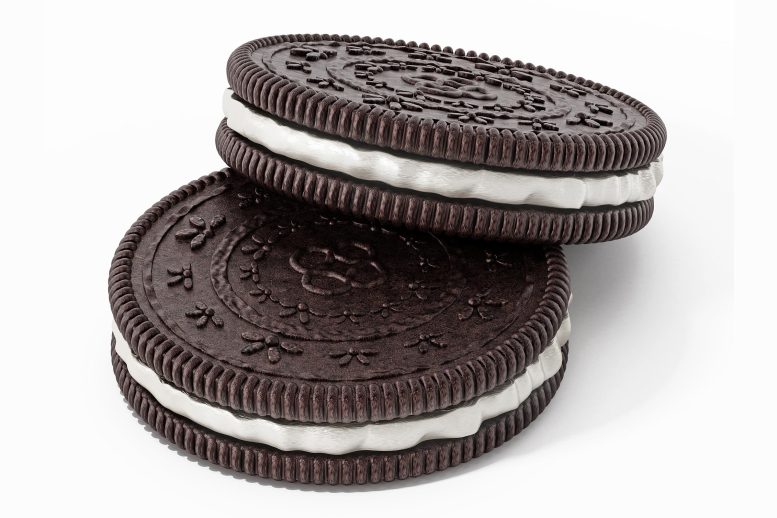
In search of an answer, the team of researchers exposed cookies to normal rheology experiments in the lab and discovered that, regardless of flavor or amount of stuffing, the cream in the center of an Oreo almost always adheres to one wafer when twisted open. Only in older boxes of cookies does the cream sometimes divide more equally between the two wafers.
The scientists also measured the torque required to twist open an Oreo, and found it to be similar to the torque required to turn a doorknob and about 1/10th what’s needed to twist open a bottlecap. The cream’s failure stress — i.e. the force per area required to get the cream to flow, or deform — is twice that of cream cheese and peanut butter, and about the same magnitude as mozzarella cheese. Judging from the cream’s response to stress, the team classifies its texture as “mushy,” rather than brittle, tough, or rubbery.
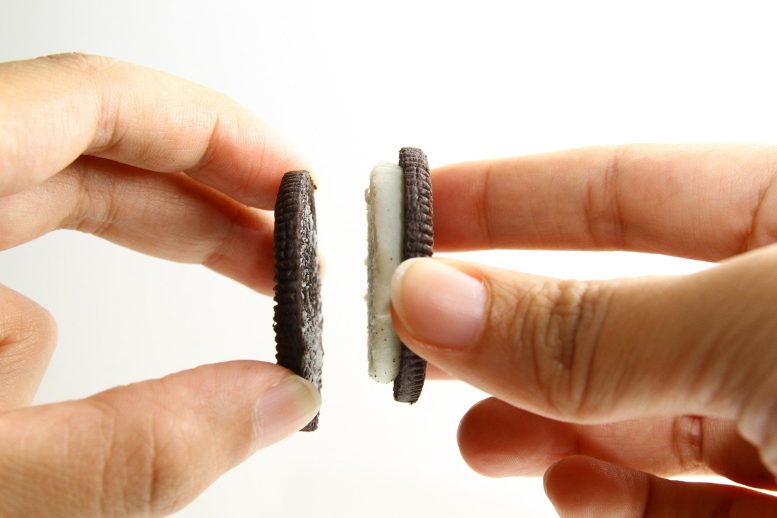
So, why does the cookie’s cream glom to one side rather than splitting evenly between both? The manufacturing process may be to blame.
“Videos of the manufacturing process show that they put the first wafer down, then dispense a ball of cream onto that wafer before putting the second wafer on top,” says Crystal Owens, an MIT mechanical engineering PhD candidate who studies the properties of complex fluids. “Apparently that little time delay may make the cream stick better to the first wafer.”
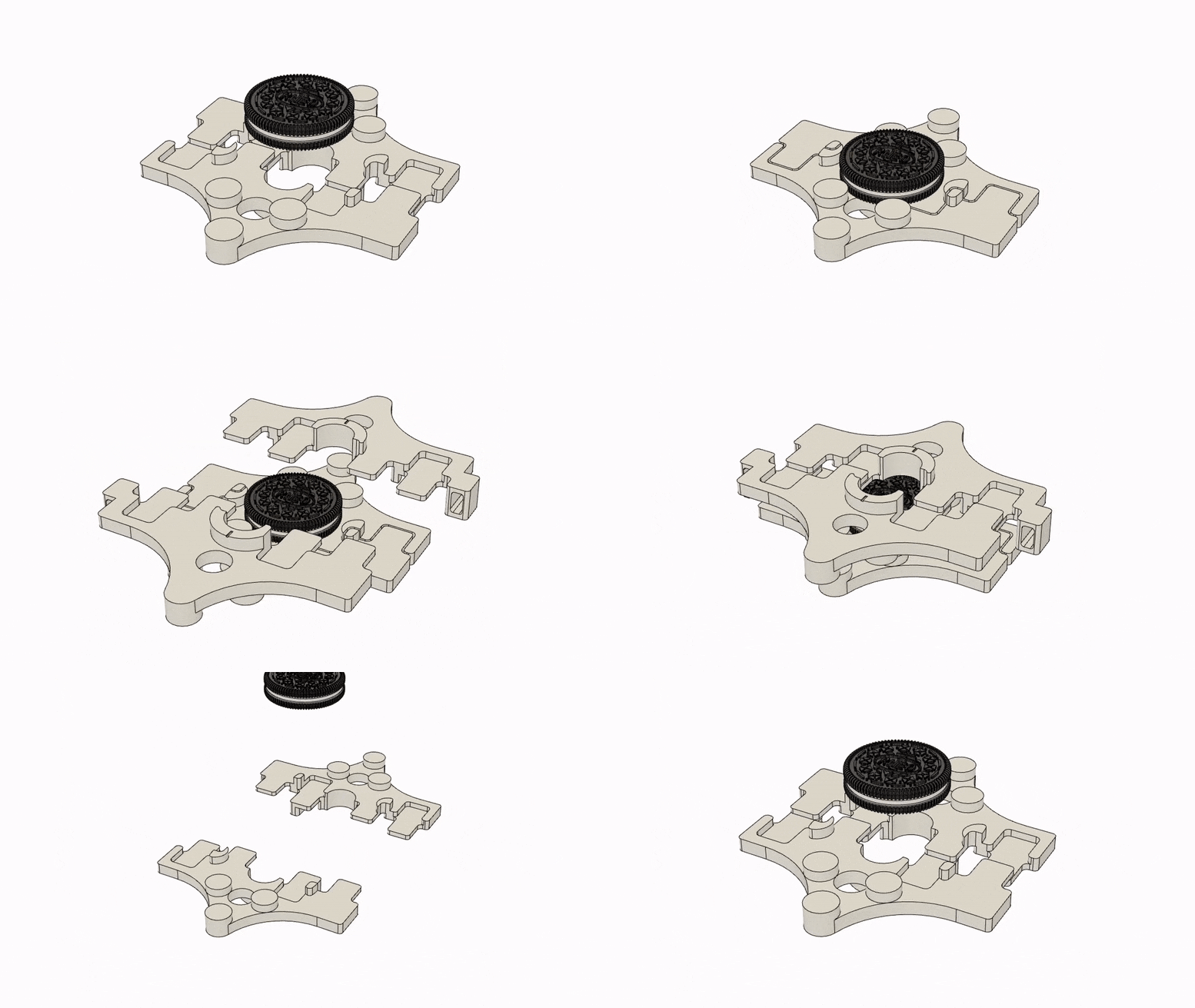
The team’s study isn’t simply a sweet diversion from bread-and-butter research; it’s also an opportunity to make the science of rheology accessible to others. To that end, the researchers have designed a 3D-printable “Oreometer” — a simple device that firmly grasps an Oreo cookie and uses pennies and rubber bands to control the twisting force that progressively twists the cookie open. Instructions for the tabletop device can be found here.
The new study, “On Oreology, the fracture and flow of ‘milk’s favorite cookie,’” appears today in Kitchen Flows, a special issue of the journal Physics of Fluids. It was conceived of early in the COVID-19 pandemic, when many scientists’ labs were closed or difficult to access. In addition to Owens and Fan, co-authors are mechanical engineering professors Gareth McKinley and A. John Hart.
Confection Connection
A standard test in rheology places a fluid, slurry, or other flowable material onto the base of an instrument known as a rheometer. A parallel plate above the base can be lowered onto the test material. The plate is then twisted as sensors track the applied rotation and torque.
Owens, who regularly uses a laboratory rheometer to test fluid materials such as 3D-printable inks, couldn’t help noting a similarity with sandwich cookies. As she writes in the new study:
“Scientifically, sandwich cookies present a paradigmatic model of parallel plate rheometry in which a fluid sample, the cream, is held between two parallel plates, the wafers. When the wafers are counter-rotated, the cream deforms, flows, and ultimately fractures, leading to separation of the cookie into two pieces.”
While Oreo cream may not appear to possess fluid-like properties, it is considered a “yield stress fluid” — a soft solid when unperturbed that can start to flow under enough stress, the way toothpaste, frosting, certain cosmetics, and concrete do.
Curious as to whether others had explored the connection between Oreos and rheology, Owens found mention of a 2016 Princeton University study in which physicists first reported that indeed, when twisting Oreos by hand, the cream almost always came off on one wafer.
“We wanted to build on this to see what actually causes this effect and if we could control it if we mounted the Oreos carefully onto our rheometer,” she says.
Cookie Twist
In an experiment that they would repeat for multiple cookies of various fillings and flavors, the researchers glued an Oreo to both the top and bottom plates of a rheometer and applied varying degrees of torque and angular rotation, noting the values that successfully twisted each cookie apart. They plugged the measurements into equations to calculate the cream’s viscoelasticity, or flowability. For each experiment, they also noted the cream’s “post-mortem distribution,” or where the cream ended up after twisting open.
In all, the team went through about 20 boxes of Oreos, including regular, Double Stuf, and Mega Stuf levels of filling, and regular, dark chocolate, and “golden” wafer flavors. Surprisingly, they found that no matter the amount of cream filling or flavor, the cream almost always separated onto one wafer.
“We had expected an effect based on size,” Owens says. “If there was more cream between layers, it should be easier to deform. But that’s not actually the case.”
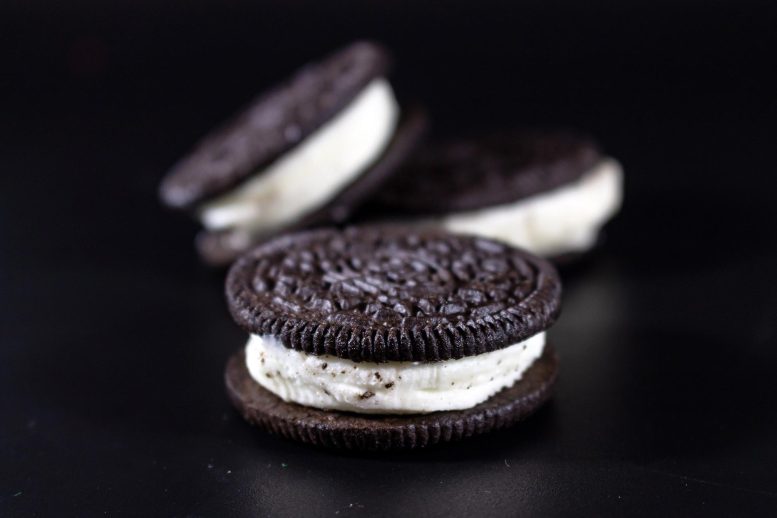
Curiously, when they mapped each cookie’s result to its original position in the box, they noticed the cream tended to stick to the inward-facing wafer: Cookies on the left side of the box twisted such that the cream ended up on the right wafer, whereas cookies on the right side separated with cream mostly on the left wafer. They suspect this box distribution may be a result of post-manufacturing environmental effects, such as heating or jostling that may cause the cream to peel slightly away from the outer wafers, even before twisting.
The understanding gained from the properties of Oreo cream could potentially be applied to the design of other complex fluid materials.
“My 3D printing fluids are in the same class of materials as Oreo cream,” she says. “So, this new understanding can help me better design ink when I’m trying to print flexible electronics from a slurry of carbon nanotubes, because they deform in almost exactly the same way.”
As for the cookie itself, she suggests that if the inside of Oreo wafers were more textured, the cream might grip better onto both sides and split more evenly when twisted.
“As they are now, we found there’s no trick to twisting that would split the cream evenly,” Owens concludes.
Reference: “On Oreology, the fracture and flow of “milk’s favorite cookie®”” by Crystal E. Owens, Max R. Fan, A. John Hart and Gareth H. McKinley, 19 April 2022, Physics of Fluids.
DOI: 10.1063/5.0085362
This research was supported, in part, by the MIT UROP program and by the National Defense Science and Engineering Graduate Fellowship Program.
Never miss a breakthrough: Join the SciTechDaily newsletter.
Follow us on Google and Google News.