
Close Menu
    Facebook X (Twitter) Instagram
    SciTechDaily
    • Biology
    • Chemistry
    • Earth
    • Health
    • Physics
    • Science
    • Space
    • Technology
    Facebook X (Twitter) Pinterest YouTube RSS
    SciTechDaily
    Home»Space»Invisible Galactic Gale: Superwind From Spectacularly Energetic Supernova Explosions
    Space

    Invisible Galactic Gale: Superwind From Spectacularly Energetic Supernova Explosions

    By ESA/HubbleOctober 10, 2021No Comments2 Mins Read
    Facebook Twitter Pinterest Telegram LinkedIn WhatsApp Email Reddit
    Share
    Facebook Twitter LinkedIn Pinterest Telegram Email Reddit
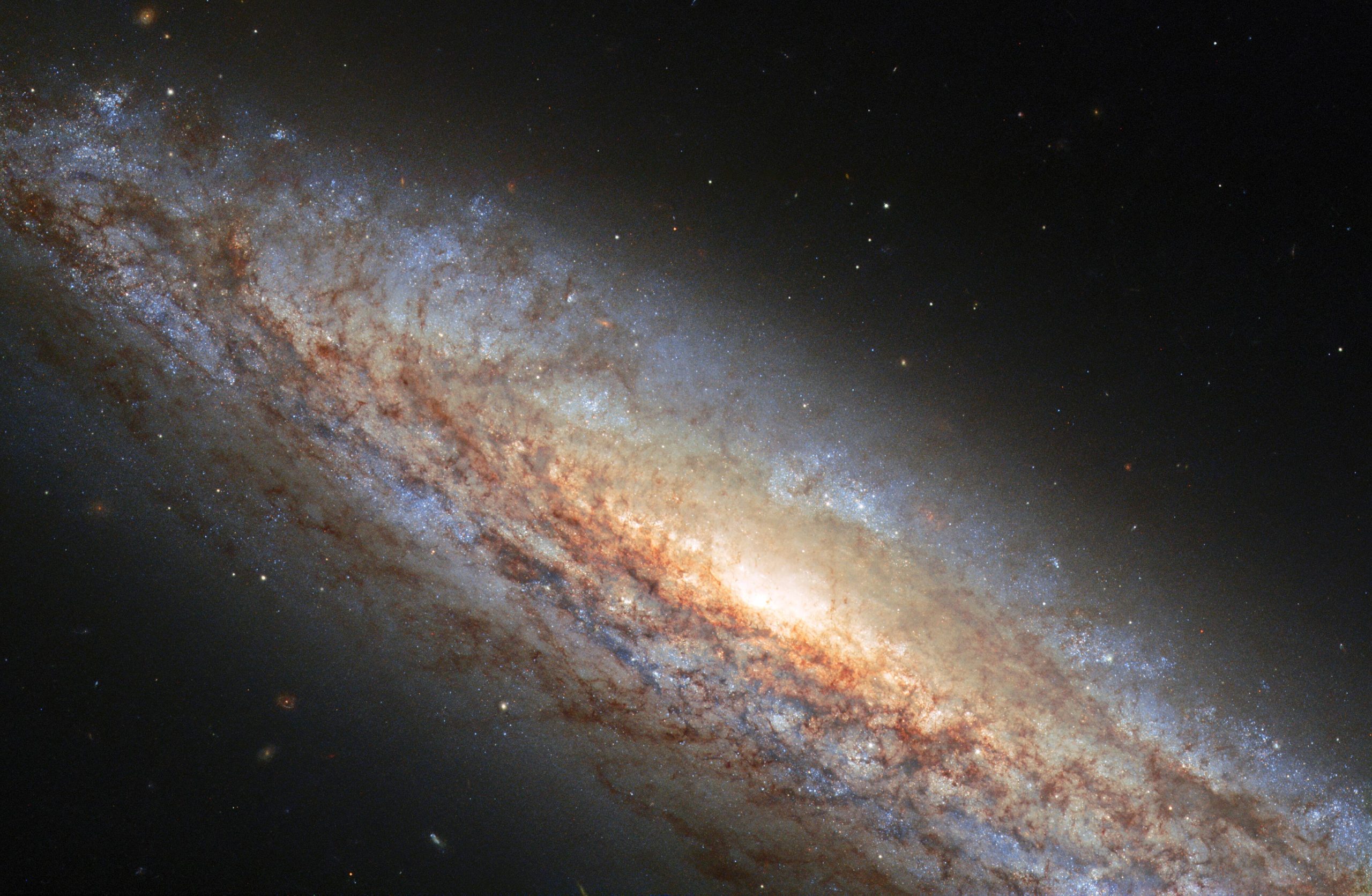
    NGC 4666
    The spiral galaxy NGC 4666 lies approximately 80 million light-years away in the constellation Virgo. Credit: ESA/Hubble & NASA, O. Graur, Acknowledgment: L. Shatz

    Hubble’s striking image of NGC 4666 reveals a starburst galaxy in Virgo undergoing furious star formation, triggered by gravitational tussles with nearby galaxies.

    NGC 4666 takes center stage in this image from the NASA/ESA Hubble Space Telescope. This majestic spiral galaxy lies about 80 million light-years away in the constellation Virgo, and is undergoing a particularly intense episode of star formation. Astronomers refer to galaxies that are forming stars anomalously quickly as starburst galaxies. NGC 4666’s starburst is thought to be due to gravitational interactions with its unruly neighbors — including the nearby galaxy NGC 4668 and a dwarf galaxy.

    NGC 4666’s burst of star formation is driving an unusual form of extreme galactic weather known as a superwind — a gigantic transfer of gas from the bright central heart of the galaxy out into space. This superwind is the result of driving winds from short-lived massive stars formed during NGC 4666’s starburst as well as spectacularly energetic supernova explosions. Two such supernova explosions have been seen in NGC 4666 within the last decade — one in 2014 and the other in 2019. The star which led to the 2019 supernova was recently determined to be 19 times as massive as our Sun!

    At peak, supernovae are often the brightest sources of light in their galaxies, shining so bright that they can be seen clearly across the Universe. The 2014 supernova in NGC 4666 is still active in this image, but more than 900 days after it peaked, the supernova has faded from its former glory and looks like just one more star in this busy galaxy.

    Though the torrent of superheated gas emanating from NGC 4666 is truly vast in scale — extending for tens of thousands of light-years — it is invisible in this image. The superwind’s extremely high temperature makes it stand out as a luminous plume in X-ray or radio observations, but it doesn’t show up at the visible wavelengths imaged by Hubble’s Wide Field Camera 3.

    Never miss a breakthrough: Join the SciTechDaily newsletter.
    Follow us on Google and Google News.

    Astronomy European Space Agency Hubble Space Telescope NASA
    Share. Facebook Twitter Pinterest LinkedIn Email Reddit

    Related Articles

    Hubble’s Newest Discovery Isn’t a Star, It’s a Window Into the Dark Universe

    This Nearby Galaxy Shows How Frozen Clouds Ignite Into Stars

    This Chaotic Spiral Galaxy Is Still Recovering From a Cosmic Collision

    This Strange Spiral Galaxy Is Hiding a Massive Black Hole

    Hubble Zooms In on a Galaxy That Maps the Universe’s Expansion

    Hubble Captures a Dazzling Spiral Galaxy Alive With Birth and Destruction

    Hubble Spots a Glowing “Ring of Fire” in a Distant Spiral Galaxy

    Dust, Light & Ancient Collisions: The Sombrero Galaxy Like You’ve Never Seen It

    Star Formation in Motion: Hubble Reveals Spiraling Stars and Sculpted Nebulae

    Leave A Reply Cancel Reply

    • Facebook
    • Twitter
    • Pinterest
    • YouTube

    Don't Miss a Discovery

    Subscribe for the Latest in Science & Tech!

    Trending News

    First-of-Its-Kind Discovery: Homer’s Iliad Found Embedded in a 1,600-Year-Old Egyptian Mummy

    Beyond Inflammation: Scientists Uncover New Cause of Persistent Rheumatoid Arthritis

    A Simple Molecule Could Unlock Safer, Easier Weight Loss

    Scientists Just Built a Quantum Battery That Charges Almost Instantly

    Researchers Unveil Groundbreaking Sustainable Solution to Vitamin B12 Deficiency

    Millions of People Have Osteopenia Without Realizing It – Here’s What You Need To Know

    Researchers Discover Boosting a Single Protein Helps the Brain Fight Alzheimer’s

    World-First Study Reveals Human Hearts Can Regenerate After a Heart Attack

    Follow SciTechDaily
    • Facebook
    • Twitter
    • YouTube
    • Pinterest
    • Newsletter
    • RSS
    SciTech News
    • Biology News
    • Chemistry News
    • Earth News
    • Health News
    • Physics News
    • Science News
    • Space News
    • Technology News
    Recent Posts
    • Why Did the Neanderthals Disappear? Scientists Reveal Humans Had a Hidden Advantage
    • Unusually Warm Water Detected Creeping Toward Antarctica – and Scientists Are Alarmed
    • Scientists Uncover Hidden Property of Light That Twists Matter Sideways
    • Artemis II Just Proved NASA Is Closer Than Ever to Returning to the Moon
    • NASA Powers Down Voyager 1 Instrument As It Fights To Survive Deep Space
    Copyright © 1998 - 2026 SciTechDaily. All Rights Reserved.
    • Science News
    • About
    • Contact
    • Editorial Board
    • Privacy Policy
    • Terms of Use

    Type above and press Enter to search. Press Esc to cancel.