
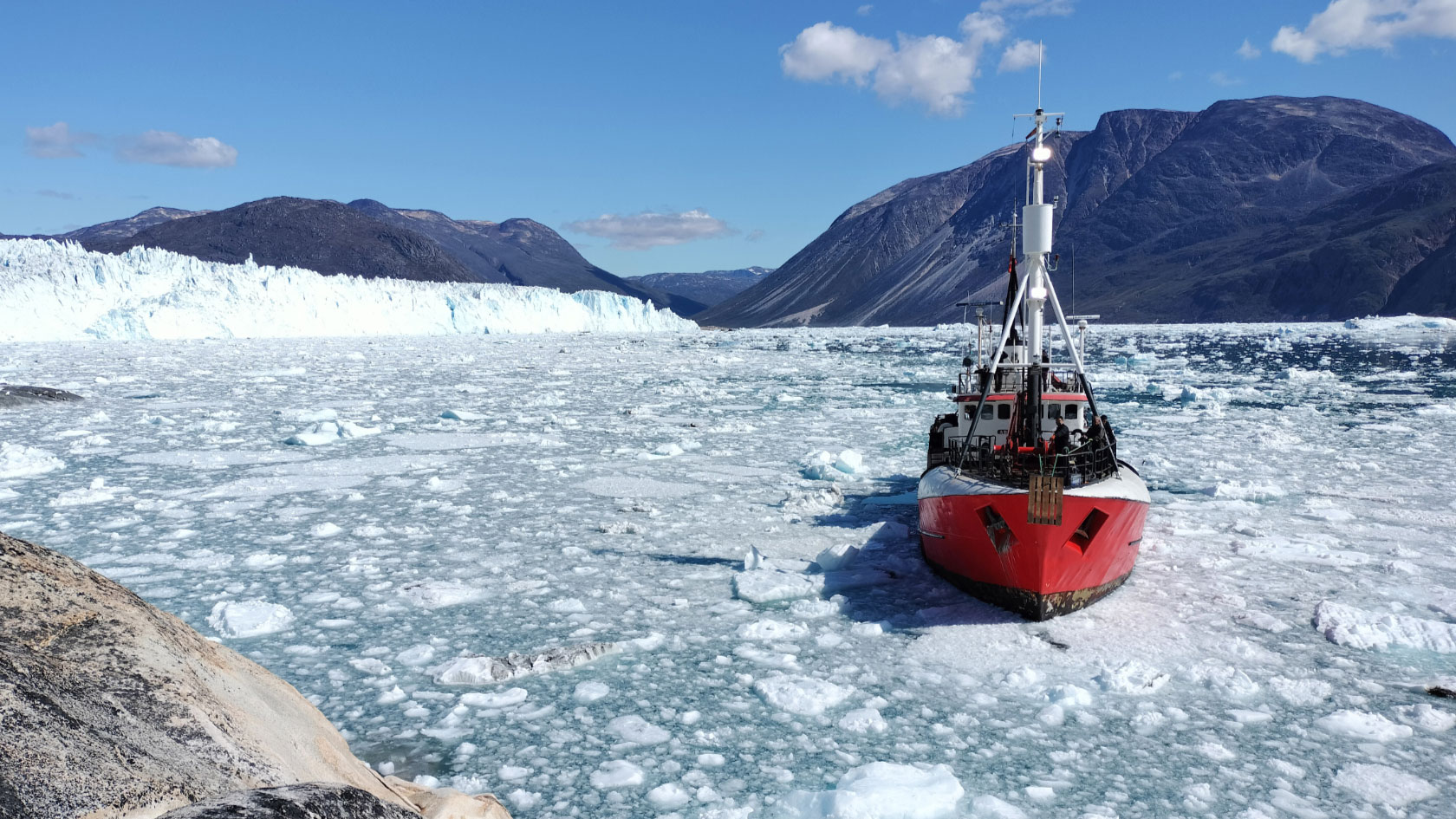
Scientists have uncovered how massive underwater waves triggered by iceberg calving secretly fuel glacier melt in Greenland.
Iceberg calving takes place when large sections of ice detach from the edges of glaciers and plunge into the ocean. This natural event is one of the main contributors to the rapid ice loss currently occurring in Greenland. Now, a team of scientists from the University of Zurich (UZH) and the University of Washington (UW) has, for the first time, used fiber-optic technology to measure how the impact and movement of these falling ice masses stir together glacial meltwater and warmer seawater below the surface.
“The warmer water increases seawater-induced melt erosion and eats away at the base of the vertical wall of ice at the glacier’s edge. This, in turn, amplifies glacier calving and the associated mass loss from ice sheets,” says Andreas Vieli, a professor at UZH’s Department of Geography and co-author of the study. Vieli heads the Cryosphere cluster, one of six clusters in the interdisciplinary GreenFjord project in southern Greenland, supported by the Swiss Polar Institute. These new insights into the dynamics of glacier ice and seawater are featured on the cover of the latest issue of Nature.
Wave measurements using fiber-optic cable on seafloor
As part of the GreenFjord project, scientists from UZH, UW, and several other Swiss institutions carried out an in-depth field investigation into glacier calving processes. They placed a ten-kilometer-long fiber-optic cable along the seafloor of the fjord at the Eqalorutsit Kangilliit Sermiat glacier. This massive, fast-moving glacier in southern Greenland releases approximately 3.6 cubic kilometers of ice into the ocean each year, nearly three times the volume of Switzerland’s Rhône Glacier near the Furka mountain pass.
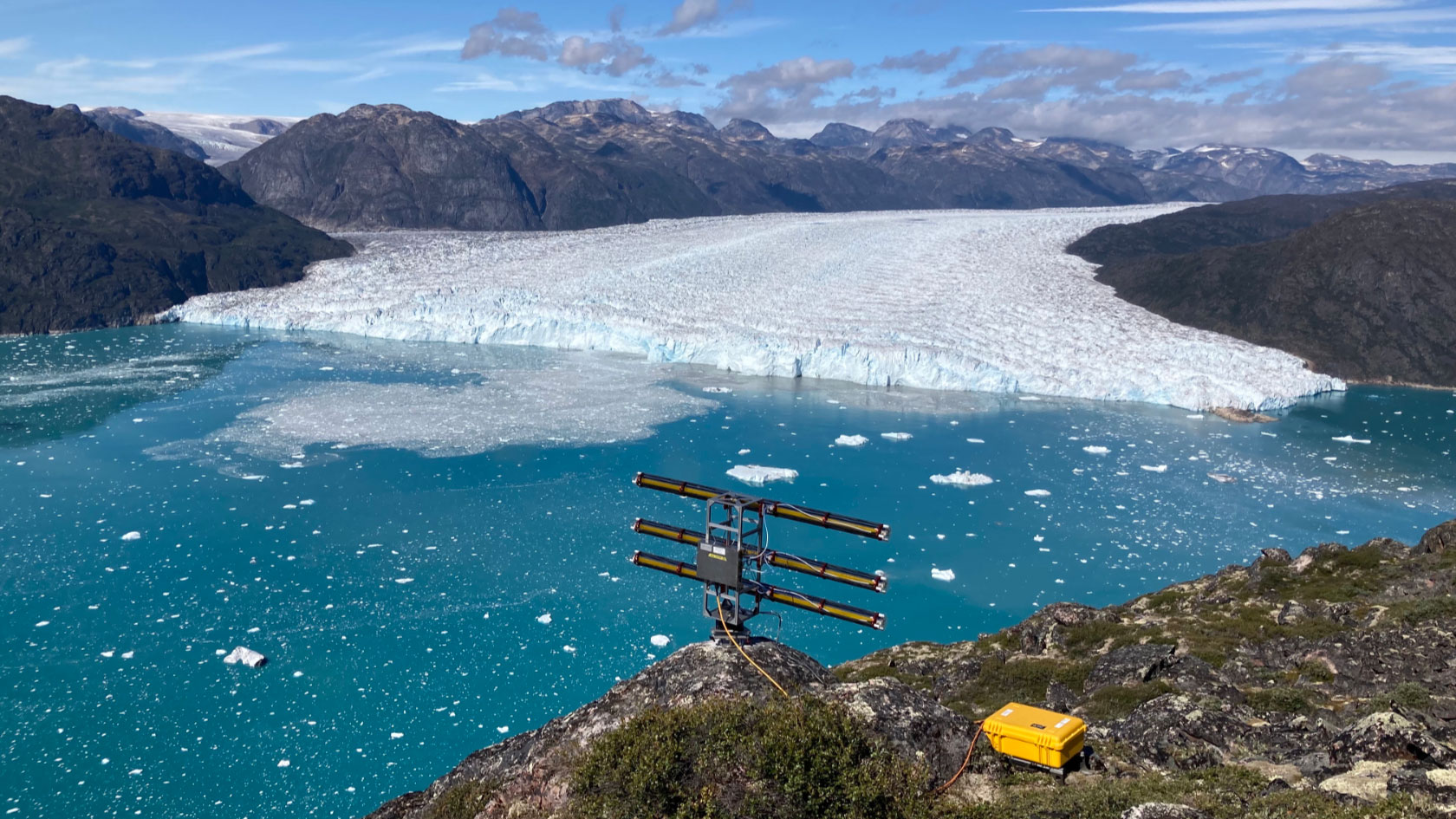
The researchers used a technology called Distributed Acoustic Sensing (DAS), which detects ground motion by monitoring cable strain caused by crevasses forming in the ice, falling ice blocks, ocean waves or changes in temperature. “This enables us to measure the many different types of waves that are generated after icebergs break off,” says lead author Dominik Gräff, a UW postdoctoral researcher affiliated with ETH Zurich.
Underwater waves amplify glacier melt and erosion
Following the initial impact, surface waves, known as calving-induced tsunamis, surge through the fjord, initially mixing the upper layers of water. As seawater in Greenland’s fjords is warmer and denser than glacial meltwater, it sinks to the bottom.
But the researchers also observed other waves propagating between density layers long after the splash, when the surface had stilled. These underwater waves, which can be as tall as skyscrapers, are not visible from the surface but prolong water mixing, bringing a steady supply of warmer water to the surface. This process increases melting and erosion at the glacier’s edge and drives ice calving.
“The fiber-optic cable allowed us to measure this incredible calving multiplier effect, which wasn’t possible before,” says Gräff. The data collected will help document iceberg calving processes and improve our understanding of the accelerating loss of ice sheets.
A fragile and threatened system
Scientists have long recognized the significance of seawater and calving dynamics. However, measuring the relevant processes on site presents considerable challenges, since the vast number of icebergs along the fjords poses a constant risk from falling chunks of ice. In addition, conventional remote sensing methods based on satellites cannot penetrate below the water’s surface, where interactions between glaciers and seawater take place. “Our previous measurements have often merely scratched the surface, so a new approach was needed,” says Andreas Vieli.
The Greenland ice sheet is a vast body of ice that covers an area roughly 40 times the size of Switzerland. If it were to melt, it would release enough water to raise global sea levels by approximately seven meters. The substantial meltwater volumes released by retreating glaciers can weaken ocean currents such as the Gulf Stream, with far-reaching consequences for Europe’s climate. In addition, the loss of these calving glaciers also affects the local ecosystem of Greenland’s fjords.
“Our entire Earth system depends, at least in part, on these ice sheets. It’s a fragile system that could collapse if temperatures rise too high,” warns Dominik Gräff.
Reference: “Calving-driven fjord dynamics resolved by seafloor fibre sensing” by Dominik Gräff, Bradley Paul Lipovsky, Andreas Vieli, Armin Dachauer, Rebecca Jackson, Daniel Farinotti, Julia Schmale, Jean-Paul Ampuero, Eric Berg, Anke Dannowski, Andrea Kneib-Walter, Manuela Köpfli, Heidrun Kopp, Enrico van der Loo, Daniel Mata Flores, Diego Mercerat, Raphael Moser, Anthony Sladen, Fabian Walter, Diego Wasser, Ethan Welty, Selina Wetter and Ethan F. Williams, 13 August 2025, Nature.
DOI: 10.1038/s41586-025-09347-7
Never miss a breakthrough: Join the SciTechDaily newsletter.
Follow us on Google and Google News.
2 Comments
Ridge Chord Profusion
Sea water being salty is, at same the temperature as freshwater, more dense than fresh water Glacial melt water could be either warmer or colder than sea water so it could be either less dense or more dense than seawater although water at zero degrees C and on the point of freezing might be…….? Some interesting physics in all that.