
Close Menu
    Facebook X (Twitter) Instagram
    SciTechDaily
    • Biology
    • Chemistry
    • Earth
    • Health
    • Physics
    • Science
    • Space
    • Technology
    Facebook X (Twitter) Pinterest YouTube RSS
    SciTechDaily
    Home»Technology»Iron Nanorobots Go Undercover to Track Living Cells Inside the Body
    Technology

    Iron Nanorobots Go Undercover to Track Living Cells Inside the Body

    By King Abdullah University of Science & Technology (KAUST)May 31, 2020No Comments3 Mins Read
    Facebook Twitter Pinterest Telegram LinkedIn WhatsApp Email Reddit
    Share
    Facebook Twitter LinkedIn Pinterest Telegram Email Reddit
    Nanorobots
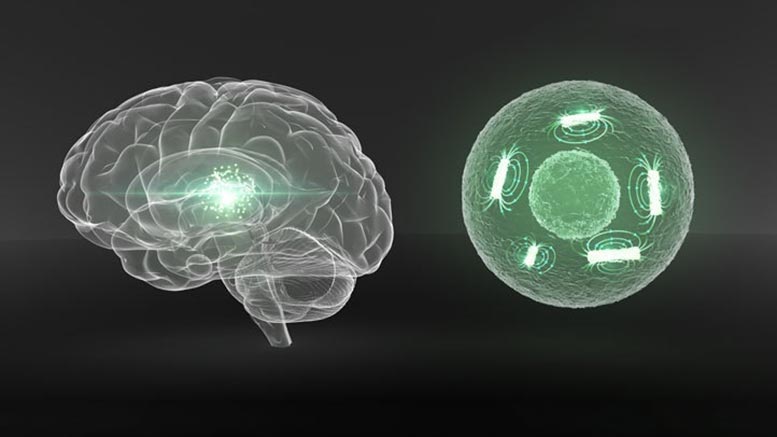
    Labeled cells could be tracked either in cell cultures or once injected into a living animal. Credit: © 2020 KAUST

    Customizable magnetic iron nanowires pinpoint and track the movements of target cells.

    Living cells inside the body could be placed under surveillance—their location and migration noninvasively tracked in real time over many days—using a new method developed by researchers at KAUST.

    The technique uses magnetic core-shell iron nanowires as nontoxic contrast agents, which can be implanted into live cells, lighting up those cells’ location inside a living organism when scanned by magnetic resonance imaging (MRI). The technique could have applications ranging from studying and treating cancer to tracking live-cell medical treatments, such as stem cell therapies.

    Jürgen Kosel and his team recently showed that core-shell iron nanowires could selectively kill cancer cells with a combination attack, delivering an anticancer drug into target cells while also puncturing the cell’s membrane and unleashing blasts of heat. Now, in collaboration with researchers from the CIC biomaGUNE in San Sebastian, Spain, the team has shown that the same type of iron core, iron-oxide shell nanowires, can be used for noninvasive medical imaging. The nanowires could potentially be used as “theranostic” agents, able to identify, track and then take out target cells.

    “Cell labeling and tracking has become an invaluable tool for scientific and clinical applications,” says Aldo Martínez-Banderas, a Ph.D. student in Kosel’s team. “One of the key aspects of cell tracking studies is the sensitivity to detect a small number of cells after implantation, so the strong magnetization and biocompatibility of our nanowires are advantageous characteristics for MRI tracking.”

    The nanowires performed well as MRI contrast agents, even at very low concentrations, and the magnetic response could be tuned by altering the thickness of the nanowire shell, the team showed. The nanowire’s biocompatibility permitted long-term tracking of the live cells. “The nanowires interacted with cells without compromising their survival, functionality or capacity to proliferate,” Martínez-Banderas explains. The labeled cells could be tracked either in cell cultures or once injected into a living animal. “The strong magnetization of the nanowires enabled the detection of approximately 10 labeled cells within the brain of a mouse for a period of at least 40 days, which allowed us to trace their exact location and fate in the animal,” Martínez-Banderas says.

    “These core-shell nanowires have various additional features, including the ability to control them magnetically to guide them to a particular location, to carry drugs, or be to heated with a laser,” Kosel says. “Combining all of that with the capability of tracking creates a theranostic platform that can open the door for very promising new approaches in nanomedicine.”

    Reference: “Magnetic core–shell nanowires as MRI contrast agents for cell tracking” by Aldo Isaac Martínez-Banderas, Antonio Aires, Sandra Plaza-García, Lorena Colás, Julián A. Moreno, Timothy Ravasi, Jasmeen S. Merzaban, Pedro Ramos-Cabrer, Aitziber L. Cortajarena and Jürgen Kosel, 12 March 2020, Journal of Nanobiotechnology.
    DOI: 10.1186/s12951-020-00597-3

    Never miss a breakthrough: Join the SciTechDaily newsletter.
    Follow us on Google and Google News.

    Bionanotechnology Biotechnology KAUST Nanotechnology
    Share. Facebook Twitter Pinterest LinkedIn Email Reddit

    Related Articles

    Nanotechnology Advances Regenerative Medicine: Bone Formation Comes Down to the Nanowire

    New Method Developed for 3D Printing Living Microbes To Enhance Biomaterials

    Researchers Design World’s Fastest Information-Fueled Engine

    New Method of 3D-Printing Soft Materials Could Jump-Start Creation of Tiny Medical Devices for the Body

    Fully Autonomous Cancer-Fighting Nanorobots Seek and Destroy Tumors

    Single-Stranded DNA and RNA Origami That Can Autonomously Fold Into Defined Structures

    Programmable Biofilm-Based Materials That Self-Assemble

    A*STAR Researchers Develop High-Capacity Method to Purify Monoclonal Antibodies

    Scientists Develop Artificial Cilia

    Leave A Reply Cancel Reply

    • Facebook
    • Twitter
    • Pinterest
    • YouTube

    Don't Miss a Discovery

    Subscribe for the Latest in Science & Tech!

    Trending News

    First-of-Its-Kind Discovery: Homer’s Iliad Found Embedded in a 1,600-Year-Old Egyptian Mummy

    Beyond Inflammation: Scientists Uncover New Cause of Persistent Rheumatoid Arthritis

    A Simple Molecule Could Unlock Safer, Easier Weight Loss

    Scientists Just Built a Quantum Battery That Charges Almost Instantly

    Researchers Unveil Groundbreaking Sustainable Solution to Vitamin B12 Deficiency

    Millions of People Have Osteopenia Without Realizing It – Here’s What You Need To Know

    Researchers Discover Boosting a Single Protein Helps the Brain Fight Alzheimer’s

    World-First Study Reveals Human Hearts Can Regenerate After a Heart Attack

    Follow SciTechDaily
    • Facebook
    • Twitter
    • YouTube
    • Pinterest
    • Newsletter
    • RSS
    SciTech News
    • Biology News
    • Chemistry News
    • Earth News
    • Health News
    • Physics News
    • Science News
    • Space News
    • Technology News
    Recent Posts
    • After Decades, MIT Researchers Capture the First 3D Atomic View of a Mysterious Material
    • Your Favorite Fishing Spot Is Turning Brown – and the Fish Are Changing
    • 380-Million-Year-Old Fish Fossil Reveals Secrets of Life’s First Steps Onto Land
    • Mezcal “Worm” in a Bottle Mystery: DNA Testing Reveals a Surprise
    • Scientists Turn Red Lettuce Green, Unlocking Hidden Nutrients
    Copyright © 1998 - 2026 SciTechDaily. All Rights Reserved.
    • Science News
    • About
    • Contact
    • Editorial Board
    • Privacy Policy
    • Terms of Use

    Type above and press Enter to search. Press Esc to cancel.