
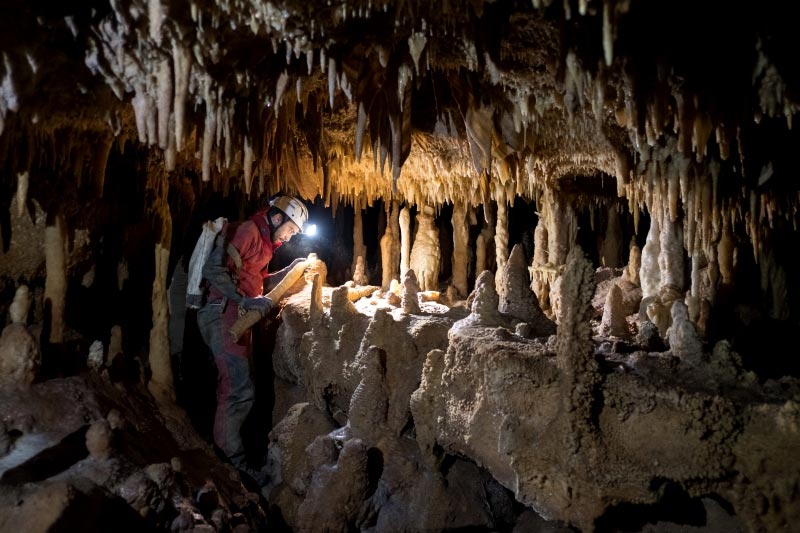
Homo Neanderthaliensis did not become extinct because of changes in climate. At least, this did not happen to the several Neanderthal groups that lived in the western Mediterranean 42,000 years ago. A research group of the University of Bologna came to this conclusion after a detailed paleoclimatic reconstruction of the last ice age through the analysis of stalagmites sampled from some caves in Apulia, Italy.
The researchers focused on the Murge karst plateau in Apulia, where Neanderthals and Homo Sapiens coexisted for at least 3,000 years, from approximately 45,000 to 42,000 years ago. This study was published in Nature Ecology & Evolution. Data extracted from the stalagmites showed that climate changes that happened during that time span were not particularly significant. “Our study shows that this area of Apulia appears as a ‘climate niche’ during the transition from Neanderthals to Homo Sapiens” explains Andrea Columbu, researcher and first author of this study. “It doesn’t seem possible that significant climate changes happened during that period, at least not impactful enough to cause the extinction of Neanderthals in Apulia and, by the same token, in similar areas of the Mediterranean.”
The Climate Change Hypothesis
The hypothesis that a changing climate was a factor in the Neanderthal extinction (that happened, in Europe, nearly 42,000 years ago) found considerable support among the scientific community. According to this theory, during the last ice age, sharp and rapid changes in climate were a decisive factor in the Neanderthals’ extinction because of the increasingly cold and dry weather.
We can find confirmation of these sharp changes in the analysis of ice cores from Greenland and from other paleoclimatic archives of continental Europe. However, when it comes to some Mediterranean areas where Neanderthals had lived since 100,000 years ago, the data tell a different story. The Western Mediterranean is rich in prehistorical findings and, until now, no one ever carried out a paleoclimatic reconstruction of these Neanderthals-occupied areas.
The Importance of Stalagmites
Where to find answers about the climate past of the Western Mediterranean? The research group of the University of Bologna turned to the Murge plateau in Apulia. “Apulia is key to our understanding of anthropological movements: we know that both Neanderthals and Homo Sapiens lived there approximately 45,000 years ago,” says Andrea Columbu. “Very few other areas in the world saw both species co-existing in a relatively small space. This makes the Murge plateau the perfect place to study the climate and the bio-cultural grounds of the transition from Neanderthal to Sapiens.”
How is it possible to provide a climate reconstruction of such a remote period? Stalagmites have the answer. These rock formations rise from the floor of karst caves thanks to ceiling water drippings. “Stalagmites are excellent paleoclimatic and paleoenvironmental archives,” explains Jo De Waele, research coordinator and professor at the University of Bologna. “Since stalagmites form through rainwater dripping, they provide unquestionable evidence of the presence or absence of rain. Moreover, they are made of calcite, which contains carbon and oxygen isotopes. The latter provides precise information about how the soil was and how much it rained during the formation period of stalagmites. We can then cross these pieces of information with radiometric dating, that provides an extremely precise reconstruction of the phases of stalagmites’ formation.”
A (Relatively) Stable Climate
The pace at which stalagmites formed is the first significant result of this study. Researchers found out that Apulian stalagmites showed a consistent pace of dripping in the last and previous ice ages. This means that no abrupt change in climate happened during the millennia under investigation. A draught would have been visible in the stalagmites.
Among all the stalagmites that were analyzed, one was particularly relevant. Researchers sampled this 50-cm long stalagmite in the Pozzo Cucù cave, in the Castellana Grotte area (Bari) and they carried out 27 high-precision datings and 2,700 analyses of carbon and oxygen stable isotopes. According to dating, this stalagmite formed between 106,000 and 27,000 years ago. This stalagmite represents the longest timeline of the last ice age in the western Mediterranean and in Europe. Moreover, this stalagmite did not show any trace of abrupt changes in climate that might have caused the Neanderthals’ extinction.
“The analyses we carried out show little variation in rainfall between 50,000 and 27,000 years ago, the extent of this variation is not enough to cause alterations in the flora inhabiting the environment above the cave,” says Jo De Waele. “Carbon isotopes show that the bio-productivity of the soil remained all in all consistent during this period that includes the 3,000 years-long coexistence between Sapiens and Neanderthals. This means that significant changes in flora and thus in climate did not happen.”
The Technology Hypothesis
The results seem to show that the dramatic changes in the climate of the last ice age had a different impact on the Mediterranean area than in continental Europe and Greenland. This may rule out the hypothesis that climate changes are responsible for Neanderthals dying out.
How do we explain their extinction after a few millennia of coexistence with Homo Sapiens? Stefano Benazzi, a paleontologist at the University of Bologna and one of the authors of the paper, provides an answer to this question. “The results we obtained corroborate the hypothesis, put forward by many scholars, that the extinction of Neanderthals had to do with technology,” says Benazzi. “According to this hypothesis, the Homo Sapiens hunted using a technology that was far more advanced than Neanderthals’, and this represented a primary reason to Sapiens’ supremacy over Neanderthals, that eventually became extinct after 3,000 years of co-existence.”
The Authors of the Study
The study was published in Nature Ecology & Evolution with the title “Speleothem record attests to stable environmental conditions during Neanderthal- modern human turnover in southern Italy.” Representing the University of Bologna, we have Andrea Columbu, Veronica Chiarini, and Jo De Waele from the Department of Bioloical, Geological and Environmental Sciences, and Stefano Benazzi from the Department of Cultural Heritage.
Other scholars also participated in the study: from the University of Innsbruck (Austria) where the isotopic analyses were carried out, from Melbourne University (Australia) and Xi’an Jiaotong University (China), that carried out the radiometric dating.
Grotte di Castellana, the Apulian Speleology Association and, for the major part, local speleology groups provided funding for this study.
Reference: “Speleothem record attests to stable environmental conditions during Neanderthal–modern human turnover in southern Italy” by Andrea Columbu, Veronica Chiarini, Christoph Spötl, Stefano Benazzi, John Hellstrom, Hai Cheng and Jo De Waele, 6 July 2020, Nature Ecology & Evolution.
DOI: 10.1038/s41559-020-1243-1
Never miss a breakthrough: Join the SciTechDaily newsletter.
Follow us on Google and Google News.
3 Comments
So the climate change is fine!?
… it might be the case that the number of Neanderthals was just smaller than a number of humans, and the idea that Neanderthals were inferior to humans might just be a wrong path.
After the genes of human are better known there is a part of this still in most of us…
One very important thing the Neanderthals had is need to plan, if you live in hot climate you just go out and eat what you collect, but if you live in cold are, one need to do strategic planning, in order to save the food for later, that might develop the brain over a long period of time, as a result.
The more likely thing is that humans were better for some things and neanderthals for some other…
You remarked, “…, and the idea that Neanderthals were inferior to humans might just be a wrong path.” That is a possibility. However, there is lots of evidence that, culturally and technologically, H. sapiens were more advanced. Perhaps your political correctness is biasing your judgment. There are many reasons that various cultures, which are themselves an evolutionary product, will be adapted to the environment in which people live. If the environment changes, or a culture invades that is technologically more advanced, it shouldn’t be a surprise that the competition between the two would cause the older culture to wane and possibly become extinct unless they adapt and are assimilated.