
Close Menu
    Facebook X (Twitter) Instagram
    SciTechDaily
    • Biology
    • Chemistry
    • Earth
    • Health
    • Physics
    • Science
    • Space
    • Technology
    Facebook X (Twitter) Pinterest YouTube RSS
    SciTechDaily
    Home»Space»Journey to the Asteroid Belt: NASA’s Psyche Spacecraft Readies for Liftoff
    Space

    Journey to the Asteroid Belt: NASA’s Psyche Spacecraft Readies for Liftoff

    By Jet Propulsion LaboratorySeptember 7, 2023No Comments4 Mins Read
    Facebook Twitter Pinterest Telegram LinkedIn WhatsApp Email Reddit
    Share
    Facebook Twitter LinkedIn Pinterest Telegram Email Reddit
    NASA Psyche Mission
    NASA’s Psyche mission to a distant metal asteroid will carry a revolutionary Deep Space Optical Communications (DSOC) package. This artist’s concept shows Psyche spacecraft with a five-panel array. Credit: NASA/JPL-Caltech/Arizona State University/Space Systems Loral/Peter Rubin

    Bound for a metal-rich asteroid of the same name, the Psyche mission is targeting October 5 to launch from NASA’s Kennedy Space Center in Florida.

    The spacecraft’s solar arrays are folded like an envelope into their stowed position. Xenon gas – fuel for the journey to the asteroid belt – is loaded. All four thrusters have passed their final tests. Engineers have confirmed the massive high-gain antenna is set to transmit data. The software is tested and ready. The science instruments – a multispectral imager, magnetometer, and gamma-ray and neutron spectrometer – that will investigate the asteroid Psyche are poised for action.

    NASA’s Psyche spacecraft has less than 30 days to go before the opening of its launch period, which runs from Thursday, October 5 through Wednesday, October 25. What the mission learns from the metal-rich asteroid may tell us more about how planets form.

    “These missions take so many people and so much meticulous, rigorous, personally driven work,” said Lindy Elkins-Tanton, principal investigator for Psyche at Arizona State University. “I am ready to be ecstatic. We all are, but we are not ecstatic yet. Let’s launch and establish communications – then we can scream, jump, and hug each other!”
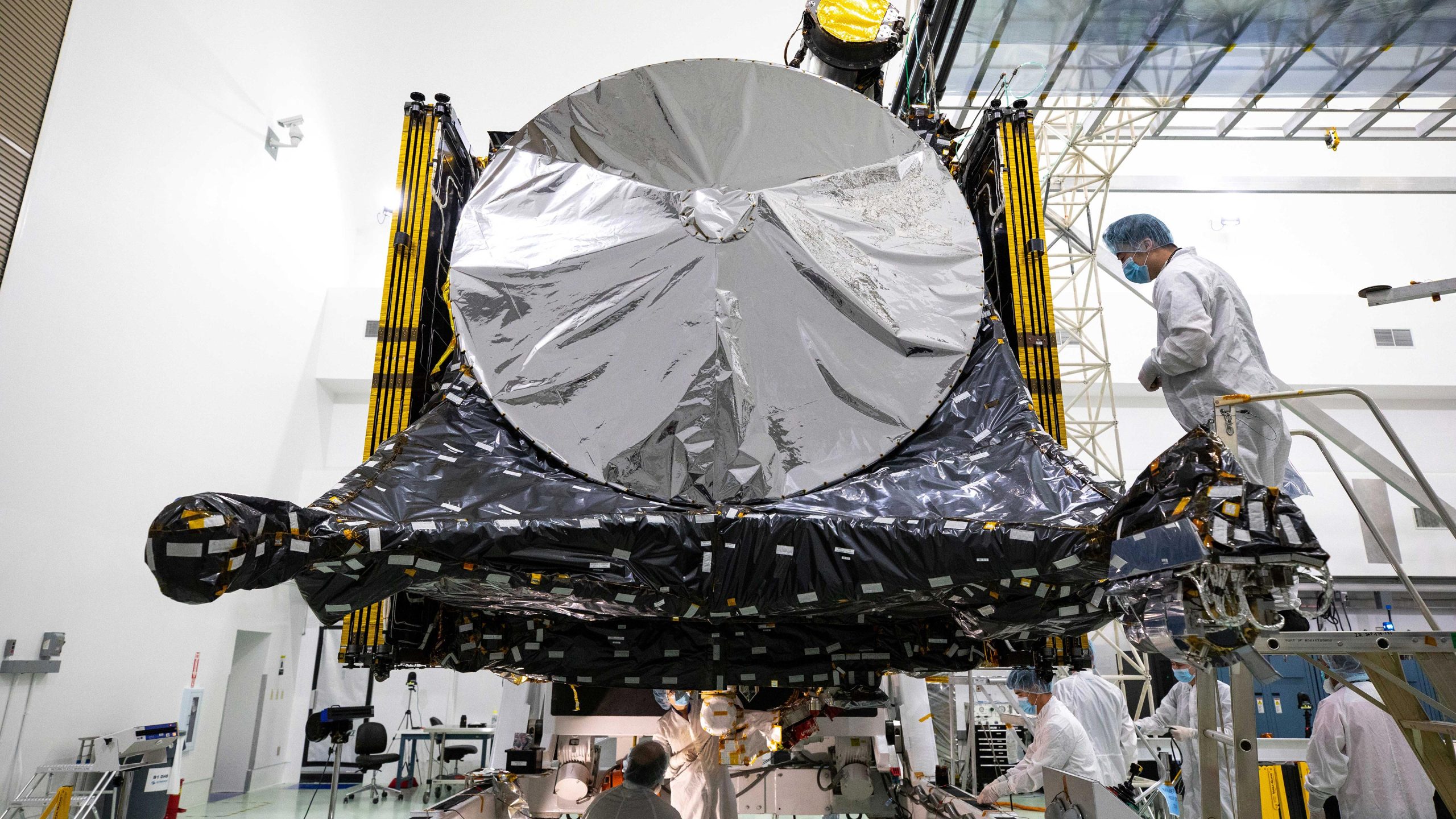
    Psyche Mission Team Members Prepare the Spacecraft
    Psyche mission team members prepare the spacecraft at a facility near NASA’s Kennedy Space Center in Florida in late July, just after the solar arrays were folded and stowed. Credit: NASA/Kim Shiflett

    Upcoming Launch Details

    Within two weeks, technicians will begin encapsulating the spacecraft in its payload fairing – the cone at the top of the rocket – and the spacecraft will move to SpaceX facilities at NASA’s Kennedy Space Center in Florida. Psyche is set to launch atop a SpaceX Falcon Heavy from the center’s Launch Complex 39A at 10:38 a.m. EDT on October 5.

    “It’s getting increasingly real,” said Henry Stone, Psyche’s project manager at NASA’s Jet Propulsion Laboratory (JPL) in Southern California. “We are counting the days. The team is more than ready to send this spacecraft off on its journey, and it’s very exciting.”
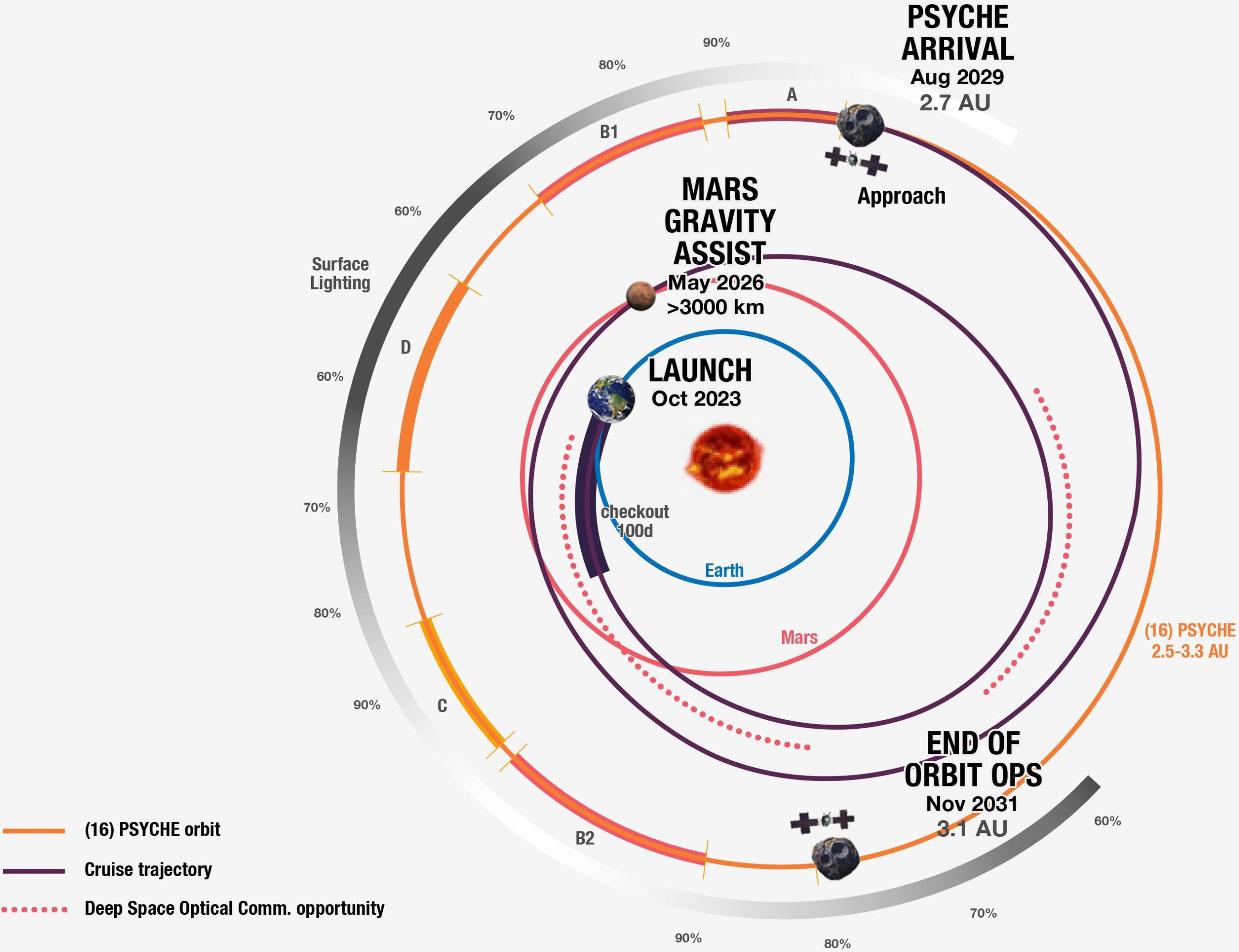
    NASA Psyche Spacecraft's Spiral Path to the Asteroid Psyche
    NASA’s Psyche spacecraft will take a spiral path to the asteroid Psyche, as depicted in this graphic, which is labeled with key milestones of the prime mission. The test periods for NASA’s Deep Space Optical Communications (DSOC) technology demonstration are indicated with red dots. Credit: NASA/JPL-Caltech

    Journey to the Asteroid

    After escaping Earth’s gravity, Psyche will use solar electric propulsion to accomplish its six-year journey to the asteroid. The efficient propulsion system works by accelerating and expelling charged atoms, or ions, of the neutral gas xenon – creating a thrust that gently propels the spacecraft with a force akin to what you’d feel holding a single AA battery in your hand. Technicians recently loaded 2,392 pounds (1,085 kilograms) of xenon onto the spacecraft over the course of about two weeks.

    Measuring roughly 173 miles (279 kilometers) at its widest point, the asteroid Psyche presents a unique opportunity to explore a metal-rich body that may be part of a core of a planetesimal, the building block of an early planet. Once the spacecraft reaches Psyche in the main asteroid belt between Mars and Jupiter, it will spend about 26 months orbiting the asteroid, gathering images and other data that will tell scientists more about its history and what it is made of.

    More About the Mission

    Arizona State University leads the Psyche mission. A division of the California Institute of Technology (Caltech) in Pasadena, JPL is responsible for the mission’s overall management, system engineering, integration and test, and mission operations. Maxar Technologies in Palo Alto, California, provided the high-power solar electric propulsion spacecraft chassis.

    A technology demonstration called Deep Space Optical Communications (DSOC) will fly on Psyche. Its purpose is to test high-data-rate laser communications that could be used by future NASA missions. JPL manages DSOC for the Technology Demonstration Missions program within NASA’s Space Technology Mission Directorate and the Space Communications and Navigation program within the Space Operations Mission Directorate.

    Psyche is the 14th mission selected as part of NASA’s Discovery Program, managed by the agency’s Marshall Space Flight Center in Huntsville, Alabama. NASA’s Launch Services Program, based at Kennedy, is managing the launch service.

    Never miss a breakthrough: Join the SciTechDaily newsletter.
    Follow us on Google and Google News.

    JPL NASA NASA Psyche
    Share. Facebook Twitter Pinterest LinkedIn Email Reddit

    Related Articles

    NASA’s Psyche Gets Huge Solar Arrays for 1.5-Billion-Mile Journey to Metal-Rich Asteroid

    How NASA’s Psyche Mission Will Explore an Unknown World We Can Barely Pinpoint From Earth

    NASA’s Psyche Spacecraft To Explore Unique Asteroid for Clues to Early Solar System

    Futuristic Solar Electric Thrusters Makes NASA’s Psyche Spacecraft Go

    NASA’s Psyche Asteroid Mission Moves Closer To Launch – “It’s Incredible To Be at This Point”

    NASA’s Metal Mission: Final Assembly of Psyche Spacecraft Begins – Destined to Explore a Metal-Rich Asteroid

    NASA’s Psyche Mission to Explore a Metal-Rich Asteroid Passes Key Milestone

    Ring of Firepower: Electric Hall Thruster for NASA’s Psyche Spacecraft Propulsion

    Design Complete for NASA’s Psyche – Spacecraft to Explore a Metal-Rich Asteroid

    Leave A Reply Cancel Reply

    • Facebook
    • Twitter
    • Pinterest
    • YouTube

    Don't Miss a Discovery

    Subscribe for the Latest in Science & Tech!

    Trending News

    Scientists Uncover Potential Brain Risks of Popular Fish Oil Supplements

    Scientists Discover a Surprising Way To Make Bread Healthier and More Nutritious

    After 60 Years, Scientists Uncover Unexpected Brain Effects of Popular Diabetes Drug Metformin

    New Research Uncovers Hidden Side Effects of Popular Weight-Loss Drugs

    Scientists Rethink Extreme Warming After Surprising Ocean Discovery

    Landmark Study Links Never Marrying to Significantly Higher Cancer Risk

    Researchers Discover Unknown Beetle Species Just Steps From Their Lab

    Largest-Ever Study Finds Medicinal Cannabis Ineffective for Anxiety, Depression, PTSD

    Follow SciTechDaily
    • Facebook
    • Twitter
    • YouTube
    • Pinterest
    • Newsletter
    • RSS
    SciTech News
    • Biology News
    • Chemistry News
    • Earth News
    • Health News
    • Physics News
    • Science News
    • Space News
    • Technology News
    Recent Posts
    • Researchers Uncover Source of Strange Deformation in Earth’s Largest Continental Rift
    • Scientists Solve Mystery of Where the Colorado River Vanished Millions of Years Ago
    • Not Just Alzheimer’s: Scientists Uncover Clues to a Second, Overlooked Disorder
    • Scientists Uncover Dangerous Connection Between Serotonin and Heart Valve Disease
    • Scientists Discover a “Protector” Protein That Could Help Reverse Hair Loss
    Copyright © 1998 - 2026 SciTechDaily. All Rights Reserved.
    • Science News
    • About
    • Contact
    • Editorial Board
    • Privacy Policy
    • Terms of Use

    Type above and press Enter to search. Press Esc to cancel.