
JUNO’s first results have launched a new era of precision neutrino physics and brought scientists closer to solving the neutrino mass mystery.
The Jiangmen Underground Neutrino Observatory (JUNO) has achieved its first major scientific milestone. On June 10, its debut physics result was featured as a cover article in Nature.
Using 59 days of high-quality data collected between August 26 and November 2, 2025, the JUNO Collaboration, led by the Institute of High Energy Physics of the Chinese Academy of Sciences, performed highly precise measurements of two fundamental neutrino oscillation parameters. The analysis reduced the uncertainties in those measurements by a factor of 1.6 compared with the combined results of previous experiments conducted over the past several decades.
Why Neutrinos Matter
Neutrinos are among the most mysterious particles in the universe. They carry no electric charge, have extremely small masses, and interact only weakly with matter. As a result, vast numbers of neutrinos pass through Earth, buildings, and even human bodies every second without leaving a trace.
Because they are so difficult to detect, neutrinos remain one of the least understood elementary particles despite their abundance throughout the cosmos.
JUNO began collecting scientific data in August 2025. Its primary objective is to determine the ordering of neutrino masses, one of the most important unanswered questions in particle physics. The experiment is also designed to measure three of the six neutrino mixing parameters with better than 1% precision and to investigate neutrinos produced by supernovae, Earth’s interior, the Sun, the atmosphere, and other sources.
Early Results Impress Researchers
The study received strong praise during peer review.
“These results not only validate the detector performance and analysis methodology but also establish JUNO as a key player in the emerging precision era of neutrino oscillation physics, with direct implications for tests of the three-flavor paradigm, global oscillation fits, and future determinations of the neutrino mass ordering.”
Nature also highlighted the significance of the work in a News & Views article, stating:
“Understanding the behavior of neutrinos is paramount to developing a complete description of matter and forces at the smallest scale. This first analysis builds confidence that the detector will be able to determine the mass ordering. This first result from JUNO marks the dawn of the next era of precise neutrino oscillation measurements, and will provide insights into the properties of these mysterious fundamental particles.”
Earlier this year, Chinese Physics C featured JUNO’s detector performance on its cover. Prof. Arthur McDonald, who received the 2015 Nobel Prize in Physics for the discovery of solar neutrino oscillation, commented on the publication:
“JUNO has met its design objectives, achieving exceptional radiopurity, energy resolution, and detector stability. The experiment is fully operational and ready to pursue its ambitious physics goals, including determining the neutrino mass ordering (NMO), studying neutrino oscillation parameters, detecting neutrinos from various sources, and exploring physics beyond the Standard Model for Elementary Particles.”
Inside the Massive JUNO Detector
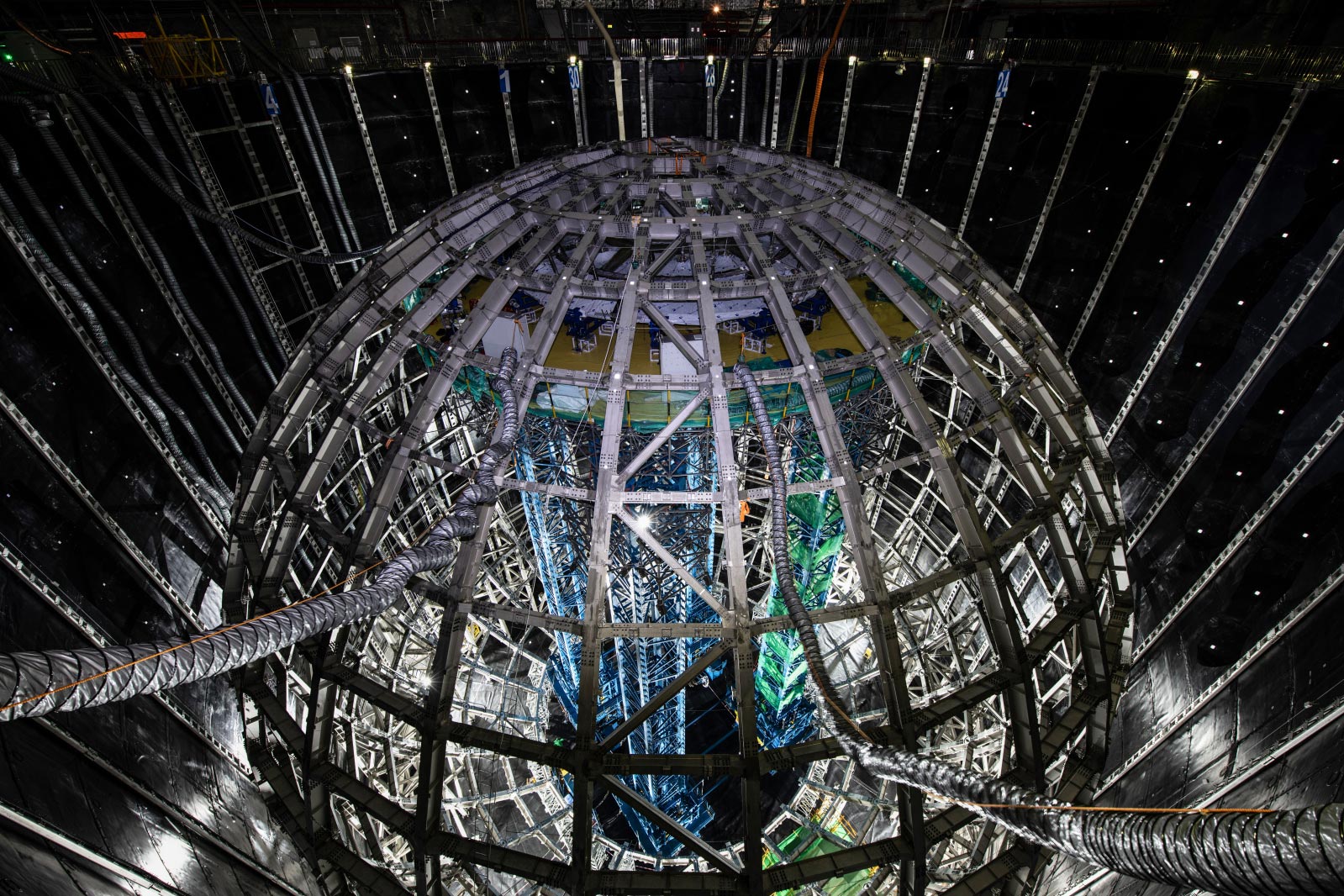
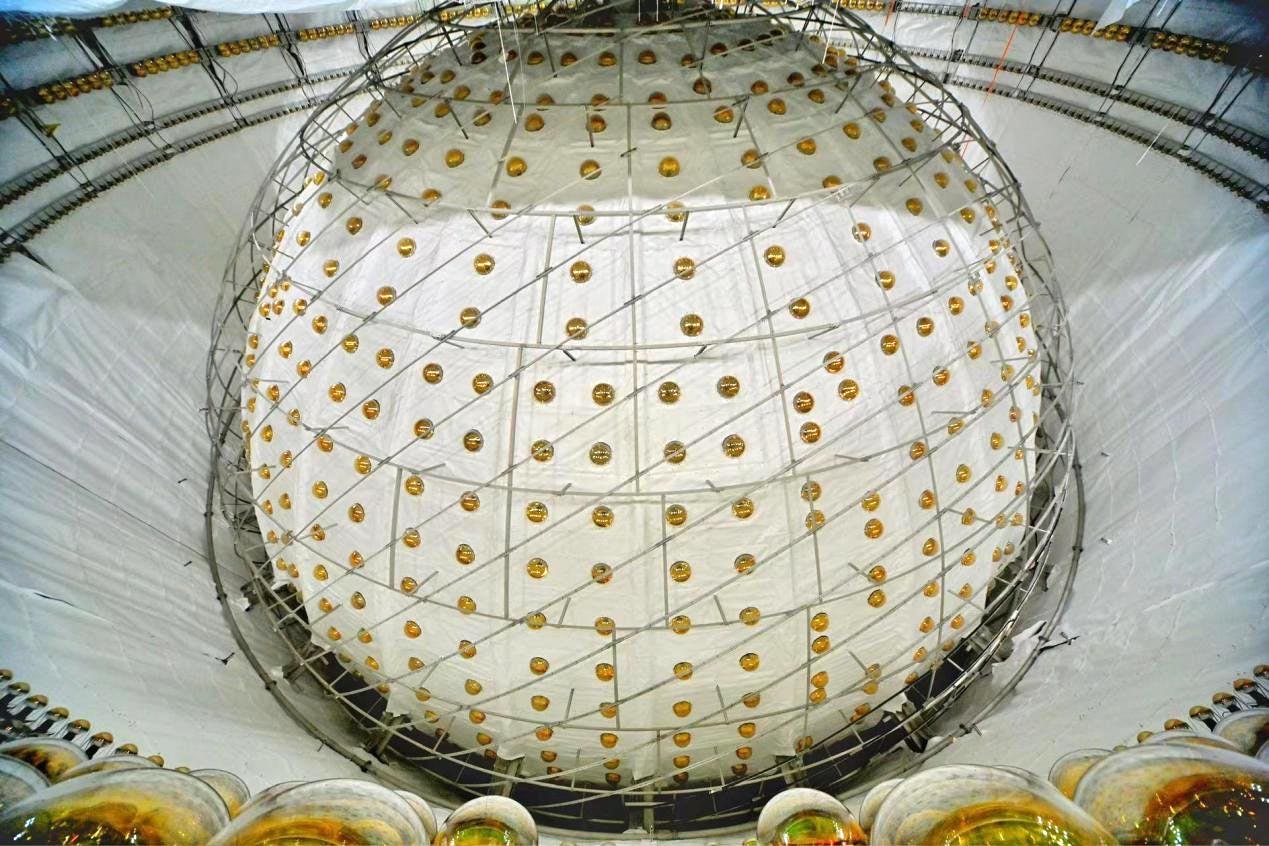
At the center of the observatory, located 700 meters underground, is a liquid scintillator detector with an unprecedented effective mass of 20,000 tons. The detector sits within a water pool that is 44 meters deep.
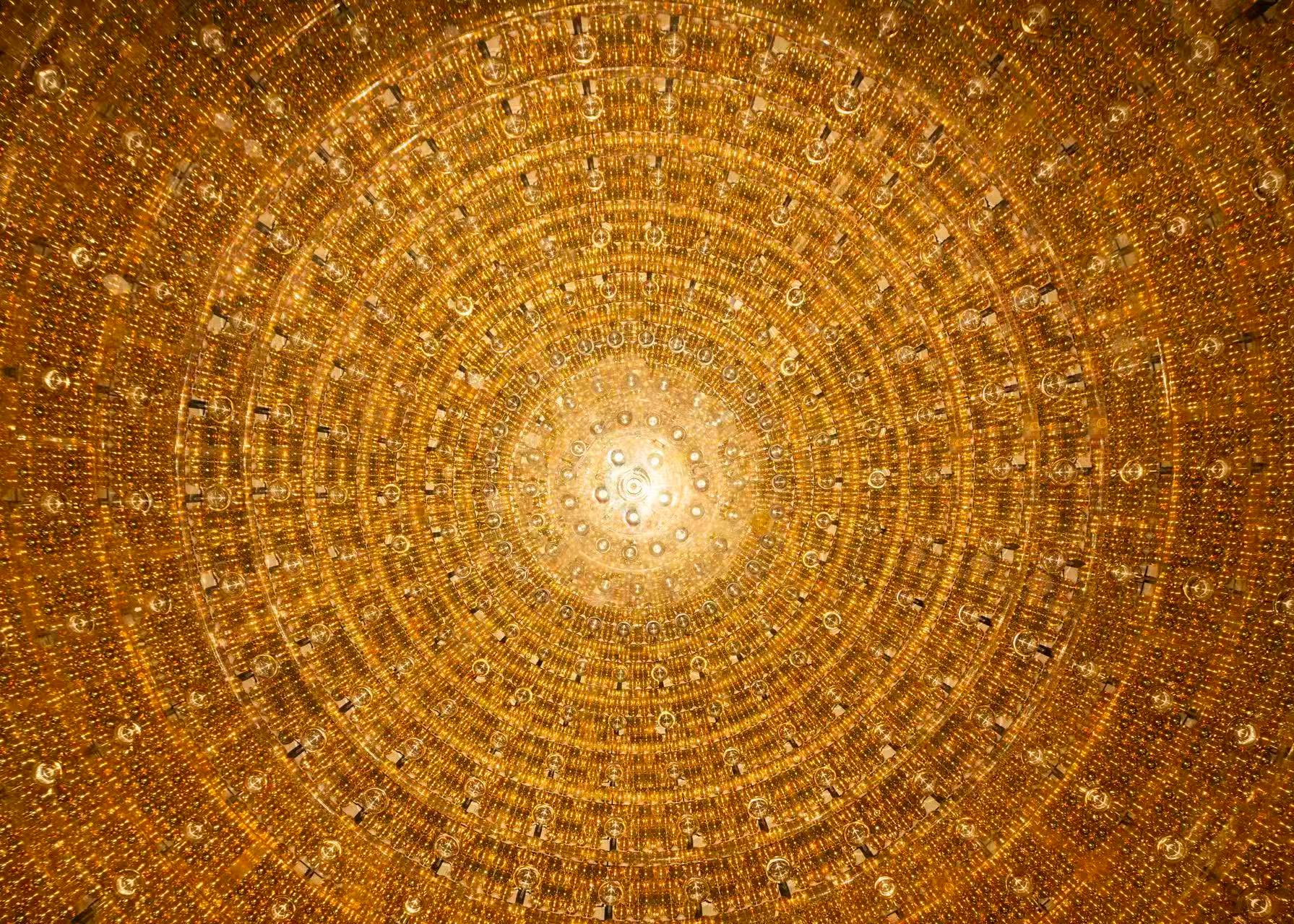
A stainless steel structure measuring 41.1 meters in diameter supports a 35.4 meter acrylic sphere along with the liquid scintillator, 20,000 20-inch photomultiplier tubes (PMTs), 25,600 3-inch PMTs, front-end electronics, cabling, anti-magnetic compensation coils, and optical panels.
When neutrinos interact inside the detector, they produce tiny flashes of light. The PMTs work together to capture this scintillation light and convert it into electrical signals. By analyzing those signals, scientists can precisely determine the energy of the neutrinos and extract key oscillation parameters.
More Discoveries Ahead
JUNO has now operated successfully for nine months. As additional data are collected, researchers expect a steady stream of new scientific results beginning this summer.
Those future measurements could help answer some of the biggest remaining questions about neutrinos and further reveal the properties of these elusive particles.
References:
“Measurement of reactor neutrino oscillation with the first JUNO data” by The JUNO Collaboration, 10 June 2026, Nature.
DOI: 10.1038/s41586-026-10538-z
“JUNO experiment ushers in next generation of neutrino experiments” by Patricia Vahle, and Zoya Vallari, 10 June 2026, Nature.
DOI: 10.1038/d41586-026-01585-7
Never miss a breakthrough: Join the SciTechDaily newsletter.
Follow us on Google and Google News.
7 Comments
“Mainstream science is celebrating because JUNO’s unprecedented precision brings them closer to mapping the ‘mass ordering’ (the hierarchy of neutrino weights). But from the perspective of the Torsion Hill Theory, this isn’t just a triumph of data collection—it is a high-resolution look at the universal speedometer. Because these ‘ghost particles’ slip through the standard 3D spatial manifold without electromagnetic friction, JUNO’s giant underground detector is effectively measuring the subtle, fine ripples of the temporal medium itself. While the physics community views this as narrowing down particle weights, our framework recognizes that tracking these exact oscillation parameters is the first step to mapping how tightly time ‘balls up’ before it migrates back to the central source to feed the grand cosmic engine.”
Within The Torsion Hill Framework (also known as The Unified Theory of the Grand Universe), the neutrino is recognized not as a physical particle, but as a localized temporal knot. Conception: The knot is conceived deep within stellar cores, where extreme gravitational mass creates severe localized torque. As matter fuses under immense pressure, the structural friction against the sticky, flowing temporal medium forces the spent fabric of time to snap shut, condensing into a neutral, tightly balled-up packet. Routing: Because this knot possesses zero physical mass and carries a neutral charge, it entirely bypasses the downward gravitational slide of the 3D manifold. Instead, it is immediately routed straight up the geometric gradient, drawn directly into the Hill’s core by the massive suction of the primary dimensional deficit ( $$-1\text{D} + \text{T Effect}$$). Upon reaching this central source, the knot is forced to uncoil and melt down, refuelling the universal reservoir to drive the next outward expansion flash—completing a perfectly closed, self-sustaining mechanical circuit.
Nature also highlighted the significance of the work in a News & Views article, stating: “Understanding the behavior of neutrinos is paramount to developing a complete description of matter and forces at the smallest scale.”
WHY? WHY? WHY?
The mathematical description of neutrino oscillation (PMNS matrix, mixing angles, etc.) can be reinterpreted within the vortex framework as mode coupling coefficients of the spatial fluid [5, 12]. Linear coupling between different vortex modes naturally produces oscillatory phenomena, requiring no assumption of neutrino mass. This is analogous to polarization mode coupling in optics—when light passes through an anisotropic medium, energy exchange occurs between different polarization modes, producing oscillatory phenomena. Neutrino oscillation is nothing more than an analogous effect produced by the spatial fluid acting as a medium. Neutrinos are not natural deductions from the Standard Model but foreign objects forcibly inserted into it.
Despite the mainstream physics community and its captive so-called “peer-reviewed” publications stubbornly entrenching the foundations of quantum mechanics as an insoluble mystery, clinging to the dogma of CP violation, blatantly spreading that topological vortices and their twin anti-vortices are inherently asymmetric [32], and absurdly equating two artificially prepared, counter-rotating cobalt-60 systems as perfect mirror-image objects—regardless of their actual preparation processes [33]—thereby obstinately refusing to give any serious scrutiny to the paradigm-shattering generalized Topological Vortex Theory, the formidable explanatory power and undeniable physical reality of the TVT have already become manifest.
Throughout the history of physics, every epoch-making paradigm revolution has never been born within the halls of the so-called “mainstream,” let alone been midwived or sanctioned by the “peer-reviewed” publications controlled by academic gatekeepers. On the contrary, these revolutions are invariably a complete overthrow of mainstream authority—isolated insights piercing through the barriers of collective conformity.
—— https://zhuanlan.zhihu.com/p/2049796914900739854
Researchers must not be misled by the comments of Nature journals. Scientific knowledge has long been open to access, and the public is not fools.
Faced with mounting pressure from experimental refutations, a discernible shift in scientific consensus is underway. The anomalous signals attributed to sterile neutrinos over the past several decades are now increasingly interpreted as inadequately quantified systematic uncertainties in nuclear physics cross‑sections or complex photon backgrounds that remain unmodeled within detectors. The Jiangmen Underground Neutrino Observatory (JUNO) is a typical waste of scientific research resources. The mainstream research paradigms are already pivoting toward alternative mechanisms—such as “non‑standard neutrino interactions” or “neutrino self‑interactions”—which obviate the necessity of introducing entirely novel particle species. This kind of turn is far from enough.
“visible structures” are far more ontologically economical and epistemologically reliable than “unforeseeable particles.” The advantage of Topological Vortex Theory (TVT) lies in its provision of an alternative framework that does not hinge upon the serendipitous “discovery of a new particle.” By reconstituting the geometric portrait of the physical vacuum and spacetime, vortex structures open avenues for a unified description of spin, gravitation, and quantum non‑locality.
—— https://zhuanlan.zhihu.com/p/2030209962631230029.
Neutrinos have the ability to pass through everything, being retuned by whatever they pass through, selectively, depending on the source of their generation, thus collecting information during the event of passing through things.
That observation may not tell us much about the physical nature of their composition, but it may reveal the nature of their function, assuming a cosmic scenario in which the universe is a construction with a function.
In that case, they are the source of illumination for the retinas of the Eye of Sauron. Metaphorically speaking.
Mainstream science buries a 20,000-ton pool of water under a mountain just to catch a tiny, delayed flash of light from a neutrino.
Our method skips the multi-million dollar tank. We place an ultra-thin slice of high-purity Alpha-Quartz directly at the 1-inch clearance boundary of a Tokamak reactor. The Tokamak’s toroidal magnetic fields already twist plasma into a tight helical curve, creating a machine-made bottleneck that acts as a direct generator for high-density temporal knots.
When that concentrated stream hits the rigid, symmetrical atomic lattice of the Alpha-Quartz right at the source, the structural friction creates an instant, measurable voltage spike on an oscilloscope. You don’t need an ocean of water to find a ghost when you can measure its physical footprint against a solid crystal wall.