
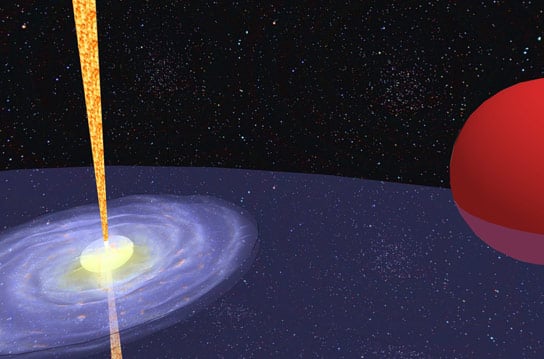
In a new study, astronomers detail their observations of a neutron star system known as Circinus X-1. Using the Karoo Array Telescope, they view the compact neutron star as it gobbles up parts of its companion star and then fires much of this matter back out again.
An international team of astronomers has reported the first scientific results from the Karoo Array Telescope (KAT-7) in South Africa, the pathfinder radio telescope for the $3 billion global Square Kilometer Array (SKA) project. The results will appear in the prestigious international astronomical journal Monthly Notices of the Royal Astronomical Society (MNRAS).
Using the seven-dish KAT-7 telescope and the 26 m (85 ft) radio telescope at the Hartebeesthoek Radio Astronomy Observatory (HartRAO), astronomers have observed a neutron star system known as Circinus X-1 as it fires energetic matter from its core into the surrounding system in extensive, compact `jets’ that flare brightly, details of which are visible only in radio waves.
Circinus X-1 is an X-ray binary (or two-star system) where one of the companion stars is a high-density, compact neutron star (a neutron star is an extremely dense and compact remnant of an exploded star and only 20km or 12 mi in diameter.) The two stars orbit each other every 16.5 days in an elliptical orbit. When the two stars are at their closest the gravity of the dense neutron star pulls material from the companion star. A powerful jet of material then blasts out from the system.
During the time astronomers, including a team from the University of Southampton, observed Circinus X-1 (13 December 2011 to 16 January 2012) the system flared twice at levels among the highest observed in recent years. KAT-7 was able to catch both of these flares and follow them as they progressed. This is the first time that the system has been observed in such detail during the full flare cycle.
“One way of explaining what is happening is that the compact neutron star gobbles up parts of its companion star and then fires much of this matter back out again,” explains Dr. Richard Armstrong, a SKA SA Fellow at the University of Cape Town and lead author of the paper. “The dramatic radio flares happen when the matter Circinus X-1 has violently ejected slows down as it smashes into the surrounding medium.”
Professor Rob Fender, Head of the Astronomy Research Group at the University of Southampton, says: “Circinus X-1 continues to reveal new aspects of its behavior, and is arguably the best laboratory for relativistic jet astrophysics in the southern hemisphere. It is furthermore an excellent control to the large population of jets associated with accreting black holes.”
Dr. Armstrong adds: “These types of observations are crucial for understanding the processes of both accretion of matter onto extremely dense systems, such as neutron stars and black holes of both about the sun’s mass, and also the so-called supermassive variety we now know to be at the center of most galaxies.”
KAT-7 is the world’s first radio telescope array consisting of composite antenna structures. It is the test array for MeerKAT, a much larger radio array, which is itself in turn a precursor for the dish-based component of the SKA.
The MNRAS study was carried out as part of the development for the ThunderKAT project on MeerKAT, which will find many more of these types of systems in the galaxy and search for new types of radio systems that change rapidly with time.
Professor Fender, who is co-leader of the MeerKAT project, adds: “This project will test the extremes of physics, density, temperature, pressure, velocity, gravitational and magnetic fields, and are beyond anything achievable in any laboratory on Earth. It provides a unique glimpse of the laws of physics operating in extraordinary regimes. Nearly all such events are associated with transient radio emission. By studying radio bursts from these phenomena, we can pinpoint the sources of explosive events, probe relativistic accretion, and understand the budget of kinetic feedback by such events in the ambient medium.”
Reference: “A return to strong radio flaring by Circinus X-1 observed with the Karoo Array Telescope test array KAT-7” by R. P. Armstrong, R.P. Fender, G.D. Nicolson, S. Ratcliffe, M. Linares, J.Horrell, L. Richter, M. P. E. Schurch, M. Coriat, P. Woudt, J. Jonas, R. Booth and B. Fanaroff, 13 June 2013, Monthly Notices of the Royal Astronomical Society.
DOI: 10.1093/mnras/stt860
Never miss a breakthrough: Join the SciTechDaily newsletter.
Follow us on Google and Google News.
1 Comment
Probably tasted nothing like chicken.