
This new four minute ScienceCast video details the upcoming NASA LADEE mission to explore lunar twilight rays and other mysteries of the lunar atmosphere.
https://www.youtube.com/watch?v=2z_oi36O8tw
A new ScienceCast video explores the mysteries of the lunar atmosphere.
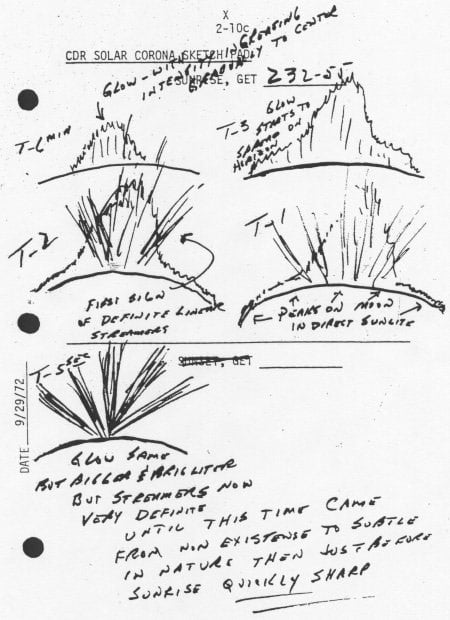
Back in the ’60s and ’70s, Apollo astronauts circling the Moon saw something that still puzzles researchers today. About 10 seconds before lunar sunrise or lunar sunset, pale luminous streamers would pop up over the gray horizon. These “twilight rays” were witnessed by crewmembers of Apollo 8, 10, 15 and 17.
Back on Earth, we see twilight rays all the time as shafts of sunlight penetrate evening clouds and haze. The “airless Moon” shouldn’t have such rays, yet the men of Apollo clearly saw them.
Later this week a NASA spacecraft is going back to the Moon to investigate. Slated for launch on Sept 6, 2013, the Lunar Atmosphere and Dust Environment Explorer (“LADEE” for short) will seek out twilight rays and other mysteries of the lunar atmosphere.
Yes, the Moon does have an atmosphere,” says Richard Elphic, the project scientist for LADEE at NASA Ames. “It’s just much more tenuous than ours.”
The Moon’s atmosphere is so flimsy—about ten thousand billion times less dense than Earth’s—that a good sneeze would rip through it like a hurricane. “Lunar air” is a gossamer mix of argon-40, which seeps out of the ground due to radioactive decay in the lunar interior, plus elements such as helium, sodium, and potassium, sputtered off the lunar surface by solar wind and micrometeoroids.
None of these gases appear in sufficient quantities, however, to explain the twilight rays.
“We’re missing something,” says Elphic.
The missing piece might be dust. When sunlight falls on the Moon, solar UV radiation electrifies the unprotected topsoil, possibly causing lightweight grains of moondust to rise off the ground, joining the gases already there.
“This electrically charged dust may be what the astronauts saw,” says Elphic. LADEE’s Lunar Dust Experiment will collect and analyze dust in the Moon’s atmosphere to test this hypothesis.
Researchers have a special name for atmospheres as fantastically thin as the Moon’s: an exosphere. On Earth, molecules in the thick air are constantly bumping into each other, spreading pressure and heat in all directions. In an exosphere, however, molecules are so far apart they rarely collide.
“Instead of bumping into each other,” says Elphic, “they bump into the lunar surface.”
Air molecules coming into contact with moondust are expected to stick, briefly, before moving on again. Hop and stick, hop and stick. At any given moment millions of molecules could be hopping like bunnies across every square inch of lunar terrain. Ultraviolet, visible light, and mass spectrometers on board LADEE will inventory the molecules present and determine how they behave.
“The dusty, flimsy mix of atoms and molecules in the lunar atmosphere is sure to have alien properties that our experience on Earth has not prepared us to anticipate,” says Elphic.
To find out, LADEE will be working on a deadline. On April 15th of next year, the sunset-colored shadow of Earth will envelop the Moon for a lunar eclipse. It will be a grand sight from Earth, but bad news for LADEE. The spacecraft is solar-powered and requires sunlight to charge its batteries. An eclipse could end the mission.
“The current plan,” says Elphic, “is, before the eclipse, to guide the spacecraft into the surface of the moon for a final impact that we can study. We’ll be taking data until the very end.”
Never miss a breakthrough: Join the SciTechDaily newsletter.
Follow us on Google and Google News.