
The Large Hadron Collider is once again delivering proton collisions to experiments, this time at an unprecedented energy of 13.6 TeV, marking the start of the accelerator’s third run of data taking for physics.
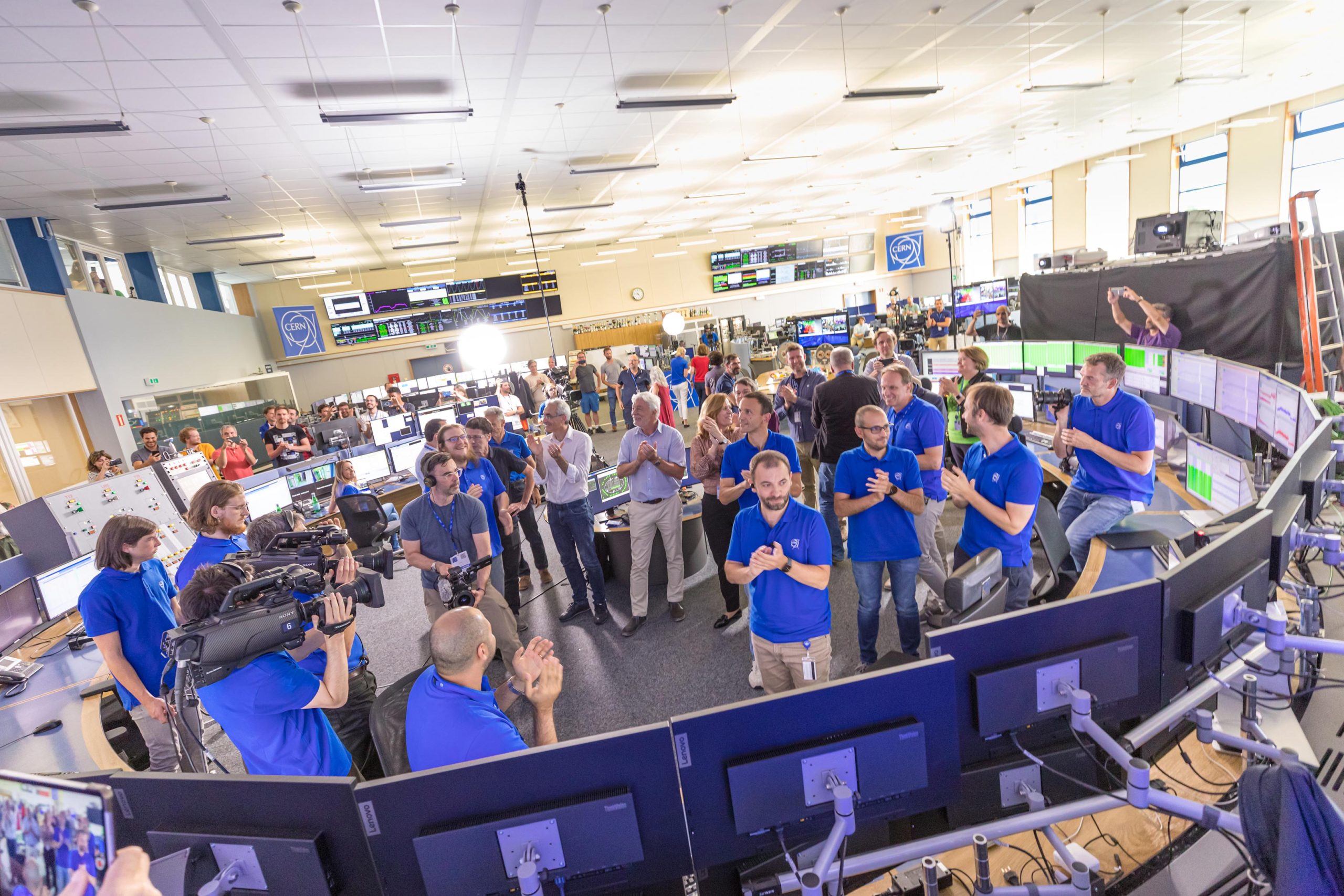
A burst of applause erupted in the CERN Control Center on July 5, 2022, at 4.47 p.m. CEST when the Large Hadron Collider (LHC) detectors switched on all subsystems and started recording high-energy collisions at the unprecedented energy of 13.6 TeV, ushering in a new physics season. This accomplishment was made possible thanks to the operators who had worked around the clock since the restart of the LHC in April to ensure the smooth beginning of these collisions with higher-intensity beams and boosted energy.
Following over three years of upgrade and maintenance work, the LHC is now set to run for close to four years at the record energy of 13.6 trillion electronvolts (TeV), providing increased precision and discovery potential. Many factors point to a promising physics season that will further expand the already very diverse LHC physics program: increased collision rates, higher collision energy, upgraded data readout and selection systems, improved detector systems and computing infrastructure.
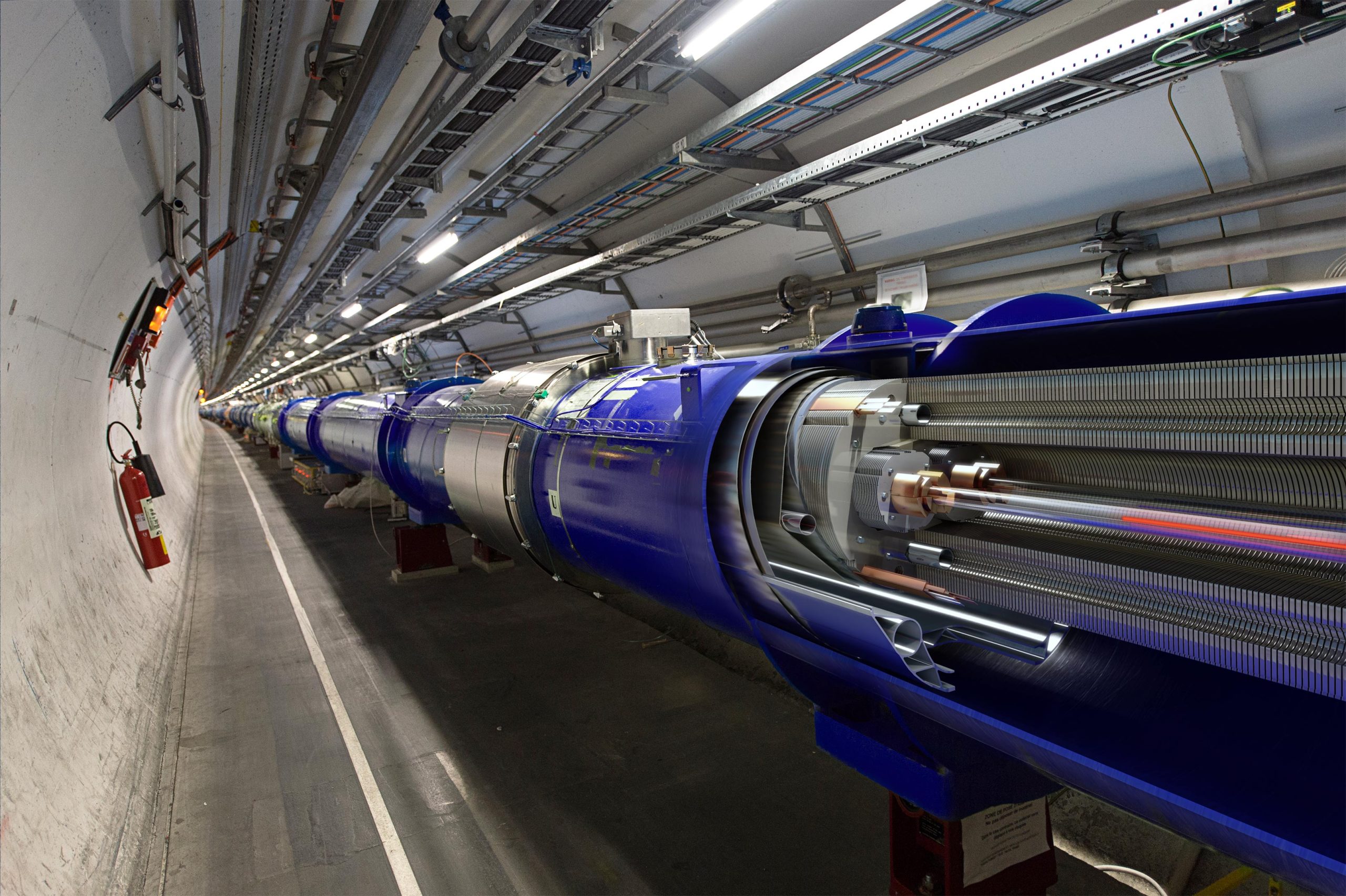
A new period of data taking began on Tuesday, July 5 for the experiments at the Large Hadron Collider (LHC), the world’s most powerful particle accelerator, after more than three years of upgrade and maintenance work. Beams have already been circulating in CERN’s accelerator complex since April, with the LHC machine and its injectors being recommissioned to operate with new higher-intensity beams and increased energy. However, now the LHC operators have announced “stable beams,” the condition allowing the experiments to switch on all their subsystems and begin taking the data that will be used for physics analysis. The LHC will run around the clock for close to four years at a record energy of 13.6 trillion electronvolts (TeV), providing greater precision and discovery potential than ever before.
“We will be focusing the proton beams at the interaction points to less than 10 micron beam size, to increase the collision rate. Compared to Run 1, in which the Higgs was discovered with 12 inverse femtobarns, now in Run 3 we will be delivering 280 inverse femtobarns. This is a significant increase, paving the way for new discoveries,” says Director for Accelerators and Technology Mike Lamont.
The four big LHC experiments have performed major upgrades to their data readout and selection systems, with new detector systems and computing infrastructure. The changes will allow them to collect significantly larger data samples, with data of higher quality than in previous runs. The ATLAS and CMS detectors expect to record more collisions during Run 3 than in the two previous runs combined. The LHCb experiment underwent a complete revamp and looks to increase its data-taking rate by a factor of ten, while ALICE is aiming at a staggering fifty-fold increase in the number of recorded collisions.
With the increased data samples and higher collision energy, Run 3 will further expand the already very diverse LHC physics program. Scientists at the experiments will probe the nature of the Higgs boson with unprecedented precision and in new channels. They may observe previously inaccessible processes, and will be able to improve the measurement precision of numerous known processes addressing fundamental questions, such as the origin of the matter-antimatter asymmetry in the universe. Scientists will study the properties of matter under extreme temperature and density, and will also be searching for candidates for dark matter and for other new phenomena, either through direct searches or – indirectly – through precise measurements of properties of known particles.
“We’re looking forward to measurements of the Higgs boson decay to second-generation particles such as muons. This would be an entirely new result in the Higgs boson saga, confirming for the first time that second-generation particles also get mass through the Higgs mechanism,” says CERN theorist Michelangelo Mangano.
“We will measure the strengths of the Higgs boson interactions with matter and force particles to unprecedented precision, and we will further our searches for Higgs boson decays to dark matter particles as well as searches for additional Higgs bosons,” says Andreas Hoecker, spokesperson of the ATLAS collaboration. “It is not at all clear whether the Higgs mechanism realized in nature is the minimal one featuring only a single Higgs particle.”
A closely watched topic will be the studies of a class of rare processes in which an unexpected difference (lepton flavor asymmetry) between electrons and their cousin particles, muons, was studied by the LHCb experiment in the data from previous LHC runs. “Data acquired during Run 3 with our brand new detector will allow us to improve the precision by a factor of two and to confirm or exclude possible deviations from lepton flavor universality,” says Chris Parkes, spokesperson of the LHCb collaboration. Theories explaining the anomalies observed by LHCb typically also predict new effects in different processes. These will be the target of specific studies performed by ATLAS and CMS. “This complementary approach is essential; if we’re able to confirm new effects in this way it will be a major discovery in particle physics,” says Luca Malgeri, spokesperson of the CMS collaboration.
The heavy-ion collision program will allow the investigation of quark-gluon plasma (QGP) – a state of matter that existed in the first 10 microseconds after the Big Bang – with unprecedented accuracy. “We expect to be moving from a phase where we observed many interesting properties of the quark-gluon plasma to a phase in which we precisely quantify those properties and connect them to the dynamics of its constituents,” says Luciano Musa, spokesperson of the ALICE collaboration. In addition to the main lead–led runs, a short period with oxygen collisions will be included for the first time, with the goal of exploring the emergence of QGP-like effects in small colliding systems.
The smallest experiments at the LHC – TOTEM, LHCf, MoEDAL, with its entirely new subdetector MAPP, and the recently installed FASER and SND@LHC – are also poised to explore phenomena within and beyond the Standard Model, from magnetic monopoles to neutrinos and cosmic rays.
Never miss a breakthrough: Join the SciTechDaily newsletter.
Follow us on Google and Google News.
10 Comments
TeV means teraelectron volt, or 10^12 electronvolts (eV), not Trillion Electronvolts as the article stated.
Semantics. Tera stands for trillion.
yeah I like to say I have a phone with 250 billion bytes of memory instead of saying 250 GB. Get rid of Tera and just make it mean Tril. lmao
I am excited to see what they find. Also the James Webb will be interesting to see what it sees. I love this new science stuff on the other hand I wish more money would be spent on stuff like trying to figure out what to do to get rid of plastic waste, produce fusion power, solve the water crisis and completely eliminate green house gas. Boy there sure is lots of work to do.
they will find whatever they want to find to justify spending billions and huge about of the time of so many. Amd for what. It is so far away, it can’t possibly make any difference in any way to life on earth, except for scientist to perceive they are doing something anything will do. Dark matter if just their mantra. say it often enough and it changes from nothing oa fact. And then they can give that fact whatever characteristics they want. But they have a long way to create enough volume of written word of one “finding after another” before the shere volume becomes proof, it all means something.
If private company’s want to spend their owners money on such things that would have no relevance even it they were true they are so far away sp be ot . But it time for government to stop going into endless debt. And this is the first place to cut way back. THAT IS What is very IMPORTANT. As we are soon to find out we must do, obviously.
Let me guess. You believe the universe is only 6000 years old…
COMPLETEY CORRECT ROWLAN STEVENS!!! (and !). Time for government to stop spending! You know, like they
stopped spending on public education when you attended grammar school (and where obviously taught by a blind construction worker).
If man’s reach does not exceed his grasp, then what’s a Heaven for ?
Particle colliders have already done everything they can do. They have created quark plasma which is the ultimate goal. This is the plasma black holes are made of. The microsecond this plasma makes trillion degree heat is due to the quarks manipulating the dark matter that causes gravity. This dark matter instantaneously gives the density back to the quarks and turns them back into different particles. When enough of this plasma is created, it becomes a self-sufficient energy that uses dark matter as its catalyst. Scientists do not understand what they have found because they expect a cloud of gas and dust to become a star using gravity. This assumption makes the scientists ignore what could be giving the mass of the plasma back.
It is only a theory that is keeping particle colliders useless to society.
Come on, it’s an accomplishment, for crying out loud. Look at the happy faces on those control room attendees. Hey world, look, we managed to fend off being unemployed for another 10 years. Let’s celebrate. Barkeep, another round of grants for all my friends here, on the house!