

Close Menu
    Facebook X (Twitter) Instagram
    SciTechDaily
    • Biology
    • Chemistry
    • Earth
    • Health
    • Physics
    • Science
    • Space
    • Technology
    Facebook X (Twitter) Pinterest YouTube RSS
    SciTechDaily
    Home»Science»Lasers Reveal a Hidden World Just Above the Waves
    Science

    Lasers Reveal a Hidden World Just Above the Waves

    By Helmholtz-Zentrum HereonAugust 10, 2025No Comments3 Mins Read
    Facebook Twitter Pinterest Telegram LinkedIn WhatsApp Email Reddit
    Share
    Facebook Twitter LinkedIn Pinterest Telegram Email Reddit
    Rolling Wave Bright Sky
    New high-resolution laser images show how wind and waves trade energy in two distinct patterns. This breakthrough could sharpen climate and weather predictions. Credit: Shutterstock


    A laser-equipped ocean platform has uncovered two rival wind–wave energy exchanges, each shaping the sea’s surface in surprising ways.

    The discovery offers a clearer window into how the atmosphere and ocean share heat, gases, and momentum.

    Laser Mapping Exposes Hidden Air–Sea Dance

    A research collaboration led by Dr. Marc Buckley of the Hereon Institute of Coastal Ocean Dynamics has developed a powerful new way to visualize the interaction between air and sea. Working aboard the FLIP (Floating Instrument Platform) in the Pacific Ocean, the team used a custom-built laser measurement system to record highly detailed images of airflow occurring just millimeters to one meter above the water’s surface. This approach allowed them to identify two distinct wind–wave coupling processes that occur at the same time but behave in very different ways.

    Short waves, roughly one meter long, travel more slowly than the wind above them. As the wind strikes these crests, it separates, creating a pressure difference that transfers energy directly into the wave. In contrast, long waves, which can stretch up to 100 meters, actually move faster than the wind. Their motion produces its own unique airflow patterns. Both of these mechanisms take place simultaneously in different parts of the wave field, an insight that could significantly improve the accuracy of atmospheric and ocean circulation models.

    FLIP (FLoating Instrument Platform) Pacific Ocean
    The researchers carried out their measurements with the laser on the FLIP platform in the Pacific Ocean. Credit: Hereon/Marc Buckley

    Airflow Insights Supercharge Climate Models

    The exchange of energy, heat, and greenhouse gases between the ocean and atmosphere is a central driver of global climate and weather systems. Although scientists have long recognized the importance of these interactions, the fine-scale physical mechanisms behind them have remained largely unexplored. The research team aims to enhance their system so that it can also track movement beneath the water’s surface with greater precision.

    “Until now, no one has measured the airflow this close to the ocean surface, let alone mapped the mechanisms of energy exchange at such a fine scale,” says lead author Buckley. “Our observations shed light on a physical frontier. This will enable us to advance the theoretical framework and develop more accurate descriptions of air-sea exchange processes, which have so far been only partially understood.”
    FLIP Platform Laser
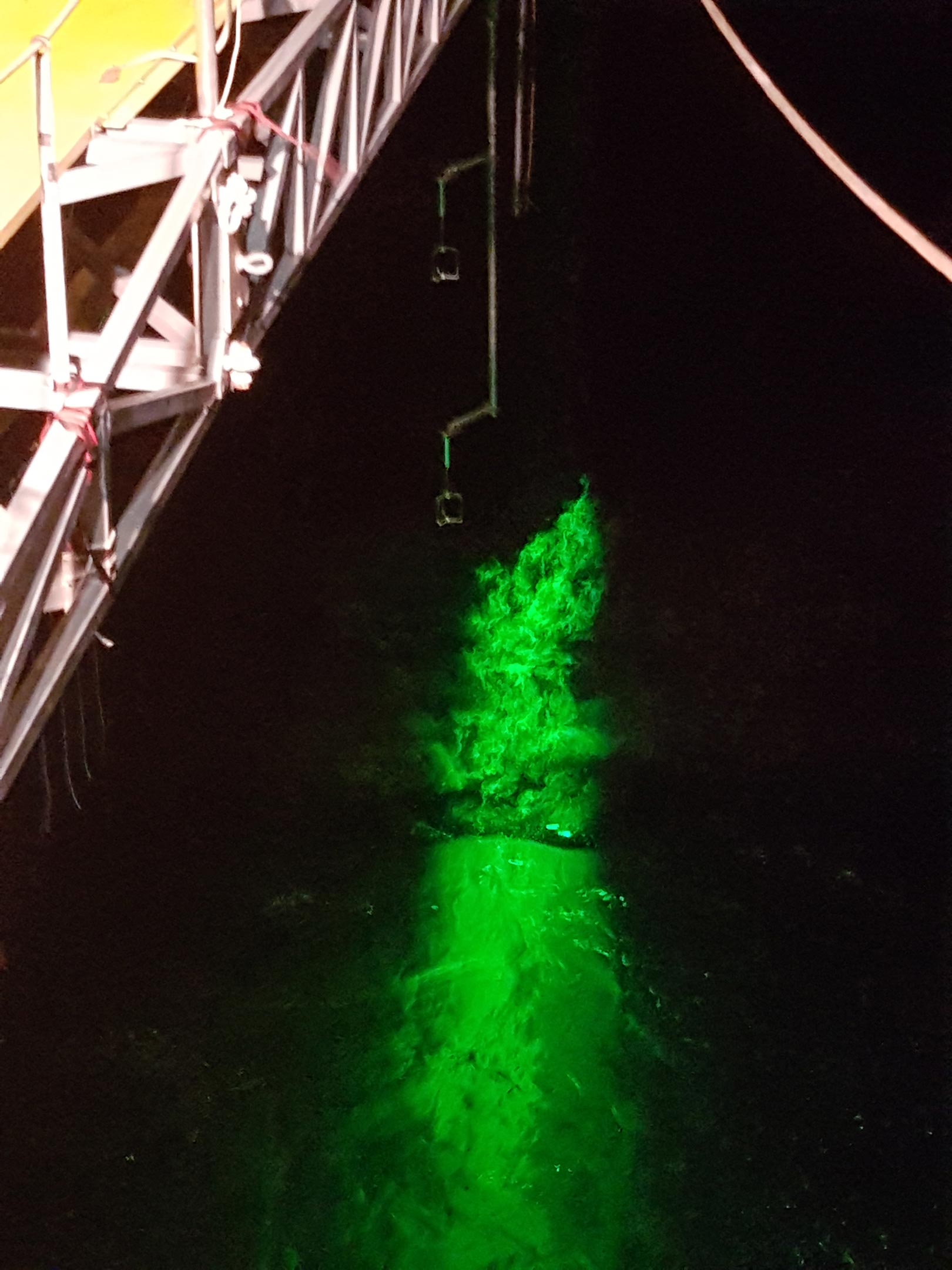
    The researchers worked with a green laser that cuts through air and water, making currents visible. Credit: Hereon/Marc Buckley

    PIV Laser Captures Ocean Surface in 3D

    The imagery is based on a laser that passes through both air and water: the green beam hits water droplets introduced into the air — similar to mist illuminated by sunlight. These droplets follow the motion of the airflow, scatter the laser light, and make even the smallest movements in the air visible. At the same time, the laser penetrates the water surface. At the wind-driven surface, the light is refracted — revealing the structure of the water surface.

    This combination allows both the air and water sides to be visualized. The method is based on Particle Image Velocimetry (PIV), an established technique in fluid dynamics. PIV provides precise information about flow structure and wind speeds. This marks the first time the technique has been used over the open ocean.

    Reference: “Direct observations of airflow separation over ocean surface waves” by Marc P. Buckley, Jochen Horstmann, Ivan Savelyev and Jeff R. Carpenter, 1 July 2025, Nature Communications.
    DOI: 10.1038/s41467-025-61133-1

    Never miss a breakthrough: Join the SciTechDaily newsletter.
    Follow us on Google and Google News.

    Atmospheric Science Oceanography Weather Wind
    Share. Facebook Twitter Pinterest LinkedIn Email Reddit

    Related Articles

    Ocean Warming Predicted to Amplify Tropical Rainfall Extremes

    World Record Smashed? Supercell Thunderstorm Pelted City With ‘Gargantuan’ Hail

    Weathering Antarctic Storms and the Importance of Weather Balloon Data

    MIT Study Shows Tiny Plankton Have a Big Effect on the Ocean’s Carbon Storage

    The Unintended Consequences of Geoengineering a Cooler Atmosphere

    How Rain Droplets Attract Aerosols Out of the Atmosphere

    Impact of Ocean Acidification on Phytoplankton Communities

    New ScienceCast Video Examines the Evidence That an El Niño is Developing

    Friction on Raindrops Dissipates Almost as Much Atmospheric Energy as Turbulence

    Leave A Reply Cancel Reply

    • Facebook
    • Twitter
    • Pinterest
    • YouTube

    Don't Miss a Discovery

    Subscribe for the Latest in Science & Tech!

    Trending News

    Mezcal “Worm” in a Bottle Mystery: DNA Testing Reveals a Surprise

    New Research Reveals That Your Morning Coffee Activates an Ancient Longevity Switch

    This Is What Makes You Irresistible to Mosquitoes

    Shockingly Powerful Giant Octopuses Ruled the Seas 100 Million Years Ago

    Scientists Stunned by New Organic Molecules Found on Mars

    Rewriting Dinosaur Evolution: Scientists Unearth Remarkable 150-Million-Year-Old Stegosaur Skull

    Omega-3 Supplements Linked to Cognitive Decline in Surprising New Study

    First-of-Its-Kind Discovery: Homer’s Iliad Found Embedded in a 1,600-Year-Old Egyptian Mummy

    Follow SciTechDaily
    • Facebook
    • Twitter
    • YouTube
    • Pinterest
    • Newsletter
    • RSS
    SciTech News
    • Biology News
    • Chemistry News
    • Earth News
    • Health News
    • Physics News
    • Science News
    • Space News
    • Technology News
    Recent Posts
    • New Research Challenges Long-Held Beliefs About How the Brain Makes Decisions
    • Breakthrough Technology Reveals New Treatment Targets for Cancer
    • Scientists Discover New Way To Make Drug-Resistant Cancer Treatable Again
    • This Simple Exercise Trick Builds Muscle With Less Effort, Study Finds
    • Middle Age Is Becoming a Breaking Point in America, Study Reveals
    Copyright © 1998 - 2026 SciTechDaily. All Rights Reserved.
    • Science News
    • About
    • Contact
    • Editorial Board
    • Privacy Policy
    • Terms of Use

    Type above and press Enter to search. Press Esc to cancel.