
Close Menu
    Facebook X (Twitter) Instagram
    SciTechDaily
    • Biology
    • Chemistry
    • Earth
    • Health
    • Physics
    • Science
    • Space
    • Technology
    Facebook X (Twitter) Pinterest YouTube RSS
    SciTechDaily
    Home»Physics»Lasing Mechanism Discovered in Water Droplets
    Physics

    Lasing Mechanism Discovered in Water Droplets

    By SPIEFebruary 7, 2021No Comments4 Mins Read
    Facebook Twitter Pinterest Telegram LinkedIn WhatsApp Email Reddit
    Share
    Facebook Twitter LinkedIn Pinterest Telegram Email Reddit
    Water Droplet Contact Angle Lasing Emissions
    Water droplet contact angle dramatically increases lasing emissions, from Qiao et al., doi 10.1117/1.AP.3.1.016003. Credit: Qiao et al.

    Lasing mechanism at the surface of water droplets can be used to record mechanical changes at biointerfaces.

    Tiny molecular forces at the surface of water droplets can play a big role in laser output emissions. As the most fundamental matrix of life, water drives numerous essential biological activities, through interactions with biomolecules and organisms. Studying the mechanical effects of water-involved interactions contributes to the understanding of biochemical processes.

    According to Yu-Cheng Chen, professor of electronic engineering at Nanyang Technological University (NTU), “As water interacts with a surface, the hydrophobicity at the bio-interface mainly determines the mechanical equilibrium of the water. Molecular hydrophobicity at the interface can serve as the basis for monitoring subtle biomolecular interactions and dynamics.”

    Water droplets have been used to form biological microlasers that exploit water’s intrinsic ability to confine light with minimal scattering. Droplet lasers benefit from laser oscillation in a microcavity, so any subtle changes induced by the gain medium or cavity can be amplified, leading to dramatic changes of laser emission characteristics. While droplet lasers have become cutting-edge platforms in biochemical/physical studies and biomedical applications, the optical interaction between droplet resonators and an interface has remained unknown.

    Molecular Forces Shape Droplet Resonator Geometry

    As reported in Advanced Photonics, Chen’s NTU team recently discovered that when a water droplet interacts with a surface to form a contact angle, the interfacial molecular forces determine the geometry of a droplet resonator. Dramatic mechanical changes at the interface play a significant role in the optical oscillation of droplet resonators.
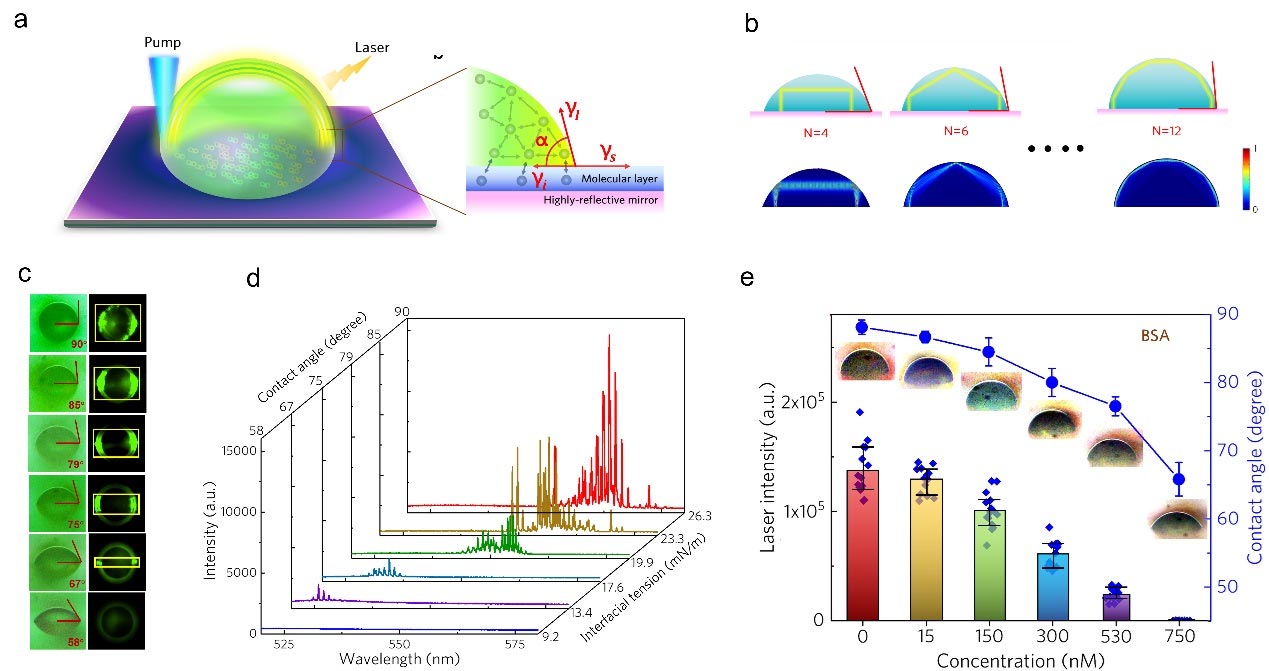
    Droplet Laser Schematic
    (a) Schematic of a droplet laser hosting arc-like (AL) modes. A molecular layer is deposited between the mirror and the droplet. The droplet-solid interfacial tension, the solid surface tension, and the droplet surface tension commonly determine the contact angle. (b) AL oscillation paths (top) and simulated electric field distributions of AL modes (below) under different contact angles. (c) Left: side-view profiles of droplets with varying contact angles. Right: optical images of the droplets after pumping. Yellow boxes, the laser emission regions. (d) Optical spectra of droplet resonators with different interfacial tensions. (e) Contact angles and spectrally integrated laser outputs as a function of different biomolecular concentration of bovine serum albumin (BSA) in droplets. Credit: Qiao et al.

    Chen’s group discovered an oscillation mechanism of droplet resonators, in which the laser resonates along the droplet-air interface in the vertical plane. Chen notes that this vertically oriented “rainbow-like” or “arc-like” lasing mode reflects back and forth between the two ends of the droplet interface, forming a unique and extremely strong laser emission. Chen’s team noticed that, unlike the commonly seen whispering-gallery mode (WGM), this newly discovered lasing mechanism is much more sensitive to interfacial molecular forces. According to Chen, “The lasing emissions of this arc-like mode increase dramatically with the increment of interfacial hydrophobicity, as well as droplet contact angle.”

    Contact Angle Enhances Laser Emission Sensitivity

    Seeking to explain this modulating phenomenon, Chen’s team also found that the quality- factor of new lasing modes increased significantly with an increasing droplet contact angle. And the number of oscillation paths of lasing modes in droplets increased dramatically. “Together, these two factors determine the enhancement of lasing emissions with the strength of interfacial molecular forces,” says Chen.

    Based on their discovery, Chen’s team explored the possibility of employing droplet lasers to record mechanical changes at biointerfaces. As anticipated, they found that a tiny change of interfacial biomolecular forces, induced by a very low concentration of biomolecules, such as peptides or proteins, can be recorded by the lasing emissions of droplet lasers.

    According to Chen, “This work demonstrates an important modulating mechanism in droplet resonators and shows the potential for exploiting optical resonators to amplify the changes of intermolecular forces.” Lasing mechanism insights open new prospects for using microlasers to study biomechanical interactions and interface physics. As droplet lasers may provide a new platform for studying the intermolecular physical interactions at the interface, they could be particularly useful for examining hydrophobic interactions, which play a vital role in numerous physical dynamics and biological systems.

    Reference: “Lasing action in microdroplets modulated by interfacial molecular forces” by Zhen Qiao, Xuerui Gong, Peng Guan, Zhiyi Yuan, Shilun Feng, Yiyu Zhang, Munho Kim, Guo-En Chang and Yu-Cheng Chen, 27 January 2021, Advanced Photonics.
    DOI: 10.1117/1.AP.3.1.016003

    Never miss a breakthrough: Join the SciTechDaily newsletter.
    Follow us on Google and Google News.

    Biophysics Electrical Engineering Molecular Physics Optics SPIE
    Share. Facebook Twitter Pinterest LinkedIn Email Reddit

    Related Articles

    Newly Discovered Memory Effect Alters Doppler Wave Signature

    Quantum Enhanced Atomic Force Microscopy: Squeezed Light Reduces Noise

    Ultra-Fast Magnetic Switching Could Transform Fiber Optic Communications & Expand the Capacity of the Internet

    Solid-State Laser Refrigeration of Nanoscale Sensors Achieved – Could Revolutionize Bio-Imaging and Quantum Communication

    A New Kind of Light in the Universe? “Super-Planckian” Material Emits Light That Exceeds Limits of Natural Law

    Light Flows Around Corners Unhindered and Without Reflecting in Special Material

    Record-Breaking Terahertz Laser Beam Turns Air Into Glowing Plasma

    Nano Antennas for Data Transfer – Could Allow Processor Cores to Exchange Data at Speed of Light

    Revolutionary Optical Tweezers Manipulate Atoms, Molecules and Living Cells Like “Tractor Beams”

    Leave A Reply Cancel Reply

    • Facebook
    • Twitter
    • Pinterest
    • YouTube

    Don't Miss a Discovery

    Subscribe for the Latest in Science & Tech!

    Trending News

    Monster Storms on Jupiter Unleash Lightning Beyond Anything on Earth

    Scientists Create “Liquid Gears” That Spin Without Touching

    The Simple Habit That Could Help Prevent Cancer

    Millions Take These IBS Drugs, But a New Study Finds Serious Risks

    Scientists Unlock Hidden Secrets of 2,300-Year-Old Mummies Using Cutting-Edge CT Scanner

    Bread Might Be Making You Gain Weight Even Without Eating More Calories

    Scientists Discover Massive Magma Reservoir Beneath Tuscany

    Europe’s Most Active Volcano Just Got Stranger – Here’s Why Scientists Are Rethinking It

    Follow SciTechDaily
    • Facebook
    • Twitter
    • YouTube
    • Pinterest
    • Newsletter
    • RSS
    SciTech News
    • Biology News
    • Chemistry News
    • Earth News
    • Health News
    • Physics News
    • Science News
    • Space News
    • Technology News
    Recent Posts
    • These Tiny Robots 50x Smaller Than a Hair Can Hunt and Move Bacteria
    • Simple Blood Test May Predict Alzheimer’s Years Before Brain Scans Show Signs
    • Scientists Say Adding This Unusual Seafood to Your Diet Could Reverse Signs of Aging
    • U.S. Waste Holds $5.7 Billion Worth of Crop Nutrients
    • Scientists Say a Hidden Structure May Exist Inside Earth’s Core
    Copyright © 1998 - 2026 SciTechDaily. All Rights Reserved.
    • Science News
    • About
    • Contact
    • Editorial Board
    • Privacy Policy
    • Terms of Use

    Type above and press Enter to search. Press Esc to cancel.