

Close Menu
    Facebook X (Twitter) Instagram
    SciTechDaily
    • Biology
    • Chemistry
    • Earth
    • Health
    • Physics
    • Science
    • Space
    • Technology
    Facebook X (Twitter) Pinterest YouTube RSS
    SciTechDaily
    Home»Science»Leaks and Contaminated Sediments Keep Radiation Near Fukushima High
    Science

    Leaks and Contaminated Sediments Keep Radiation Near Fukushima High

    By SciTechDailyNovember 15, 2012No Comments3 Mins Read
    Facebook Twitter Pinterest Telegram LinkedIn WhatsApp Email Reddit
    Share
    Facebook Twitter LinkedIn Pinterest Telegram Email Reddit
    bluefin-tuna-japan
    Radioactivity persists in the ocean waters near Japan’s Fukushima Daiichi nuclear power plant, with levels remaining stable rather than declining as expected.

    Researchers presented their findings at the Fukushima Symposium conference on the 12th and 13th of November at the University of Tokyo on the radioactivity that is persisting in the ocean waters close to Japan’s failed nuclear power plant at Fukushima Daiichi.

    The findings show that levels of radioactivity in the sea around the plant remain stable, rather than falling as expected. The run-off from rivers, as well as continuing leaks from the plant may be to blame and contaminated sediment and marine organisms could also be involved.
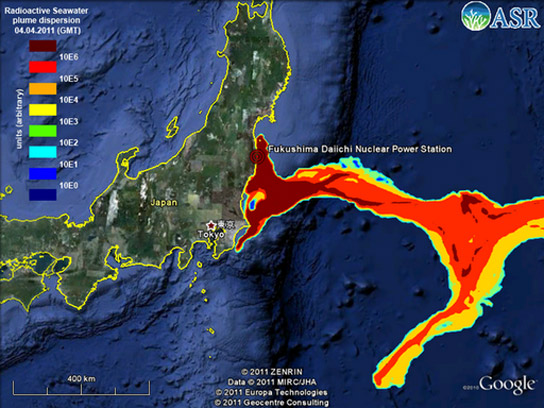
    radiation-plume-dispersal
    Excessive radiation found in sea organisms near Japan’s nuclear plant. Image by ASR

    The level of contamination isn’t going to pose a significant health risk to people, but could have long-term economic consequences for the fishermen along Japan’s east coast.

    Three of the nuclear plant’s six reactors suffered meltdown on March 11, 2011, when a 9.0-magnitude earthquake struck off the coast of Japan. Large quantities of radioactivity were released into the atmosphere and emergency cooling water leaked into the sea.

    A new model from the Woods Hole Oceanographic Institution in Massachusetts estimates that 16.2 petabecquerels (1015 becquerels) of radioactive cesium leaked from the plant, about the same amount that went into the atmosphere.

    Most of the radioactivity was dispersed across the Pacific Ocean, where it was diluted to extremely low levels. However, in regions near the plant, levels of cesium-137 have remained fixed at about 1,000 becquerels, which is relatively high compared to the natural background radiation.

    Researchers are convinced that there is something preventing the radiation levels from dropping significantly. There may be some source of radiation that they haven’t yet discovered.

    A new analysis suggests that it might come from three different sources. First, the radioactivity from the land is being washed into the rivers by rainfall, which in turn, is carried to the sea. Second, the plant is still leaking radioactivity at around 0.3 terabecquerels a month. Third, the marine sediment is the main cause of the contamination. Around 95 terabecquerels of radioactive cesium has found its way to the sandy floor near the plant.

    The contamination is finding itself in the food chain. Bottom-dwelling fish in the Fukushima area show radioactivity above the limit of 100 becquerels per kg set by the Japanese government. Greenlings have been found with levels as high as 25,000 per kg. However, the contamination varies widely between species. Octopi and squid have escaped contamination, whereas fish like red snappers and sea bass are only sometimes contaminated. The levels of cesium in fish and marine life begun to drop slightly this autumn, states Tomowo Watanabe, an oceanographer with the Fisheries Research Agency in Yokohama.

    The fishing industry lost ¥100 billion to ¥200 billion ($1.3 billion to $2.6 billion) in 2011 because of the accident and many fisheries remain closed because of persistent contamination.

    Never miss a breakthrough: Join the SciTechDaily newsletter.
    Follow us on Google and Google News.

    Contamination Ecosystems Fukushima Japan Nuclear Oceanography Radiation
    Share. Facebook Twitter Pinterest LinkedIn Email Reddit

    Related Articles

    What Is the Bigscale Pomfret? Scientists Unravel Secrets of an Oceanic Enigma

    NOAA Determines Radiation Risk of Underwater Aircraft Carrier

    Fukushima Disaster Caused Butterflies to Mutate

    Likelihood of Nuclear Accident 200 Times Greater than Previously Thought

    Study Confirms Low Levels of Fallout from Fukushima in the US

    Baleen Whales Disturbed by Underwater Noises From 120 Miles Away

    DARPA Researchers Treat Previously Lethal Doses of Radiation Successfully

    First Hybrid Sharks Discovered Near Australia

    Seismologists Record Whale Songs While Listening for Underwater Earthquakes

    Leave A Reply Cancel Reply

    • Facebook
    • Twitter
    • Pinterest
    • YouTube

    Don't Miss a Discovery

    Subscribe for the Latest in Science & Tech!

    Trending News

    Scientists Discover Bizarre 100-Million-Year-Old Insect With Giant Claws

    Scientists Discover “Good” Gut Microbes That Could Protect Against Autism and ADHD

    Scientists Reveal That Eating Almonds Every Day Could Transform Your Gut, Metabolism, and Appetite

    Scientists May Have Solved Two of Fusion Energy’s Biggest Problems at Once

    Scientists Discover Hidden “Switch” That Burns Fat and Could Treat Bone Disease

    After 50 Years of Mystery, Researchers Identify New Human Blood Group

    Beyond Pain Relief: Scientists Discover a Protein That Could Stop Osteoarthritis in Its Tracks

    Scientists Discover Why Alcohol Prevents the Liver From Healing, Even After You Quit

    Follow SciTechDaily
    • Facebook
    • Twitter
    • YouTube
    • Pinterest
    • Newsletter
    • RSS
    SciTech News
    • Biology News
    • Chemistry News
    • Earth News
    • Health News
    • Physics News
    • Science News
    • Space News
    • Technology News
    Recent Posts
    • NASA’s Roman Space Telescope Nears Launch for Epic Hunt Across the Universe
    • Ancient Mega-Floods Once Ripped Across Mars and Left This Giant Scar
    • Scientists Just Used Sunlight To Pull Off a Quantum Physics Feat Once Thought Impossible
    • Scientists Discover “Immature” Brain Cells That May Defy Alzheimer’s
    • Children of Centenarians Share One Surprising Habit That May Boost Longevity
    Copyright © 1998 - 2026 SciTechDaily. All Rights Reserved.
    • Science News
    • About
    • Contact
    • Editorial Board
    • Privacy Policy
    • Terms of Use

    Type above and press Enter to search. Press Esc to cancel.