
Steering and monitoring the light-driven motion of electrons inside matter on the time-scale of a single optical cycle is a key challenge in ultrafast light wave electronics and laser-based material processing.
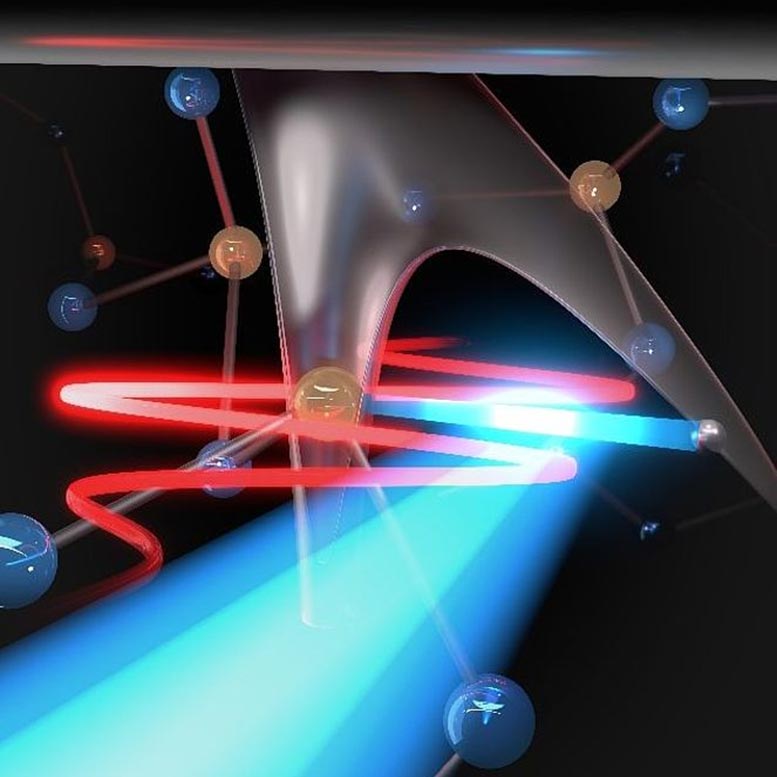
Physicists from the Max Born Institute in Berlin and the University of Rostock have now revealed a so-far overlooked nonlinear optical mechanism that emerges from the light-induced tunneling of electrons inside dielectrics. For intensities near the material damage threshold, the nonlinear current arising during tunneling becomes the dominant source of bright bursts of light, which are low-order harmonics of the incident radiation.
These findings, which have just been published in Nature Physics, significantly expand both the fundamental understanding of optical non-linearity in dielectric materials and its potential for applications in information processing and light-based material processing.
Our current understanding of non-linear optics at moderate light intensities is based on the so-called Kerr non-linearity, which describes the non-linear displacement of tightly bound electrons under the influence of an incident optical light field. This picture changes dramatically when the intensity of this light field is sufficiently high to eject bound electrons from their ground state. At long wavelengths of the incident light field, this scenario is associated with the phenomenon of tunneling, a quantum process where an electron performs a classically forbidden transit through a barrier formed by the combined action of the light force and the atomic potential.
Already since the 1990s and pioneered by studies from the Canadian scientist François Brunel, the motion of electrons that have emerged at the “end of the tunnel,” which happens with maximal probability at the crest of the light wave, has been considered as an important source for optical non-linearity. This picture has now changed fundamentally.
“In the new experiment on glass, we could show that the current associated with the quantum mechanical tunneling process itself creates an optical non-linearity that surpasses the traditional Brunel mechanism,” explains Dr. Alexandre Mermillod-Blondin from the Max Born Institute for Nonlinear Optics and Short Pulse Spectroscopy, who supervised the experiment.
In the experiment, two ultrashort light pulses with different wavelengths and slightly different propagation directions were focused onto a thin slab of glass, and a time- and frequency-resolved analysis of the emerging light emission was performed.
Identification of the mechanism responsible for this emission was made possible by a theoretical analysis of the measurements that was performed by the group of Prof. Thomas Fennel, who works at the University of Rostock and at the Max Born Institute in the framework of a DFG Heisenberg Professorship. “The analysis of the measured signals in terms of a quantity that we termed the effective non-linearity was key to distinguish the new ionization current mechanism from other possible mechanisms and to demonstrate its dominance”, explains Fennel.
Future studies using this knowledge and the novel metrology method that was developed in the course of this work may enable researchers to temporally resolve and steer strong-field ionization and avalanching in dielectric materials with unprecedented resolution, ultimately possibly on the time-scale of a single cycle of light.
Reference: “Origin of strong-field-induced low-order harmonic generation in amorphous quartz” by P. Jürgens, B. Liewehr, B. Kruse, C. Peltz, D. Engel, A. Husakou, T. Witting, M. Ivanov, M. J. J. Vrakking, T. Fennel and A. Mermillod-Blondin, 29 June 2020, Nature Physics.
DOI: 10.1038/s41567-020-0943-4
Never miss a breakthrough: Join the SciTechDaily newsletter.
Follow us on Google and Google News.