
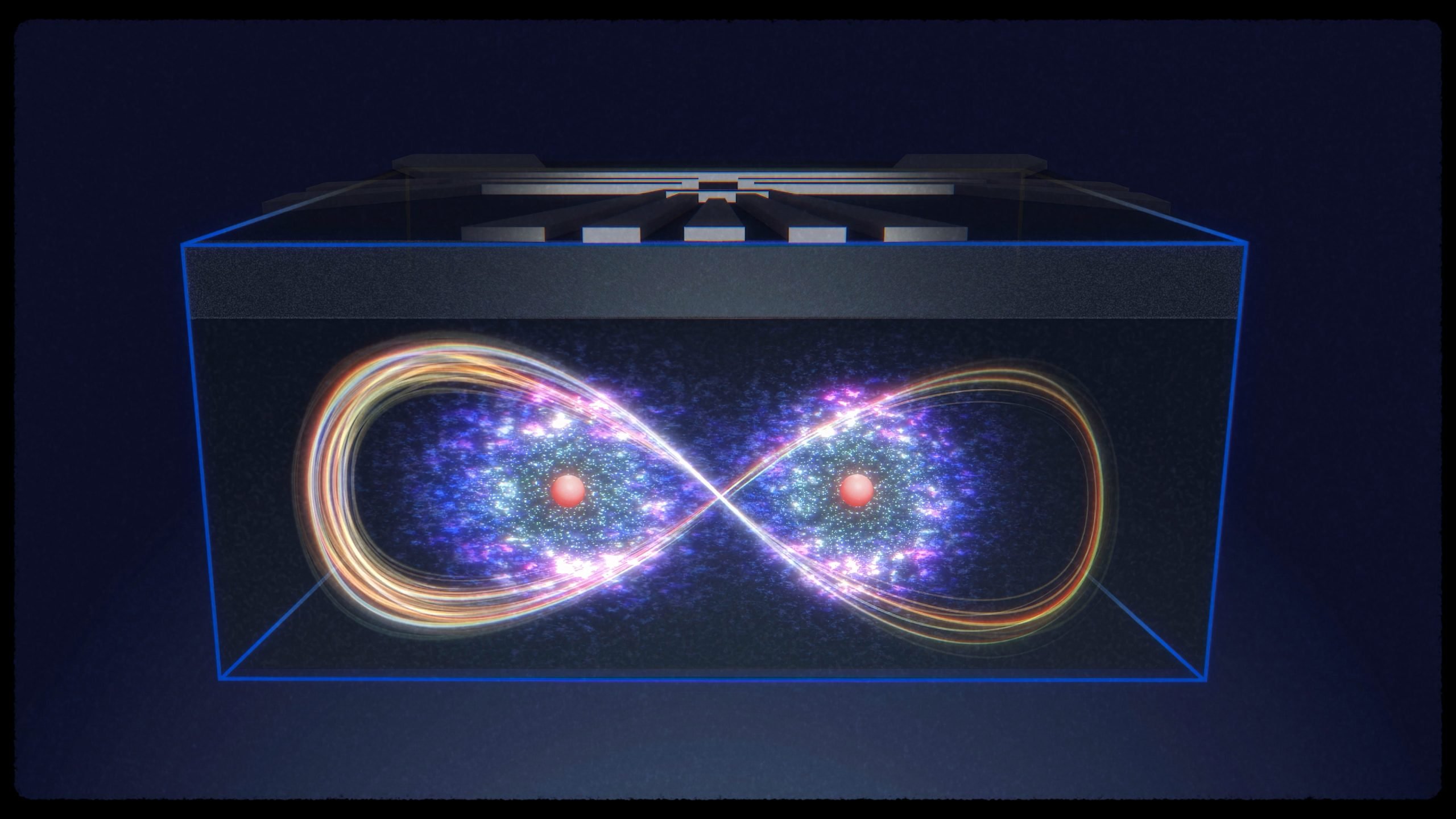
Scientists have linked nuclear spins inside silicon chips, marking a leap toward scalable quantum computers.
Engineers at UNSW have achieved a major breakthrough in quantum computing by creating what are known as “quantum entangled states.” In this phenomenon, two particles become so strongly connected that their behavior can no longer be described independently of each other. The team accomplished this using the spins of two atomic nuclei, a resource considered essential for quantum computers to outperform traditional machines.
The findings, published in Science, mark a crucial step toward the development of large-scale quantum computers, which are widely seen as one of the most ambitious scientific and technological frontiers of the 21st century.
According to lead author Dr. Holly Stemp, the work demonstrates a path to building future quantum microchips with technology already available.
“We succeeded in making the cleanest, most isolated quantum objects talk to each other, at the scale at which standard silicon electronic devices are currently fabricated,” she says.
A central difficulty in designing quantum computers has been finding the right balance between two conflicting requirements: protecting the delicate quantum states from interference and noise, while still allowing them to interact in order to perform computations. This challenge explains why different types of quantum hardware remain in competition. Some systems can perform operations very quickly but are highly vulnerable to noise, while others are better protected from interference but much harder to control and expand.
The UNSW team has invested in a platform that – until today – could be placed in the second camp. They have used the nuclear spin of phosphorus atoms, implanted in a silicon chip, to encode quantum information.
“The spin of an atomic nucleus is the cleanest, most isolated quantum object one can find in the solid state,” says Scientia Professor Andrea Morello, UNSW School of Electrical Engineering & Telecommunications.
“Over the last 15 years, our group has pioneered all the breakthroughs that made this technology a real contender in the quantum computing race. We already demonstrated that we could hold quantum information for over 30 seconds – an eternity, in the quantum world – and perform quantum logic operations with less than 1% errors.
“We were the first in the world to achieve this in a silicon device, but it all came at a price: the same isolation that makes atomic nuclei so clean, makes it hard to connect them together in a large-scale quantum processor.”
Until now, the only way to operate multiple atomic nuclei was for them to be placed very close together inside a solid, and to be surrounded by one and the same electron.
“Most people think of an electron as the tiniest subatomic particle, but quantum physics tells us that it has the ability to ‘spread out’ in space, so that it can interact with multiple atomic nuclei,” says Dr. Holly Stemp, who conducted this research at UNSW and is now a postdoctoral researcher at MIT in Boston.
“Even so, the range over which the electron can spread is quite limited. Moreover, adding more nuclei to the same electron makes it very challenging to control each nucleus individually.”
Making atomic nuclei talk through electronic ‘telephones’
“By way of metaphor, one could say that, until now, nuclei were like people placed in a soundproof room,” Dr. Stemp says.
“They can talk to each other as long as they are all in the same room, and the conversations are really clear. But they can’t hear anything from the outside, and there’s only so many people who can fit inside the room. This mode of conversation doesn’t ‘scale’.
“With this breakthrough, it’s as if we gave people telephones to communicate to other rooms. All the rooms are still nice and quiet on the inside, but now we can have conversations between many more people, even if they are far away.”
The ’telephones’ are, in fact, electrons. Mark van Blankenstein, another author on the paper, explains what’s really going on at the sub-atomic level.
“By their ability to spread out in space, two electrons can ‘touch’ each other at quite some distance. And if each electron is directly coupled to an atomic nucleus, the nuclei can communicate through that.”
So how far apart were the nuclei involved in the experiments?
“The distance between our nuclei was about 20 nanometers – one thousandth of the width of a human hair,” says Dr. Stemp.
“That doesn’t sound like much, but consider this: if we scaled each nucleus to the size of a person, the distance between the nuclei would be about the same as that between Sydney and Boston!”
She adds that 20 nanometers is the scale at which modern silicon computer chips are routinely manufactured to work in personal computers and mobile phones.
“You have billions of silicon transistors in your pocket or in your bag right now, each one about 20 nanometers in size. This is our real technological breakthrough: getting our cleanest and most isolated quantum objects talking to each other at the same scale as existing electronic devices. This means we can adapt the manufacturing processes developed by the trillion-dollar semiconductor industry, to the construction of quantum computers based on the spins of atomic nuclei.”
A scalable way forward
Despite the exotic nature of the experiments, the researchers say these devices remain fundamentally compatible with the way all current computer chips are built. The phosphorus atoms were introduced in the chip by the team of Professor David Jamieson at the University of Melbourne, using an ultra-pure silicon slab supplied by Professor Kohei Itoh at Keio University in Japan.
By removing the need for the atomic nuclei to be attached to the same electron, the UNSW team has swept aside the biggest roadblock to the scale-up of silicon quantum computers based on atomic nuclei.
“Our method is remarkably robust and scalable. Here we just used two electrons, but in the future we can even add more electrons, and force them in an elongated shape, to spread out the nuclei even further,” Prof. Morello says.
“Electrons are easy to move around and to ‘massage’ into shape, which means the interactions can be switched on and off quickly and precisely. That’s exactly what is needed for a scalable quantum computer.”
Reference: “Scalable entanglement of nuclear spins mediated by electron exchange” by Holly G. Stemp, Mark R. van Blankenstein, Serwan Asaad, Mateusz T. Mądzik, Benjamin Joecker, Hannes R. Firgau, Arne Laucht, Fay E. Hudson, Andrew S. Dzurak, Kohei M. Itoh, Alexander M. Jakob, Brett C. Johnson, David N. Jamieson and Andrea Morello, 18 September 2025, Science.
DOI: 10.1126/science.ady3799
Never miss a breakthrough: Join the SciTechDaily newsletter.
Follow us on Google and Google News.
2 Comments
Scientists have linked nuclear spins inside silicon chips, marking a leap toward scalable quantum computers.
very good!
Please ask researchers to think deeply:
1. Why do nuclei spin?
2. Is the period of nuclear spin absolutely the same?
In today’s physics, some so-called peer-reviewed journals—including Physical Review Letters, PNAS, Nature, Science, and others—stubbornly insist on and promote the following:
1. Even though θ and τ particles exhibit differences in experiments, physics can claim they are the same particle. This is science.
2. Even though topological vortices and antivortices have identical structures and opposite rotational directions, physics can define their structures and directions as entirely different. This is science.
3. Even though two sets of cobalt-60 rotate in opposite directions and experiments reveal asymmetry, physics can still define them as mirror images of each other. This is science.
4. Even though vortex structures are ubiquitous—from cosmic accretion disks to particle spins—physics must insist that vortex structures do not exist and require verification. Only the particles that like God, Demonic, or Angelic are the most fundamental structures of the universe. This is science.
5. Even though everything occupies space and maintains its existence in time, physics must still debate and insist on whether space exists and whether time is a figment of the human mind. This is science.
6. Even though space, with its non-stick, incompressible, and isotropic characteristics, provides a solid foundation for the development of physics, physics must still insist that the ideal fluid properties of space do not exist. This is science.
and go on.
What are the shames?
Is this the counterintuitive science they widely promote? Fortunately, not every member of the public is gullible. Topology is reconfiguring the cognitive framework of modern civilization. With the gradual refinement of artificial intelligence (AI), we are no longer entirely reliant on mediated deception by some so-called peer-reviewed publications (including Physical Review Letters, PNAS, Science, Nature, etc.). We now possess the means to leverage AI’s efficiency to enhance scientific rigor and productivity.
If researchers are interested, please visit https://zhuanlan.zhihu.com/p/1954126217461602098 (If the link is available).
Всего лишь, наличие у каждой фундаментальной частицы, своей массы, своего времени, как вращение. Пространства как собственного размера, и промежутков взаимодействия. Сложенные определенными сторонами в любом теле. Окруженные импульсами сил, по вращению и по сложению этих импульсов строит всю Вселенную. Синхронизация, это стабильность, поляризация это форма. Как бы сказал Эйнштейн – ” Бог с костями не играет.” Мудрость Бога в простоте. Мир един.