
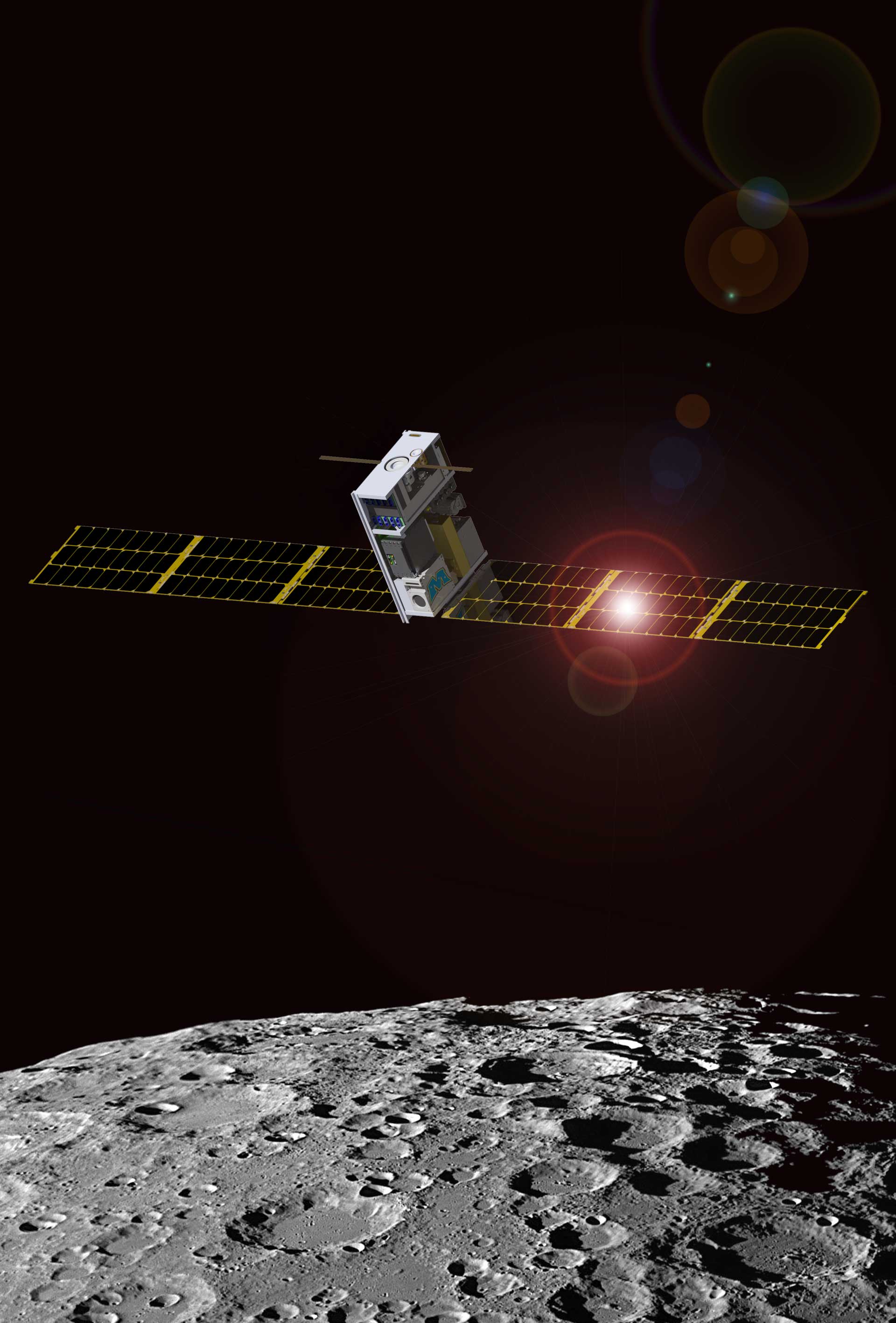
As we venture forward to the Moon and establish a sustained lunar presence, finding and understanding water on the lunar surface becomes increasingly important. Lunar water is largely in the form of, but not necessarily limited to, water ice. Astronauts on the Moon could use this ice for various crew needs, potentially including rocket fuel. The Lunar IceCube mission, led by Morehead State University in Morehead, Kentucky, will study water distribution and interaction on the Moon. The mission will carry a NASA instrument called Broadband InfraRed Compact High-Resolution Exploration Spectrometer (BIRCHES) to investigate the distribution of water and other organic volatiles. NASA scientists will use this data to understand where the water is on the Moon, its origins, and how we can use it.
“Lunar IceCube will help pave the way for human missions through significantly less expensive robotic missions and by addressing water dynamics on the Moon,” said Mark Lupisella, exploration research, and development manager. “This is not only important for science, but it could also be important for reducing the cost of human missions over the long term.”
The BIRCHES instrument will not only help map the distribution and dynamics of water on the Moon’s surface, but also in the exosphere — a very thin atmosphere-like volume surrounding the Moon. Scientists are interested in understanding the absorption and release of water from the Moon’s regolith, which is comparable to soil on Earth’s surface. By studying the absorption and release of water, scientists can start to map changes occurring on the Moon. Finding and understanding water on the lunar surface is vital to establishing a sustained presence on the Moon.
Lunar IceCube plans to have a seven-hour elliptical orbit around the Moon, where it will observe the lunar surface for an hour of that time. This limited observational time is due to BIRCHES’ view of the Moon. If the Sun peeks into the Lunar IceCube’s point of view while it is observing or traveling to the Moon, the BIRCHES instrument would be permanently damaged due to the intensity of the Sun’s energy on the infrared detector and other sensitive optical components within the instrument. To prevent this, the team developed a small garage-like door on the instrument that will open and close to protect the instrument.
Lunar IceCube is designed to provide several site observations at different latitudes for further understanding of water cycles on the Moon. Additionally, the findings from Lunar IceCube will provide complementary measurements to other CubeSats observing the Moon.
“Anything we learn about the Moon is valuable,” said Cliff Brambora, BIRCHES lead engineer. “The Moon is a kind of proving ground for technology and exploration, and the knowledge we gain there will help us with the potential for establishing a sustained presence on other planets, such as Mars.”
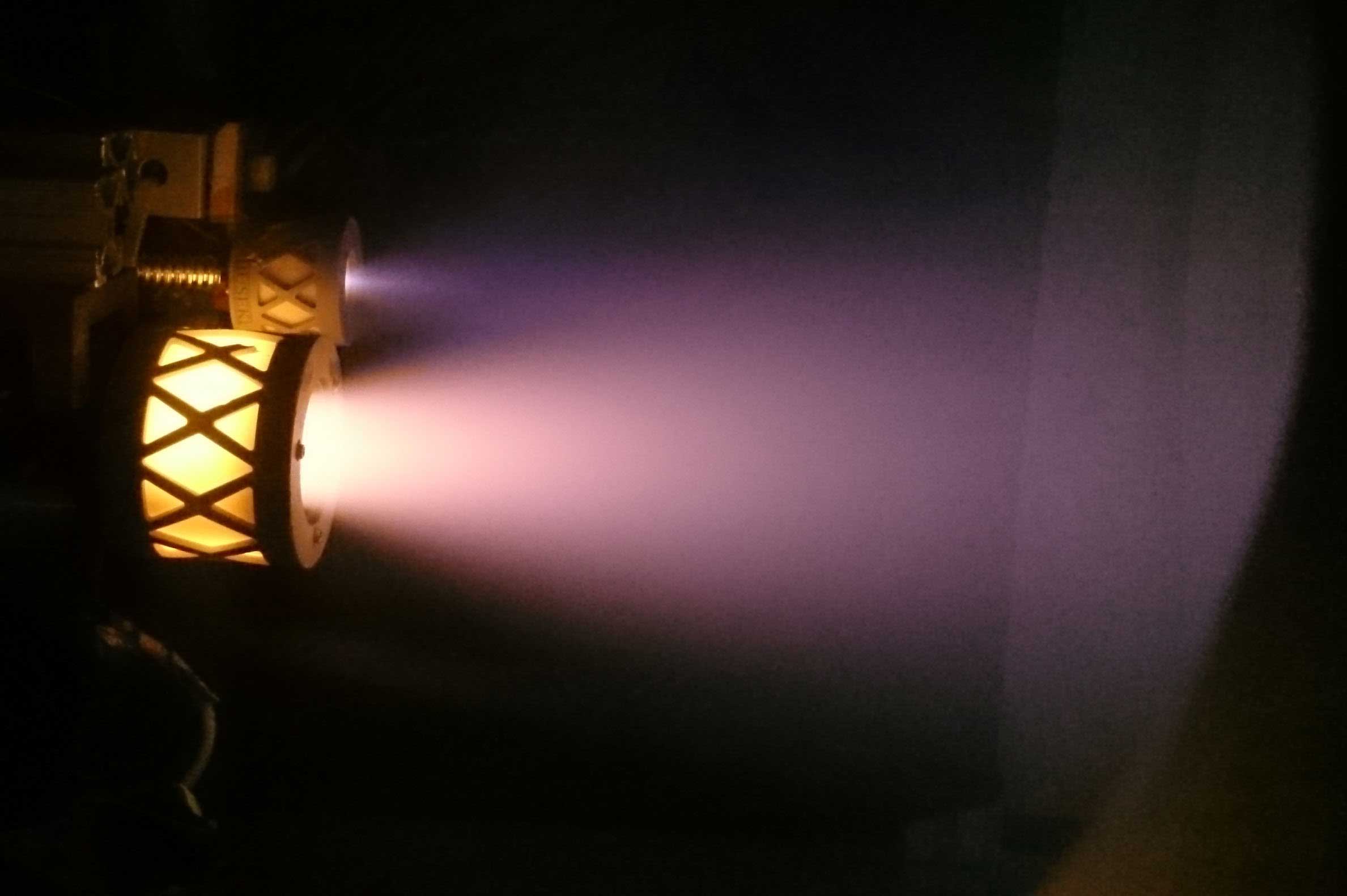
In addition to the miniaturized technology for the BIRCHES instrument, Lunar IceCube will feature an ion propulsion thruster, a new technology for CubeSats. Due to the minuscule size of the spacecraft, the thruster operates electrically using small amounts of propellant to give a small push and drive the spacecraft along its path, similar to that of butterfly wings.
“Interplanetary exploration with CubeSats is possible through the use of innovative propulsion systems and creative trajectories,” said Benjamin Malphrus from Morehead State University. “The ion propulsion system is an enabling technology that will open the door to solar system exploration with small satellite platforms, ushering in a new era of space exploration.”
As a CubeSat, a miniaturized satellite typically weighing less than 397 pounds, Lunar IceCube, which weighs 31 pounds, provides the agency with an efficient and cost-effective way to study the Moon. CubeSats offer NASA, universities, and other organizations a platform for science investigations, technology demonstrations, and advanced mission concepts. The BIRCHES payload is roughly the size of an eight-inch tissue box, and during the development of BIRCHES, the team had to drastically miniaturize legacy hardware from a previous NASA mission to approximately one-sixth of its original size.
Lunar IceCube is a collaborative effort between NASA’s Goddard Space Flight Center in Greenbelt, Maryland; NASA’s Jet Propulsion Laboratory in Pasadena, California; NASA’s Katherine Johnson Independent Verification and Validation Center in Fairmont, West Virginia; Morehead State University (MSU); and commercial partners, including the Busek space propulsion company.
The BIRCHES instrument is currently undergoing environmental testing at Goddard and is planned for delivery to MSU in August for integration into the spacecraft. The mission will launch as a secondary payload on the Space Launch System’s (SLS) Artemis -1.
Lunar IceCube is paving the way for NASA’s mission to the Moon. By distinguishing water on and around the lunar surface, scientists will be able to predict seasonal changes and determine possible in situ use for water on the Moon. This will be valuable information as NASA works to establish a sustained lunar presence by 2024.
Never miss a breakthrough: Join the SciTechDaily newsletter.
Follow us on Google and Google News.