
Close Menu
    Facebook X (Twitter) Instagram
    SciTechDaily
    • Biology
    • Chemistry
    • Earth
    • Health
    • Physics
    • Science
    • Space
    • Technology
    Facebook X (Twitter) Pinterest YouTube RSS
    SciTechDaily
    Home»Space»Lyman-Alpha Blobs are Some of the Largest Individual Objects in the Observable Universe
    Space

    Lyman-Alpha Blobs are Some of the Largest Individual Objects in the Observable Universe

    By SciTechDailyFebruary 15, 20124 Comments2 Mins Read
    Facebook Twitter Pinterest Telegram LinkedIn WhatsApp Email Reddit
    Share
    Facebook Twitter LinkedIn Pinterest Telegram Email Reddit
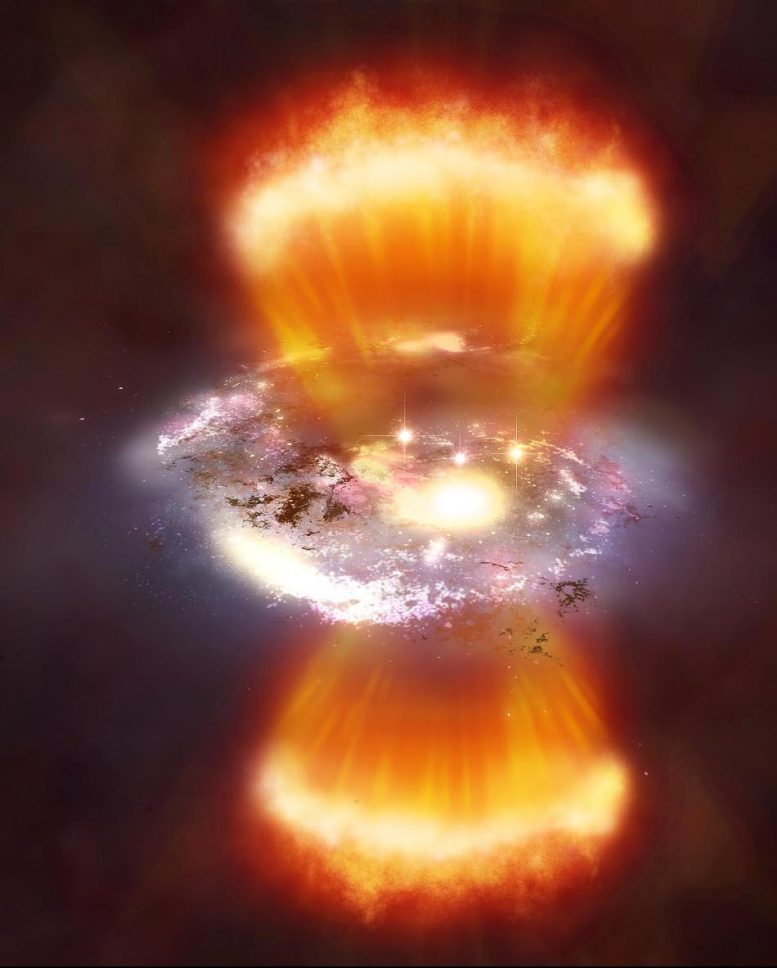
    Lyman Alpha Blob Artist's Impression
    Artist’s depiction of Lyman Alpha Blob 

    In extragalactic astronomy, a Lyman-alpha blob (LAB) is a huge concentration of gas emitting the Lyman-alpha emission line, a spectral line of hydrogen, or more generally of one-electron ions, in the Lyman series. Lyman-alpha blobs are some of the largest known individual objects in the observable universe.
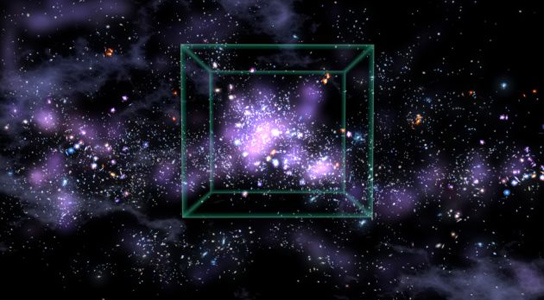
    himiko-lyman-alpha-blob

    Some of these gaseous structures are more than 400,000 light-years across and have only been found in the high-redshift universe, which is due to the ultraviolet nature of the Lyman-alpha emission line.
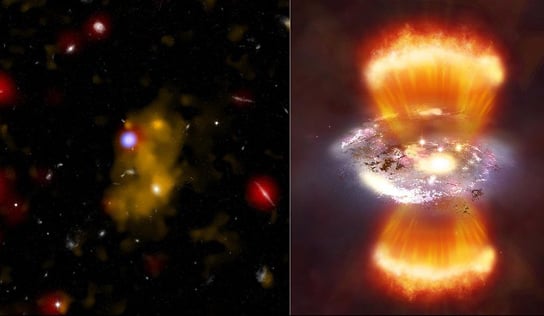
    lyman-alpha-blob

    Some of the most famous Lyman-alpha blobs were discovered in 2000 by Steidel, Mastuda and their colleagues, using the Subaru Telescope of the National Astronomical Observatory of Japan. Since then, over thirty new LABs have been found, but most of these are smaller than the ones which were found originally. Together, these LABs form a structure that is more than 200 million light-years in extent and it’s currently unknown whether LABs trace overdensities of galaxies in the high-redshift universe, like high-redshift radio galaxies, which also have extended Lyman-alpha halos.
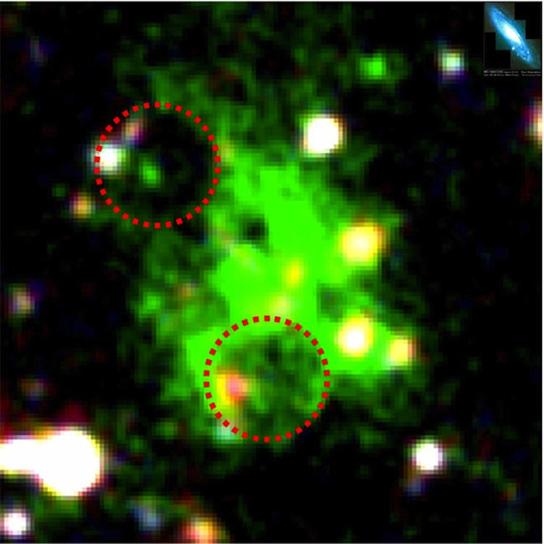
    extended-lyman-alpha-blob

    It’s also unknown which mechanism produces the Lyman-alpha emission line or how the LABs are connected to the galaxies that surround them. Further study of LABs might reveal clues on how exactly galaxies are formed.

    The Himiko Lyman-alpha blob is one of the most massive objects ever discovered in the early universe, and it’s 12.9 billion light-years from Earth. It’s 55,000 light-years across, which is half of the diameter of the Milky Way, but it is said to hold more than 10 times as much mass as the next largest (known) early universe, roughly equivalent to 40 billion M☉(solar masses). This makes it the most massive object in the known universe.

    Never miss a breakthrough: Join the SciTechDaily newsletter.
    Follow us on Google and Google News.

    Astronomy Astrophysics Cosmology Extragalactic Hydrogen
    Share. Facebook Twitter Pinterest LinkedIn Email Reddit

    Related Articles

    Supercomputer Simulations Present a New View of Black Hole Jets and Accretion Disks

    Scientists Use Quasars To Probe Dark Energy & Measure Its Role in the Evolution of the Universe

    The Brightest Flare Ever Observed From Sagittarius A*

    12 Billion-Year Old Supernova Discovered by Astronomers

    Dark Matter Filament in Galaxy Supercluster Directly Measured

    Calculations Show the Ideal Time to Study the Cosmos

    Links Between Core Collapse Supernovae and Star Formation Established

    The Bolshoi Simulation: Boxing the Universe

    Baryon Oscillation Spectroscopic Survey Measures the Universe’s Expansion and Dark Energy

    4 Comments

    1. daver on February 19, 2012 2:19 am

      10 times as much mass as the next largest universe, roughly equivalent to 40 billion M☉

      misprint, I assume. you mean next largest LAB ?

      Reply
      • Staff on February 19, 2012 8:21 am

        The information came from Wikipedia and the cited work bellow.

        “…. but is said to “hold more than 10 times as much mass as the next largest object found in the early universe, or roughly the equivalent mass of 40 billion suns”, making it the most massive object in the known universe.[1]”

        Citations

        ^ a b c d Hsu, Jeremy (2009-04-22). “Giant Mystery Blob Discovered Near Dawn of Time“. SPACE.com. Retrieved 2009-04-24.

        Reply
    2. Range on February 19, 2012 4:16 pm

      As James so nicely pointed out, thanks to a citation, no it’s not a misprint. It comes directly from a citation. Thanks.

      Reply
      • Phio Banadio on January 13, 2017 12:46 pm

        Range/Staff – The citation must have been corrected, because it clearly states “the next largest object in the —-early—– universe”.

        It’s a typo on the scitechdaily’s part. We have no idea what the mass of the “next largest universe” is……..

        Reply
    Leave A Reply Cancel Reply

    • Facebook
    • Twitter
    • Pinterest
    • YouTube

    Don't Miss a Discovery

    Subscribe for the Latest in Science & Tech!

    Trending News

    First-of-Its-Kind Discovery: Homer’s Iliad Found Embedded in a 1,600-Year-Old Egyptian Mummy

    Beyond Inflammation: Scientists Uncover New Cause of Persistent Rheumatoid Arthritis

    A Simple Molecule Could Unlock Safer, Easier Weight Loss

    Scientists Just Built a Quantum Battery That Charges Almost Instantly

    Researchers Unveil Groundbreaking Sustainable Solution to Vitamin B12 Deficiency

    Millions of People Have Osteopenia Without Realizing It – Here’s What You Need To Know

    Researchers Discover Boosting a Single Protein Helps the Brain Fight Alzheimer’s

    World-First Study Reveals Human Hearts Can Regenerate After a Heart Attack

    Follow SciTechDaily
    • Facebook
    • Twitter
    • YouTube
    • Pinterest
    • Newsletter
    • RSS
    SciTech News
    • Biology News
    • Chemistry News
    • Earth News
    • Health News
    • Physics News
    • Science News
    • Space News
    • Technology News
    Recent Posts
    • Physicists Propose Strange Experiment Where Time Goes Quantum
    • Scientists Flip Immune System “Switch,” Uncover Surprising Path To Stop Gut Inflammation
    • Magnesium Magic: New Drug Melts Fat Even on a High-Fat, High-Sugar Diet
    • Weight-Loss Drugs Like Ozempic May Come With an Unexpected Cost
    • After Decades, MIT Researchers Capture the First 3D Atomic View of a Mysterious Material
    Copyright © 1998 - 2026 SciTechDaily. All Rights Reserved.
    • Science News
    • About
    • Contact
    • Editorial Board
    • Privacy Policy
    • Terms of Use

    Type above and press Enter to search. Press Esc to cancel.