
Close Menu
    Facebook X (Twitter) Instagram
    SciTechDaily
    • Biology
    • Chemistry
    • Earth
    • Health
    • Physics
    • Science
    • Space
    • Technology
    Facebook X (Twitter) Pinterest YouTube RSS
    SciTechDaily
    Home»Space»Cassini Views Saturn’s Rings and the Shadows They Cast on the Planet
    Space

    Cassini Views Saturn’s Rings and the Shadows They Cast on the Planet

    By NASAApril 30, 2014No Comments2 Mins Read
    Facebook Twitter Pinterest Telegram LinkedIn WhatsApp Email Reddit
    Share
    Facebook Twitter LinkedIn Pinterest Telegram Email Reddit
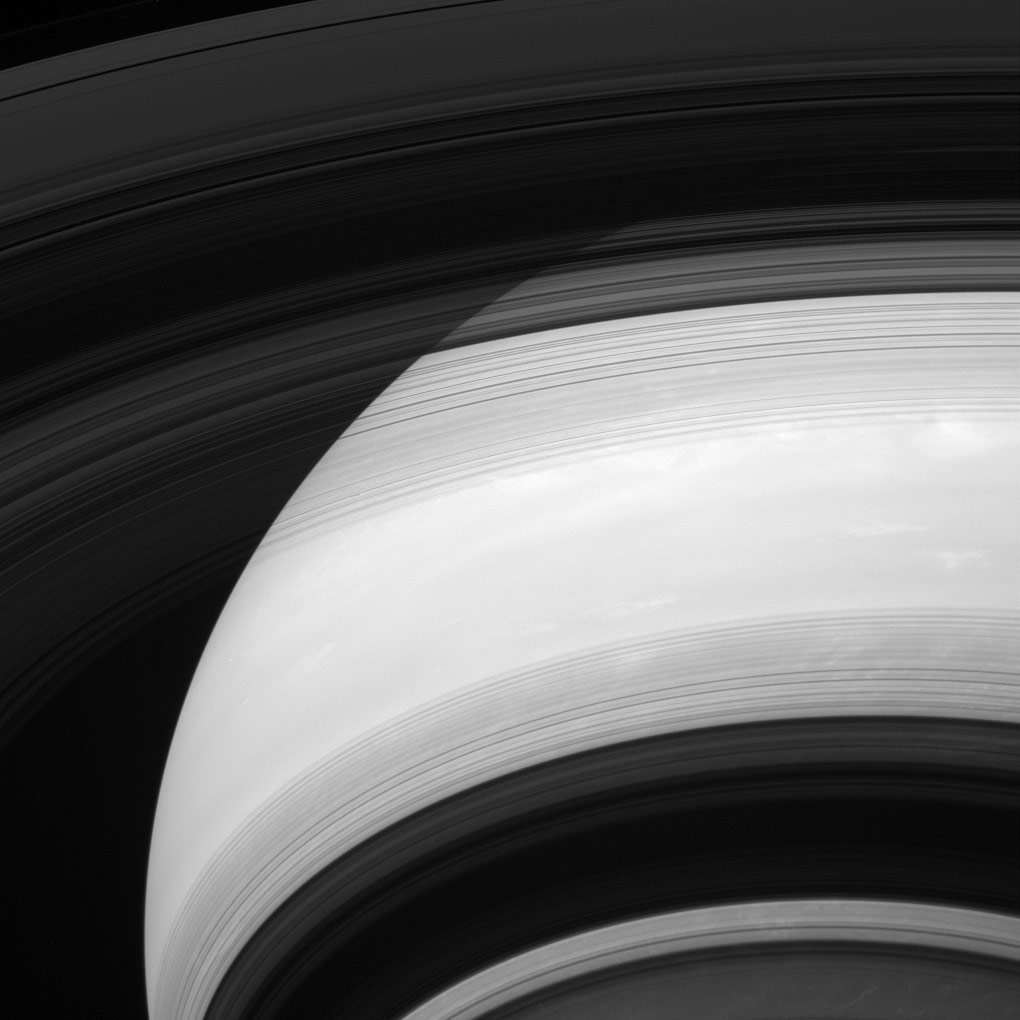
    Cassini Views Saturn and Its Rings
    The image shows Saturn’s rings from the A ring’s edge at the top left, moving down to the Cassini Division, B ring, and inner C ring. In the lower half, the ring shadows in reverse order against Saturn: C ring, B ring, Cassini Division, and the inner A ring. Credit: NASA/JPL-Caltech/Space Science Institute

    This newly released image from NASA’s Cassini spacecraft shows Saturn’s rings and the shadows they cast on the planet.

    Saturn’s rings cast shadows on the planet, but the shadows appear to be inside out! The edge of Saturn’s outermost A ring can be seen at the top left corner of the image. Moving toward the bottom of the page, one can see the faint Cassini Division, the opaque B ring, and the innermost C ring, which contains several ringlets that appear dark against Saturn in this geometry. The bottom half of the image features the shadows of these rings in reverse order superposed against the disk of the planet: the C ring, the B ring, the Cassini Division, and the inner half of the A ring.

    This view looks toward the unilluminated side of the rings from about 28 degrees below the ringplane. The image was taken with the Cassini spacecraft wide-angle camera on December 2, 2013, using a spectral filter which preferentially admits wavelengths of near-infrared light centered at 752 nanometers.

    The view was acquired at a distance of approximately 750,000 miles (1.2 million kilometers) from Saturn and at a Sun-Saturn-spacecraft, or phase, angle of 57 degrees. The image scale is 45 miles (72 kilometers) per pixel.

    The Cassini-Huygens mission is a cooperative project of NASA, the European Space Agency, and the Italian Space Agency. The Jet Propulsion Laboratory, a division of the California Institute of Technology in Pasadena, manages the mission for NASA’s Science Mission Directorate, Washington, D.C. The Cassini orbiter and its two onboard cameras were designed, developed, and assembled at JPL. The imaging operations center is based at the Space Science Institute in Boulder, Colorado.

    Never miss a breakthrough: Join the SciTechDaily newsletter.
    Follow us on Google and Google News.

    Astronomy Cassini-Huygens Mission NASA Saturn
    Share. Facebook Twitter Pinterest LinkedIn Email Reddit

    Related Articles

    Cassini Views Saturn’s North Polar Hexagon

    Storm Spawns the Largest Tropospheric Vortex Ever Seen on Saturn

    NASA’s Image of the Day Shows Saturnian Moons Prometheus and Pan

    New Cassini Image of Saturn and Its Rings

    Natural Color View of Saturn and Titan

    NASA’s Cassini Spots Lightning in Saturn’s Northern Hemisphere

    Cassini Changes Orbit, Saturn’s Rings Visible Again

    Cassini Data Reveals Likely Subsurface Ocean on Titan

    Heat from Within the Planet Powers Saturn’s Jet Streams

    Leave A Reply Cancel Reply

    • Facebook
    • Twitter
    • Pinterest
    • YouTube

    Don't Miss a Discovery

    Subscribe for the Latest in Science & Tech!

    Trending News

    Monster Storms on Jupiter Unleash Lightning Beyond Anything on Earth

    Scientists Create “Liquid Gears” That Spin Without Touching

    The Simple Habit That Could Help Prevent Cancer

    Millions Take These IBS Drugs, But a New Study Finds Serious Risks

    Scientists Unlock Hidden Secrets of 2,300-Year-Old Mummies Using Cutting-Edge CT Scanner

    Bread Might Be Making You Gain Weight Even Without Eating More Calories

    Scientists Discover Massive Magma Reservoir Beneath Tuscany

    Europe’s Most Active Volcano Just Got Stranger – Here’s Why Scientists Are Rethinking It

    Follow SciTechDaily
    • Facebook
    • Twitter
    • YouTube
    • Pinterest
    • Newsletter
    • RSS
    SciTech News
    • Biology News
    • Chemistry News
    • Earth News
    • Health News
    • Physics News
    • Science News
    • Space News
    • Technology News
    Recent Posts
    • Scientists Were Wrong About This Strange “Rule-Breaking” Particle
    • Webb Space Telescope Uncovers Unexpected Ice Clouds on a Jupiter-Like World
    • 289-Million-Year-Old Reptile Mummy Reveals Origin of Human Breathing System
    • New Brain Discovery Challenges Long-Held Theory of Teenage Brain Development
    • Sharks Are Overheating as Warming Oceans Push Them to the Edge
    Copyright © 1998 - 2026 SciTechDaily. All Rights Reserved.
    • Science News
    • About
    • Contact
    • Editorial Board
    • Privacy Policy
    • Terms of Use

    Type above and press Enter to search. Press Esc to cancel.