
Scientists have unlocked a previously unseen behavior of acoustic waves, opening up new possibilities for cutting-edge communication technologies.
By experimenting with nanoscale magnetic materials, researchers observed an asymmetric diffraction pattern in surface acoustic waves — something only known in optics until now. This groundbreaking discovery suggests that sound waves can be manipulated in ways never imagined, potentially revolutionizing both classical and quantum communication.
A Breakthrough in Acoustic Wave Propagation
Researchers have discovered a new way that acoustic waves propagate, which could lead to significant advancements in communication technology. The study was conducted by the Institute for Materials Research at Tohoku University in collaboration with the Japan Atomic Energy Agency and the RIKEN Center for Emergent Matter Science.
Surface acoustic waves (SAWs) — vibrations that travel along the surface of materials like ripples on water — are essential in modern communication devices. They play a key role in frequency filters used in mobile phones, converting electrical signals into vibrations through the piezoelectric effect. This conversion enables efficient signal processing, making a deeper understanding of SAWs crucial for future technological advancements.
A Surprising Experimental Discovery
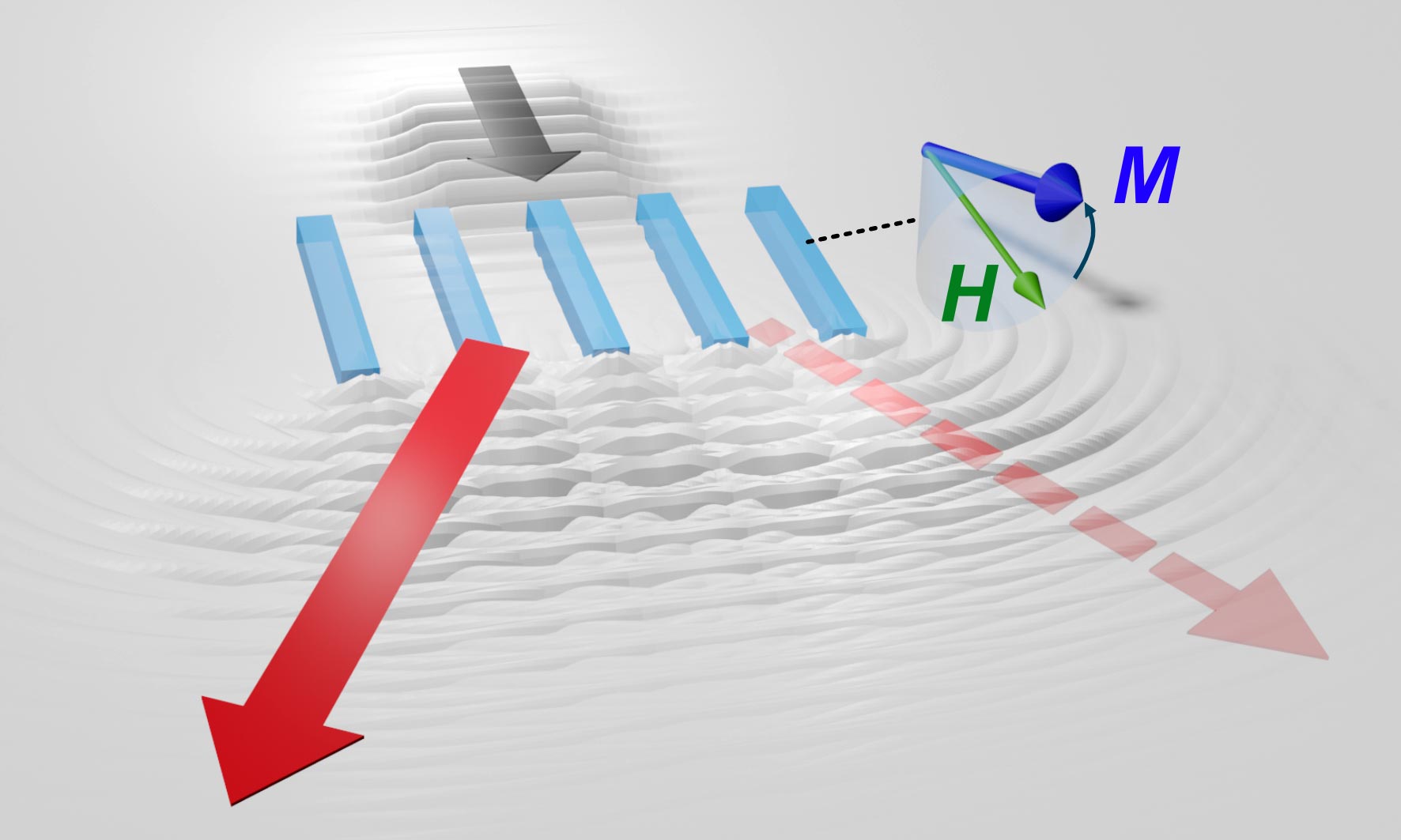
In their experiment, the research team used advanced nanofabrication techniques to create a structured array of nanoscale magnetic materials. This array functioned like a specialized grating that the acoustic waves passed through. However, instead of the expected symmetrical diffraction pattern, the team observed an entirely new and unexpected phenomenon: “nonreciprocal diffraction” — an asymmetrical way in which SAWs interact with the material.
“This phenomenon has previously been observed only in optics,” remarks Yoichi Nii, “so we are very excited to confirm that it extends beyond optics to other wave phenomena.”
Through theoretical analysis, the research team identified this asymmetrical behavior as arising from the unique interaction between SAWs and magnetic materials, specifically related to their angular momenta.
Transforming Communication Technologies
This finding may enable precise control of SAW propagation paths using magnetic fields, leading to the development of innovative acoustic devices that advance both classical and quantum communication technologies. Uncovering new properties of SAWs is essential for developing next-generation communication systems and devices.
The study was published in Physical Review Letters on January 14, 2025.
Reference: “Observation of Nonreciprocal Diffraction of Surface Acoustic Wave” by Y. Nii, K. Yamamoto, M. Kanno, S. Maekawa and Y. Onose, 14 January 2025, Physical Review Letters.
DOI: 10.1103/PhysRevLett.134.027001
Never miss a breakthrough: Join the SciTechDaily newsletter.
Follow us on Google and Google News.
4 Comments
THANK YOU FOR THIS
Through theoretical analysis, the research team identified this asymmetrical behavior as arising from the unique interaction between SAWs and magnetic materials, specifically related to their angular momenta.
VERY GOOD!
Scientific research guided by correct theories can enable researchers to think more.
According to the Topological Vortex Theory (TVT), spins create everything, spins shape the world. There are substantial distinctions between Topological Vortex Theory (TVT) and traditional physical theories. Grounded in the inviscid and absolutely incompressible spaces, TVT introduces the concept of topological phase transitions and employs topological principles to elucidate the formation and evolution of matter in the universe, as well as the impact of interactions between topological vortices and anti-vortices on spacetime dynamics and thermodynamics.
Within TVT, low-dimensional spacetime matter serves as the foundation for high-dimensional spacetime matter, and the hierarchical structure of matter and its interaction mechanisms challenge conventional macroscopic and microscopic interpretations. The conflict between Quantum Physics and Classical Physics can be attributed to their differing focuses: Quantum Physics emphasizes low-dimensional spacetime matter, whereas Classical Physics centers on high-dimensional spacetime matter.
Subatomic particles in the quantum world often defy the familiar rules of the physical world. The fact repeatedly suggests that the familiar rules of the physical world are pseudoscience. In the familiar rules of the physical world, two sets of cobalt-60 can form the mirror image of each other by rotating in opposite directions, and should receive the Nobel Prize for physics.
Please witness the grand performance of some so-called peer review publications (including PRL, PNAS, Nature, Science, etc.). https://scitechdaily.com/microscope-spacecrafts-most-precise-test-of-key-component-of-the-theory-of-general-relativity/#comment-854286. Some so-called academic publications (including PRL, PNAS, Nature, Science, etc.) are addicted to their own small circles and have deviated from science for a long time.
If the researchers are truly interested in science, please read: The Application of Inviscid and Absolutely Incompressible Spaces in Engineering Simulation (https://scitechdaily.com/microscope-spacecrafts-most-precise-test-of-key-component-of-the-theory-of-general-relativity/#comment-870077).
In the topological vortex architecture, the distinction between science and pseudoscience becomes evident. Topological Vortex Theory (TVT) can play a crucial role in elucidating the foundations of physics, establishing its principles, and combating pseudoscience. TVT may encounter significant opposition and resistance from traditional peer review publications. The field of physics faces an ongoing challenge in maintaining scientific rigor and integrity in the face of pervasive pseudoscientific claims. Fighting against rampant pseudoscience, physics still has a long way to go.
You said that according to TVT, spins create everything. Well I have to wonder. Can spins create a Big Mac? Right here, right now. In front of me. They can’t? Then spins can’t create everything!
VERY GOOD!
Thank for your browsing and thinking.
If you employ rigorous scientific methodologies to investigate the space-time structure of the Big Mac, the final result will reveal the answer.