
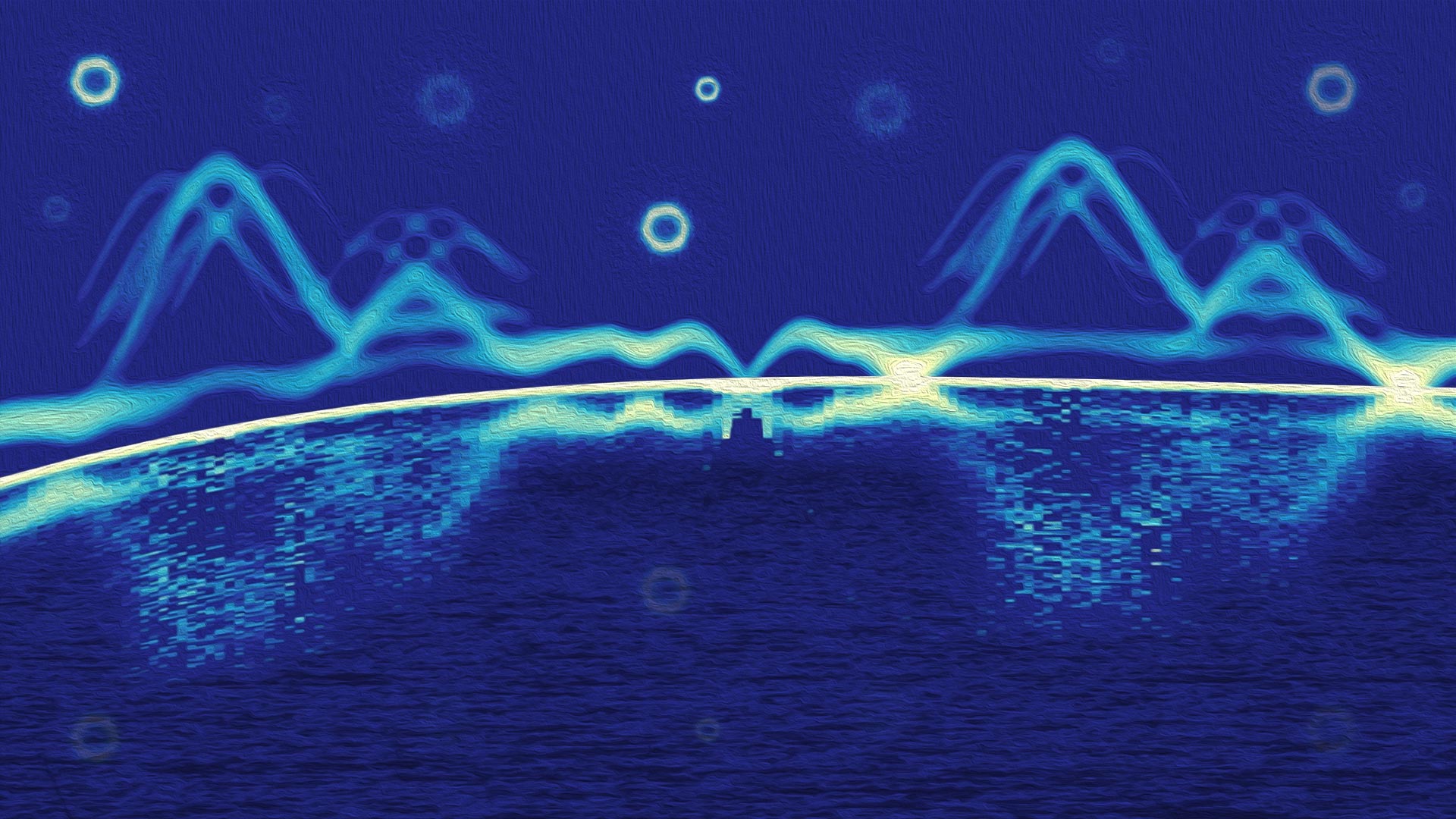
ORNL scientists discovered a spiral spin liquid in iron trichloride, a finding that could advance quantum computing and data storage technologies.
Scientists at the Department of Energy’s Oak Ridge National Laboratory (ORNL) used neutron scattering to determine whether a specific material’s atomic structure could host a novel state of matter called a spiral spin liquid. The team discovered the first 2D system to host a spiral spin liquid by tracking tiny magnetic moments known as “spins” on the honeycomb lattice of a layered iron trichloride magnet.
The finding provides a test bed for future studies of physics phenomena that may drive next-generation information technologies. These include fractons and skyrmions. Fractons are collective quantized vibrations that may prove promising in quantum computing. Skyrmions are novel magnetic spin textures that could advance high-density data storage.
“Materials hosting spiral spin liquids are particularly exciting due to their potential to be used to generate quantum spin liquids, spin textures, and fracton excitations,” said ORNL’s Shang Gao, who led the study published in Physical Review Letters.
A long-held theory predicted that the honeycomb lattice can host a spiral spin liquid. This is a novel phase of matter in which spins form fluctuating corkscrew-like structures.
However, until the present study, experimental evidence of this phase in a 2D system had been lacking. A 2D system comprises a layered crystalline material in which interactions are stronger in the planar than in the stacking direction.
Gao identified iron trichloride as a promising platform for testing the theory, which was proposed more than a decade ago. He and co-author Andrew Christianson of ORNL approached Michael McGuire, also of ORNL, who has worked extensively on growing and studying 2D materials, asking if he would synthesize and characterize a sample of iron trichloride for neutron diffraction measurements. Like 2D graphene layers exist in bulk graphite as honeycomb lattices of pure carbon, 2D iron layers exist in bulk iron trichloride as 2D honeycomb layers. “Previous reports hinted that this interesting honeycomb material could show complex magnetic behavior at low temperatures,” McGuire said.
Unique Properties of Iron Trichloride’s Honeycomb Lattice
“Each honeycomb layer of iron has chlorine atoms above and below it, making chlorine-iron-chlorine slabs,” McGuire said. “The chlorine atoms on top of one slab interact very weakly with the chlorine atoms on the bottom of the next slab through van der Waals bonding. This weak bonding makes materials like this easily peeled apart into very thin layers, often down to a single slab. This is useful for developing devices and understanding the evolution of quantum physics from three dimensions to two dimensions.”
In quantum materials, electron spins can behave collectively and exotically. If one spin moves, all react – an entangled state Einstein called “spooky action at a distance.” The system stays in a state of frustration – a liquid that preserves disorder because electron spins constantly change direction, forcing other entangled electrons to fluctuate in response.
60 years ago, the first neutron diffraction studies of ferric chloride crystals were performed at ORNL. Today, ORNL’s extensive expertise in materials synthesis, neutron scattering, simulation, theory, imaging, and computation enables pioneering explorations of magnetic quantum materials that drive the development of next-generation technologies for information security and storage.
Neutron Scattering
Mapping spin movements in the spiral spin liquid was made possible by experts and tools at the Spallation Neutron Source and the High Flux Isotope Reactor, DOE Office of Science user facilities at ORNL. ORNL co-authors were essential for the success of the neutron scattering experiments: Clarina dela Cruz, who led experiments using HFIR’s POWDER diffractometer; Yaohua Liu, who led experiments employing SNS’s CORELLI spectrometer; Matthias Frontzek, who led experiments engaging HFIR’s WAND2 diffractometer; Matthew Stone, who led experiments operating SNS’s SEQUOIA spectrometer; and Douglas Abernathy, who led experiments working SNS’s ARCS spectrometer.
“The neutron scattering data from our measurements at SNS and HFIR provided compelling evidence of a spiral spin liquid phase,” Gao said.
“The neutron scattering experiments measured how the neutrons exchange energy and momentum with the sample, allowing the magnetic properties to be inferred,” said co-author Matthew Stone. He described the magnetic structure of a spiral spin liquid: “It looks like a topographic map of a group of mountains with a bunch of rings going outward. If you were to walk along a ring, all spins would point in the same direction. But if you walk outward and cross different rings, you’re going to see those spins begin to rotate about their axes. That’s the spiral.”
“Our study shows that the concept of a spiral spin liquid is viable for the broad class of honeycomb lattice materials,” said co-author Andrew Christianson. “It gives the community a new route to explore spin textures and novel excitations, such as fractons, that then may be used in future applications, such as quantum computing.”
Reference: “Spiral Spin Liquid on a Honeycomb Lattice” by Shang Gao, Michael A. McGuire, Yaohua Liu, Douglas L. Abernathy, Clarina dela Cruz, Matthias Frontzek, Matthew B. Stone and Andrew D. Christianson, 1 June 2022, Physical Review Letters.
DOI: 10.1103/PhysRevLett.128.2272
DOE’s Office of Science supported the work.
Never miss a breakthrough: Join the SciTechDaily newsletter.
Follow us on Google and Google News.