

Close Menu
    Facebook X (Twitter) Instagram
    SciTechDaily
    • Biology
    • Chemistry
    • Earth
    • Health
    • Physics
    • Science
    • Space
    • Technology
    Facebook X (Twitter) Pinterest YouTube RSS
    SciTechDaily
    Home»Science»Making (and Breaking) Eye Contact Repeatedly Makes Conversation More Engaging
    Science

    Making (and Breaking) Eye Contact Repeatedly Makes Conversation More Engaging

    By Dartmouth CollegeSeptember 13, 2021No Comments4 Mins Read
    Facebook Twitter Pinterest Telegram LinkedIn WhatsApp Email Reddit
    Share
    Facebook Twitter LinkedIn Pinterest Telegram Email Reddit
    Eye Contact Conversation
    In conversations, eye contact signals high shared attention and synchrony between individuals. However, prolonged eye contact can lead to decreased synchrony, which is beneficial as excessive synchrony can make conversations stale. Engaging conversations involve being on the same page while also introducing new ideas. Eye contact helps create a shared space while leaving room for fresh perspectives.

    Researchers found that eye contact happens when conversational partners are most in sync, but it also breaks that synchrony to refresh the dialogue. This dynamic helps maintain engagement and promotes creativity during conversation.

    Making eye contact repeatedly when you’re talking to someone is common, but why do we do it? When two people are having a conversation, eye contact occurs during moments of “shared attention” when both people are engaged, with their pupils dilating in synchrony as a result, according to a Dartmouth study published in the Proceedings of the National Academy of Sciences.

    “Eye contact is really immersive and powerful,” says lead author Sophie Wohltjen, a graduate student in psychological and brain sciences at Dartmouth. “When two people are having a conversation, eye contact signals that shared attention is high —that they are in peak synchrony with one another. As eye contact persists, that synchrony then decreases. We think this is also good because too much synchrony can make a conversation stale. An engaging conversation requires at times being on the same page and at times saying something new. Eye contact seems to be one way we create a shared space while also allowing space for new ideas.”

    “In the past, it has been assumed that eye contact creates synchrony, but our findings suggest that it’s not that simple,” says senior author Thalia Wheatley, a professor of psychological and brain sciences at Dartmouth, and principal investigator of the Dartmouth Social Systems Laboratory. “We make eye contact when we are already in sync, and, if anything, eye contact seems to then help break that synchrony. Eye contact may usefully disrupt synchrony momentarily in order to allow for a new thought or idea.”
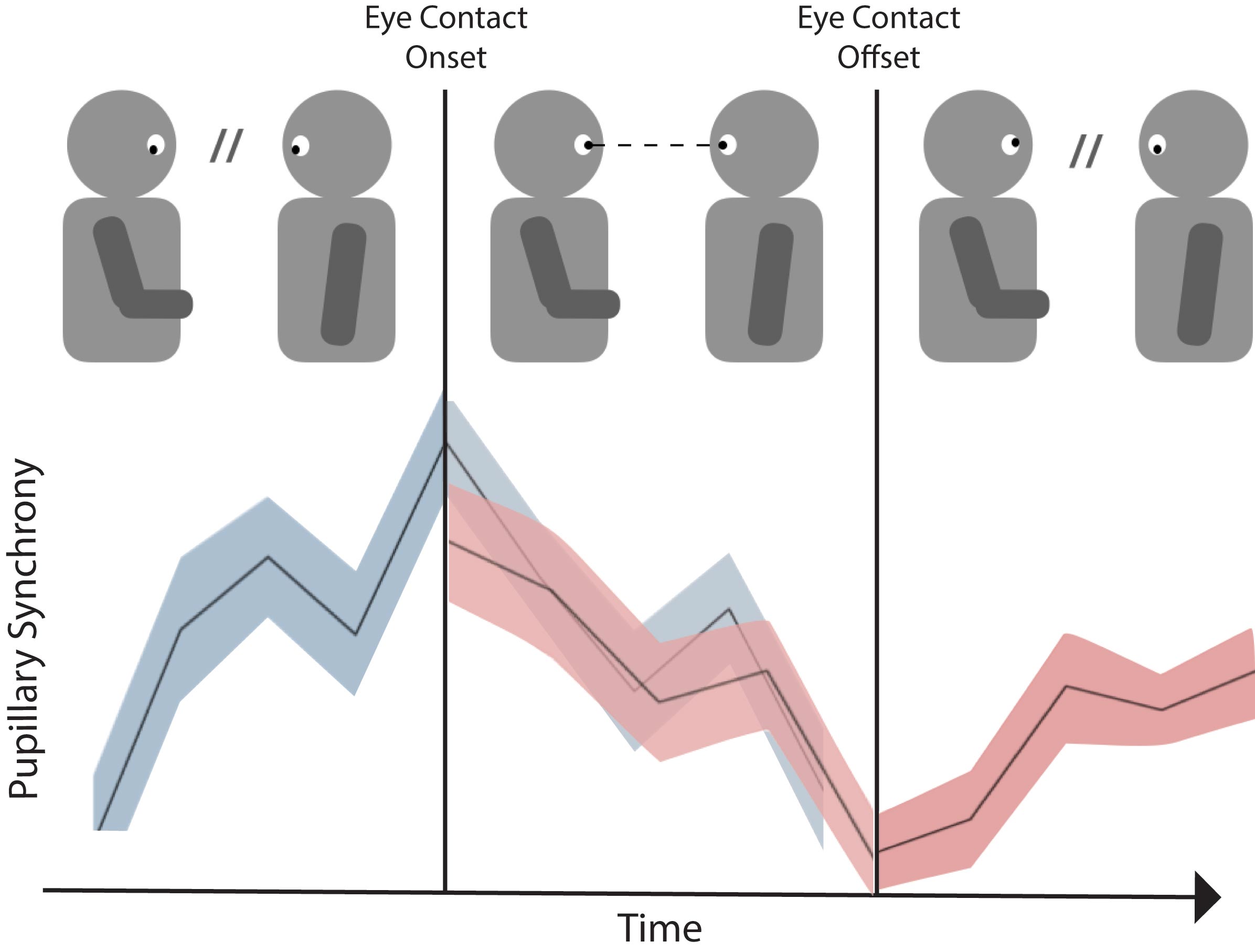
    Making (and Breaking) Eye Contact Makes Conversation More Engaging
    Cartoon of how a single instance of eye contact coincides with pupillary synchrony. Prior to eye contact, pupillary synchrony increases until it peaks at eye contact onset. As eye contact is maintained, synchrony declines until its trough when eye contact is broken. Credit: Figure by Sophie Wohltjen

    To examine the relationship between eye contact and pupillary synchrony in a natural conversation, pairs of Dartmouth students were brought into the lab. Wearing eye-tracking glasses and sitting across from each other, each pair was asked to have a conversation for 10 minutes, which was audio and video recorded. Participants could talk about whatever they wanted. After the conversation was over, the two participants were separated into different rooms and were asked to watch the conversation that they just had and to continuously rate how engaged they were.

    Eye Contact Peaks with Synchrony, Then Breaks It

    The research team looked at how pupillary synchrony increases and decreases around instances of eye contact. The results showed that people make eye contact as pupillary synchrony is at its peak. Pupillary synchrony then immediately decreases, only recovering again once eye contact is broken. The data also demonstrated a correlation between instances of eye contact and higher levels of engagement during the conversation.

    “Conversation is a creative act in which people build a shared story from independent voices.” Wheatley adds, “Moments of eye contact seem to signal when we have achieved shared understanding and need to contribute our independent voice.”

    The team’s results are consistent with other work, which has illustrated how periodically breaking synchrony can allow for creativity and individual exploration.

    Reference: “Eye contact marks the rise and fall of shared attention in conversation” by Sophie Wohltjen and Thalia Wheatley, 10 September 2021, Proceedings of the National Academy of Sciences.
    DOI: 10.1073/pnas.2106645118

    Never miss a breakthrough: Join the SciTechDaily newsletter.
    Follow us on Google and Google News.

    Behavioral Science Dartmouth College Neuroscience Psychology
    Share. Facebook Twitter Pinterest LinkedIn Email Reddit

    Related Articles

    This Is What Happens in Your Brain During a Soccer Match

    Fear Engrams Unlocked: A Neuroscientific Journey Into Memory and Behavior

    New Detailed Look at the Neuroscience of Placebo Effects

    Writing by Hand Makes Kids Smarter – Here’s Why

    Brain Regions Associated With the Successful Spread of Ideas Identified

    Curing Boredom

    Body Language Is a Better Indicator of Intense Emotions Than Facial Expressions

    Searching for a More Accurate Classification of the Dimensions of Psychopathology

    Listening to Mozart Can Make You Smarter but No More Than Justin Bieber

    Leave A Reply Cancel Reply

    • Facebook
    • Twitter
    • Pinterest
    • YouTube

    Don't Miss a Discovery

    Subscribe for the Latest in Science & Tech!

    Trending News

    New “Nanozyme Hypothesis” Could Rewrite the Story of Life’s Origins

    Anatomy Isn’t Finished: The Human Body Still Holds Secrets

    “Pretty Close to Home”: The Hidden Earthquake Threat Beneath Seattle

    The Surprising Reason You Might Want To Sleep Without a Pillow

    Scientists Say This Natural Hormone Reverses Obesity by Targeting the Brain

    35-Million-Year-Old Mystery: Strange Arachnid Discovered Preserved in Amber

    Is AI Really Just a Tool? It Could Be Altering How You See Reality

    JWST Reveals a “Forbidden” Planet With a Baffling Composition

    Follow SciTechDaily
    • Facebook
    • Twitter
    • YouTube
    • Pinterest
    • Newsletter
    • RSS
    SciTech News
    • Biology News
    • Chemistry News
    • Earth News
    • Health News
    • Physics News
    • Science News
    • Space News
    • Technology News
    Recent Posts
    • Scientists Finally Crack the 100-Million-Year Evolutionary Mystery of Squid and Cuttlefish
    • This Algae Could One Day Pull Microplastics out of Your Drinking Water
    • Scientists Can Now Read Your Body Clock From a Single Hair
    • Beyond “Safe Levels”: Study Challenges What We Know About Pesticides and Cancer
    • Researchers Have Found a Dietary Compound That Increases Longevity
    Copyright © 1998 - 2026 SciTechDaily. All Rights Reserved.
    • Science News
    • About
    • Contact
    • Editorial Board
    • Privacy Policy
    • Terms of Use

    Type above and press Enter to search. Press Esc to cancel.