
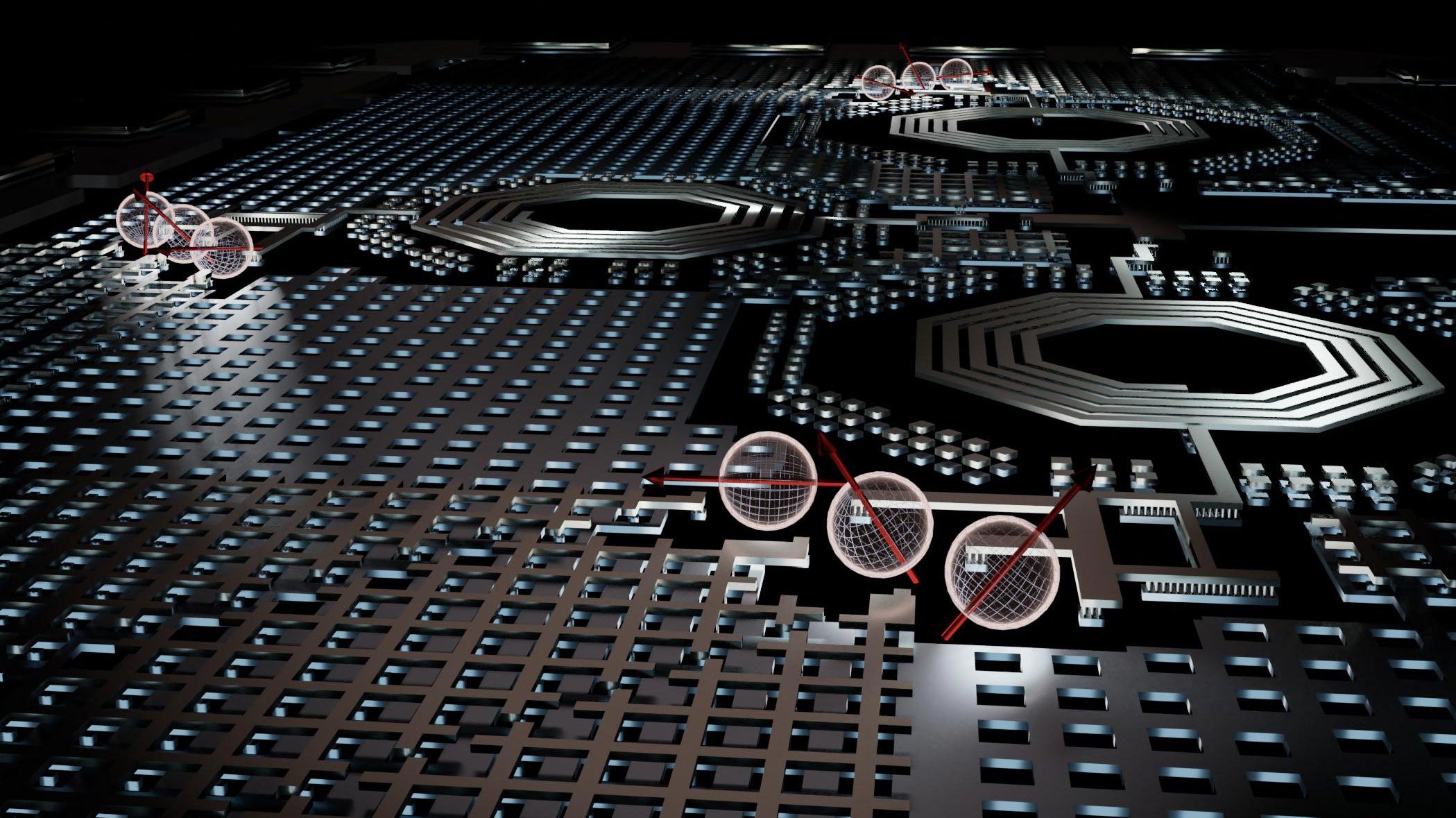
Engineers at EPFL have improved the efficiency of qubit reading in quantum computers, potentially overcoming current limitations on the number of qubits. This advancement, involving fewer connections and allowing simultaneous reading of multiple qubits, is significant for quantum computing applications in areas such as biochemistry and cryptography.
“IBM and Google currently have the world’s most powerful quantum computers,” says Prof. Edoardo Charbon, head of the Advanced Quantum Architecture Laboratory (AQUA Lab) in EPFL’s School of Engineering. “IBM has just unveiled a 127-qubit machine, while Google’s is 53 qubits.” The scope for making quantum computers even faster is limited, however, due to an upper bound on the number of qubits. But a team of engineers led by Charbon, in collaboration with researchers in the U.K., has just developed a promising method for breaking through this technological barrier. Their approach can read qubits more efficiently, meaning more of them can be packed into quantum processors. Their findings appear in Nature Electronics.
Biochemistry and Cryptography
Quantum computers don’t work like the computers we’re used to. Instead of having a separate processor and memory chip, the two are combined into a single unit known as a qubit. These computers use quantum properties such as superposition and entanglement to perform complicated calculations that regular computers could never do in a reasonable timeframe. Potential applications for quantum computers include biochemistry, cryptography, and more. The machines used by research groups today have around a dozen qubits.
“Our challenge now is to interconnect more qubits into quantum processors – we’re talking hundreds, even thousands – in order to boost the computers’ processing power,” says Charbon.
The number of qubits is currently limited by the fact that there’s no technology yet available that can read all the qubits rapidly. “Complicating things further, qubits operate at temperatures close to absolute zero, or –273.15oC (-459.67oF),” says Charbon. “That makes reading and controlling them even harder. What engineers typically do is use machines at room temperature and control each qubit individually.”
“It’s a Real Breakthrough”
Andrea Ruffino, a PhD student at Charbon’s lab, has developed a method enabling nine qubits to be read simultaneously and effectively. What’s more, his approach could be scaled up to larger qubit matrices. “Our method is based on using time and frequency domains,” he explains. “The basic idea is to reduce the number of connections by having three qubits work with a single bond.”
EPFL doesn’t have a quantum computer, but that didn’t stop Ruffino. He found a way to emulate qubits and run experiments under nearly the same conditions as those in a quantum computer. “I incorporated quantum dots, which are nanometer-sized semiconductor particles, into a transistor. That gave me something that works the same as qubits,” says Ruffino.
He’s the first PhD student in the AQUA Lab to study this topic for his thesis. “Andrea showed that his method works with integrated circuits on regular computer chips, and at temperatures approaching qubit ones,” says Charbon. “It’s a real breakthrough that could lead to systems of large qubit matrices integrated with the necessary electronics. The two types of technology could work together simply, effectively and in a reproducible manner.”
Reference: “A cryo-CMOS chip that integrates silicon quantum dots and multiplexed dispersive readout electronics” by Andrea Ruffino, Tsung-Yeh Yang, John Michniewicz, Yatao Peng, Edoardo Charbon and Miguel Fernando Gonzalez-Zalba, 27 December 2021, Nature Electronics.
DOI: 10.1038/s41928-021-00687-6
Never miss a breakthrough: Join the SciTechDaily newsletter.
Follow us on Google and Google News.
1 Comment
Goods Jobs