
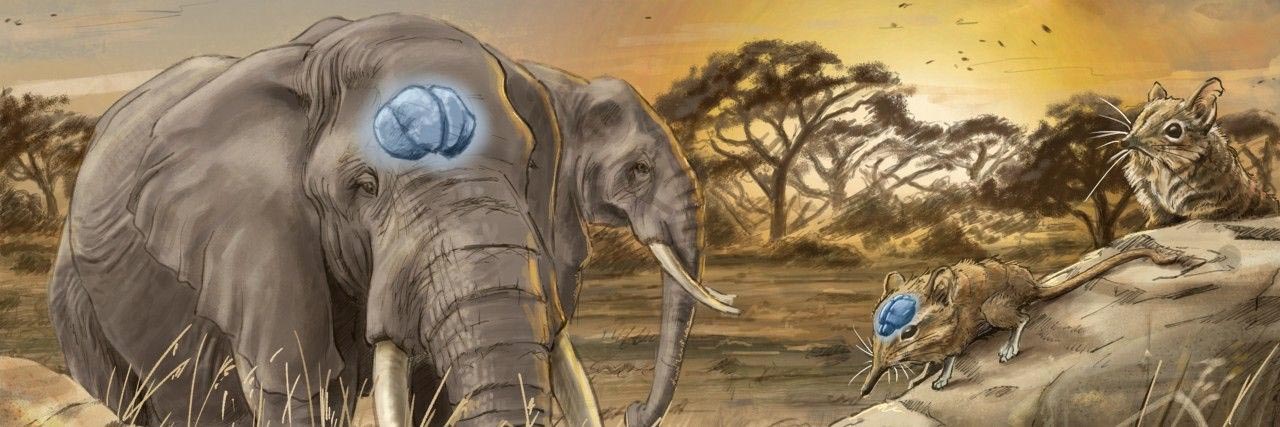
Largest study of its kind reveals the way relative brain size of mammals changed over the last 150 million years.
Scientists from Stony Brook University and the Max Planck Institute of Animal Behavior have pieced together a timeline of how brain and body size evolved in mammals over the last 150 million years. The international team of 22 scientists, including biologists, evolutionary statisticians, and anthropologists, compared the brain mass of 1400 living and extinct mammals. For the 107 fossils examined — among them ancient whales and the oldest Old World monkey skull ever found — they used endocranial volume data from skulls instead of brain mass data. The brain measurements were then analyzed along with body size to compare the scale of brain size to body size over deep evolutionary time.
Brain-Body Scaling Shows Complex Evolutionary Paths
The findings, published in Science Advances, showed that brain size relative to body size — long considered an indicator of animal intelligence — has not followed a stable scale over evolutionary time. Famous “big-brained” humans, dolphins, and elephants, for example, attained their proportions in different ways. Elephants increased in body size, but surprisingly, even more in brain size. Dolphins, on the other hand, generally decreased their body size while increasing brain size. Great apes showed a wide variety of body sizes, with a general trend towards increases in brain and body size. In comparison, ancestral hominins, which represent the human line, showed a relative decrease in body size and increase in brain size compared to great apes.
The authors say that these complex patterns urge a re-evaluation of the deeply rooted paradigm that comparing brain size to body size for any species provides a measure of the species’ intelligence. “At first sight, the importance of taking the evolutionary trajectory of body size into account may seem unimportant,” says Jeroen Smaers, an evolutionary biologist at Stony Brook University and first author on the study. “After all, many of the big-brained mammals such as elephants, dolphins, and great apes also have a high brain-to-body size. But this is not always the case. The California sea lion, for example, has a low relative brain size, which lies in contrast to their remarkable intelligence.”
By taking into account evolutionary history, the current study reveals that the California sea lion attained a low brain-to-body size because of the strong selective pressures on body size, most likely because aquatic carnivorans diversified into a semi-aquatic niche. In other words, they have a low relative brain size because of selection on increased body size, not because of selection on decreased brain size.
“We’ve overturned a long-standing dogma that relative brain size can be equivocated with intelligence,” says Kamran Safi, a research scientist at the Max Planck Institute of Animal Behavior and senior author on the study. “Sometimes, relatively big brains can be the end result of a gradual decrease in body size to suit a new habitat or way of moving — in other words, nothing to do with intelligence at all. Using relative brain size as a proxy for cognitive capacity must be set against an animal’s evolutionary history and the nuances in the way brain and body have changed over the tree of life.”
Mass Extinction and Climate Events Sparked Major Brain Shifts
The study further showed that most changes in brain size occurred after two cataclysmic events in Earth’s history: the mass extinction 66 million years ago and a climatic transition 23-33 million years ago.
After the mass extinction event at the end of the Cretaceous period, the researchers noticed a dramatic shift in brain-body scaling in lineages such as rodents, bats, and carnivores as animals radiated into the empty niches left by extinct dinosaurs. Roughly 30 million years later, a cooling climate in the Late Paleogene led to more profound changes, with seals, bears, whales, and primates all undergoing evolutionary shifts in their brain and body size.
“A big surprise was that much of the variation in relative brain size of mammals that live today can be explained by changes that their ancestral lineages underwent following these cataclysmic events,” says Smaers. This includes evolution of the biggest mammalian brains, such as the dolphins, elephants, and great apes, which all evolved their extreme proportions after the climate change event 23-33 million years ago.
The authors conclude that efforts to truly capture the evolution of intelligence will require increased effort in examining neuroanatomical features, such as brain regions known for higher cognitive processes. “Brain-to-body size is, of course, not independent of the evolution of intelligence,” says Smaers. “But it may actually be more indicative of more general adaptations to large-scale environmental pressures that go beyond intelligence.”
Reference: “The evolution of mammalian brain size” by J. B. Smaers, R. S. Rothman, D. R. Hudson, A. M. Balanoff, B. Beatty, D. K. N. Dechmann, D. de Vries, J. C. Dunn, J. G. Fleagle, C. C. Gilbert, A. Goswami, A. N. Iwaniuk, W. L. Jungers, M. Kerney, D. T. Ksepka, P. R. Manger, C. S. Mongle, F. J. Rohlf, N. A. Smith, C. Soligo, V. Weisbecker and K. Safi, 28 April 2021, Science Advances.
DOI: 10.1126/sciadv.abe2101
Never miss a breakthrough: Join the SciTechDaily newsletter.
Follow us on Google and Google News.