
Close Menu
    Facebook X (Twitter) Instagram
    SciTechDaily
    • Biology
    • Chemistry
    • Earth
    • Health
    • Physics
    • Science
    • Space
    • Technology
    Facebook X (Twitter) Pinterest YouTube RSS
    SciTechDaily
    Home»Technology»Smart Glass Has a Bright Future: Daylight Steering Provide Huge Energy Savings
    Technology

    Smart Glass Has a Bright Future: Daylight Steering Provide Huge Energy Savings

    By SPIE—International Society for Optics and PhotonicsApril 29, 20212 Comments4 Mins Read
    Facebook Twitter Pinterest Telegram LinkedIn WhatsApp Email Reddit
    Share
    Facebook Twitter LinkedIn Pinterest Telegram Email Reddit
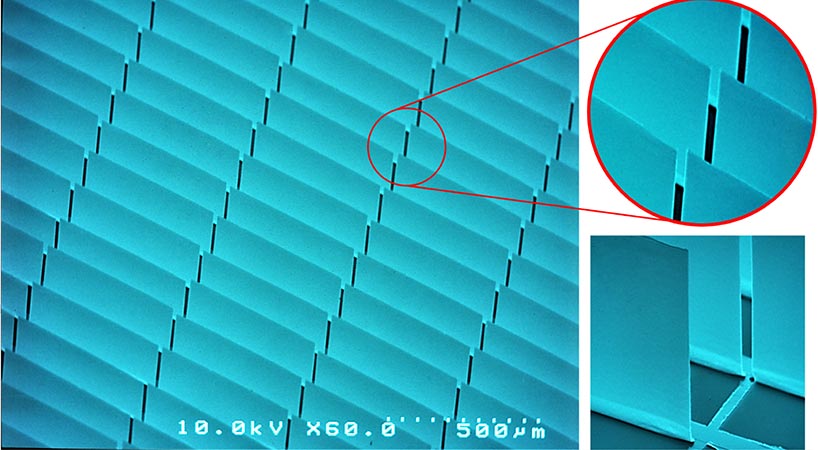
    Vertically Standing Flat Micromirror Array
    SEM micrograph of vertically standing, flat micromirror array with an inset of magnified area. Credit: Hillmer et al.

    Light modulation via optical MEMS microshutter and micromirror arrays could provide huge energy savings.

    Buildings are responsible for 40 percent of primary energy consumption and 36 percent of total CO2 emissions. And, as we know, CO2 emissions trigger global warming, sea level rise, and profound changes in ocean ecosystems. Substituting the inefficient glazing areas of buildings with energy efficient smart glazing windows has great potential to decrease energy consumption for lighting and temperature control.

    Harmut Hillmer et al. of the University of Kassel in Germany demonstrate that potential in “MOEMS micromirror arrays in smart windows for daylight steering,” a paper published recently in the inaugural issue of the Journal of Optical Microsystems.

    “Our smart glazing is based on millions of micromirrors, invisible to the bare eye, and reflects incoming sunlight according to user actions, sun positions, daytime, and seasons, providing a personalized light steering inside the building,” Hillmer said.
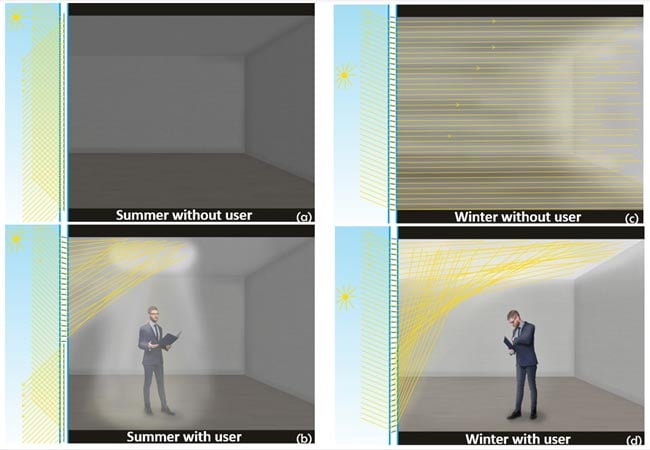
    Smart Glass Demonstration
    (a) If no user is present in summer all mirrors switch vertically, keeping solar heat outside. This saves huge energy by minimizing heat transfer. (b) Once user presence is detected by sensors in summer, upper mirrors open and reflect daylight to the ceiling area. The room stays cool where no user is standing, saving energy on climatization. Parts of the room far away from the window can be efficiently illuminated by daylight, saving energy on artificial light. (c) If no user is present in winter, all mirrors open and harvest energy by reflecting solar radiation onto a wall, acting as a radiation heater. This saves energy for heating. (d) Once user presence is detected in winter, all the mirrors will redirect the complete solar radiation to the ceiling to minimize glare. Now, the ceiling acts as a radiation heater, saving heating energy. Credit: Hillmer et al.

    Adaptive and Weather-Proof Smart Glazing

    The micromirror array is invulnerable to wind, window cleaning, or any weather conditions because it is located in the space between the windowpanes filled with noble gas such as argon or krypton. The glazing provides free solar heat in winter and overheating prevention in summer, and it enables healthy natural daylight, huge energy savings (up to 35 percent), massive CO2 reduction (up to 30 percent), and a reduction of 10 percent steel and concrete in high-rise buildings.

    Apart from the energy problem, artificial lighting also has consequences for health and well-being. Various studies have linked artificial lighting to lack of concentration, high susceptibility to illness, disturbed biorhythms, and sleeplessness. Smart glass can reduce reliance on artificial lighting by optimizing natural daylight in a room.

    Current state-of-the-art smart glazings are optimized either for winter or for summer and are not able to ensure energy-saving performance year-round. There has been a need for a smart and automatic technology that can react to local climate (daytime, season), uses available sunlight, regulates light and temperature, and saves substantial energy.

    MEMS Micromirrors Offer High-Speed, Low-Power Control

    The researchers’ MEMS micromirror arrays are integrated inside insulation glazing and are operated by an electronic control system. The orientation of mirrors is controlled by the voltage between respective electrodes. Motion sensors in the room detect the number, position, and movement of users in the room.

    The results include much higher actuation speed in the sub-ms range, 40 times lower power consumption than electrochromic or liquid crystal concepts, reflection instead of absorption, and color neutrality. Rapid aging tests of the micromirror structure were performed to study reliability and revealed sustainability, robustness, and long lifetimes of the micromirror arrays.

    And with positive results like that, the benefits of this smart glass are crystal clear.

    Reference: “MOEMS micromirror arrays in smart windows for daylight steering” by Harmut H. Hillmer, Mustaqim Siddi Que Iskhandar, Muhammad Kamrul Hasan, Sapida Akhundzada, Basim Al-Qargholi and Andreas Tatzel, 26 January 2021, Journal of Optical Microsystems.
    DOI: 10.1117/1.JOM.1.1.014502

    Never miss a breakthrough: Join the SciTechDaily newsletter.
    Follow us on Google and Google News.

    Energy Industrial Engineering Materials Science Optics SPIE
    Share. Facebook Twitter Pinterest LinkedIn Email Reddit

    Related Articles

    Smelting Steel Without Fossil Fuels: Solar Power Shatters the 1,000°C Barrier for Industrial Heating

    New Holographic Light Collector Boosts Solar Panel Efficiency

    Illuminating Dark, Underground Spaces: Scientists Design “Smart” Device to Harvest Daylight

    Direct Solar Steam Generation: Harvesting the Sun’s Energy for Clean Drinking Water

    “Perfect” Solar Energy Absorber Created by Laser Etching Metal With Nanoscale Structures

    New Material Can Be Molded into Highly Conductive 3D Structures

    Thermal Cloak Molds the Flow of Heat Around an Object

    Researchers Reveal the Cause of LED Efficiency Droop

    Nanosheet-Flower Structure Boosts Energy Storage

    2 Comments

    1. John Campbell on April 29, 2021 11:31 am

      Miniaturization can even extend to venetian blinds! Whoda thunk?!

      Reply
    2. MrScott on May 4, 2021 4:47 am

      Where would the “reduction of 10 percent steel and concrete in high-rise buildings” come from, exactly? Reduction of HVAC equipment weight and volume?

      Reply
    Leave A Reply Cancel Reply

    • Facebook
    • Twitter
    • Pinterest
    • YouTube

    Don't Miss a Discovery

    Subscribe for the Latest in Science & Tech!

    Trending News

    The Universe Is Expanding Too Fast and Scientists Can’t Explain Why

    “Like Liquid Metal”: Scientists Create Strange Shape-Shifting Material

    Early Warning Signals of Esophageal Cancer May Be Hiding in Plain Sight

    Common Blood Pressure Drug Shows Surprising Power Against Deadly Antibiotic-Resistant Superbug

    Scientists Uncover Dangerous Connection Between Serotonin and Heart Valve Disease

    Scientists Discover a “Protector” Protein That Could Help Reverse Hair Loss

    Bone-Strengthening Discovery Could Reverse Osteoporosis

    Scientists Uncover Hidden Trigger Behind Stem Cell Aging

    Follow SciTechDaily
    • Facebook
    • Twitter
    • YouTube
    • Pinterest
    • Newsletter
    • RSS
    SciTech News
    • Biology News
    • Chemistry News
    • Earth News
    • Health News
    • Physics News
    • Science News
    • Space News
    • Technology News
    Recent Posts
    • A Common Diabetes Drug May Hold the Key to Stopping HIV From Coming Back
    • Ancient “Syphilis-Like” Disease in Vietnam Challenges Key Scientific Assumptions
    • Drinking Alcohol To Cope in Your 20s Could Damage Your Brain for Life
    • Scientists Crack Alfalfa’s Chromosome Mystery After Decades of Debate
    • Ancient Ant-Plant Alliance Collapses As Predatory Wasps Move In
    Copyright © 1998 - 2026 SciTechDaily. All Rights Reserved.
    • Science News
    • About
    • Contact
    • Editorial Board
    • Privacy Policy
    • Terms of Use

    Type above and press Enter to search. Press Esc to cancel.