
Close Menu
    Facebook X (Twitter) Instagram
    SciTechDaily
    • Biology
    • Chemistry
    • Earth
    • Health
    • Physics
    • Science
    • Space
    • Technology
    Facebook X (Twitter) Pinterest YouTube RSS
    SciTechDaily
    Home»Space»Mars-Directed Coronal Mass Ejection Erupts From the Sun
    Space

    Mars-Directed Coronal Mass Ejection Erupts From the Sun

    By NASAApril 26, 2021No Comments2 Mins Read
    Facebook Twitter Pinterest Telegram LinkedIn WhatsApp Email Reddit
    Share
    Facebook Twitter LinkedIn Pinterest Telegram Email Reddit
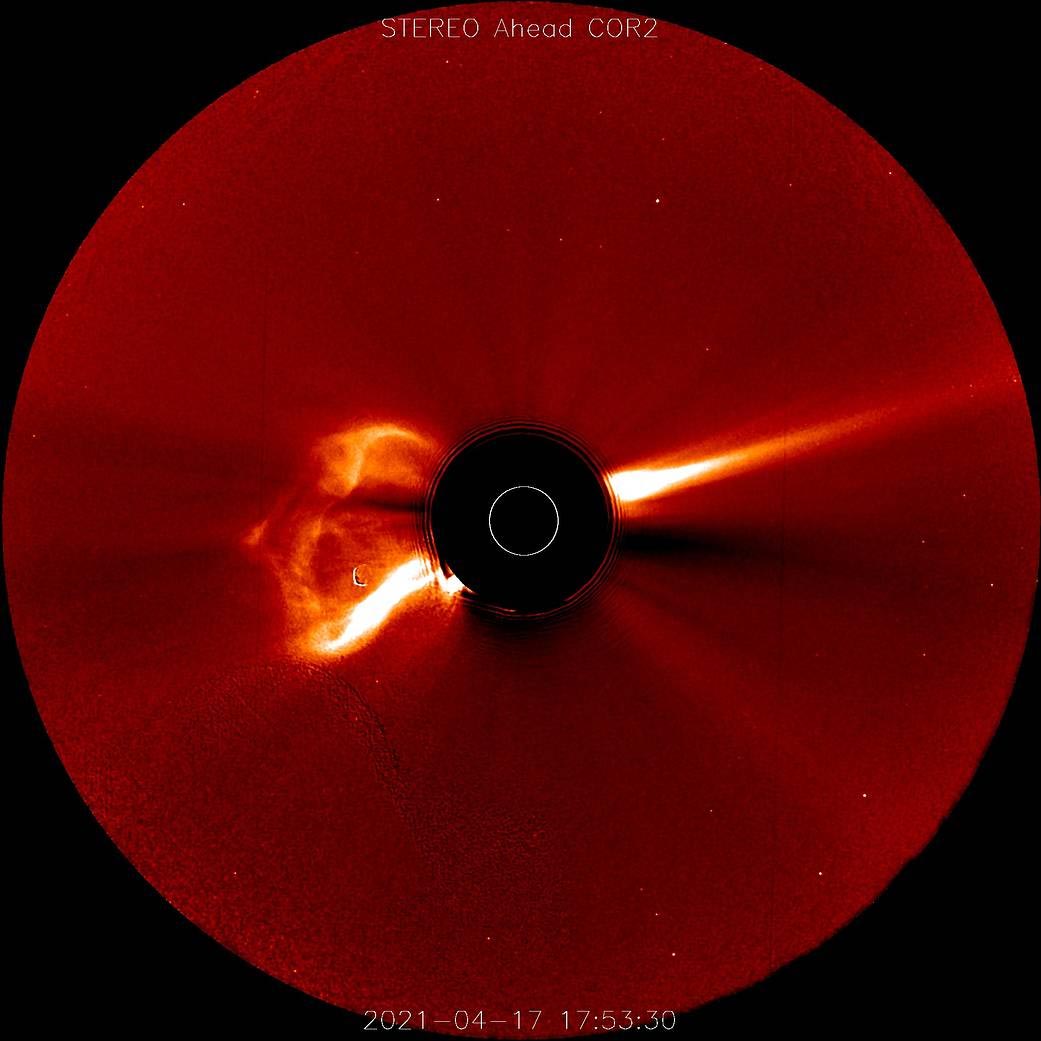
    STEREO-A Spacecraft CME April 2021
    Imagery from NASA’s STEREO-A spacecraft detected the CME erupting from the Sun’s limb. This coronagraph image blocks the Sun’s bright surface (black circle, center image) to reveal the Sun’s corona, or outer atmosphere. Credit: NASA/STEREO-A/COR2

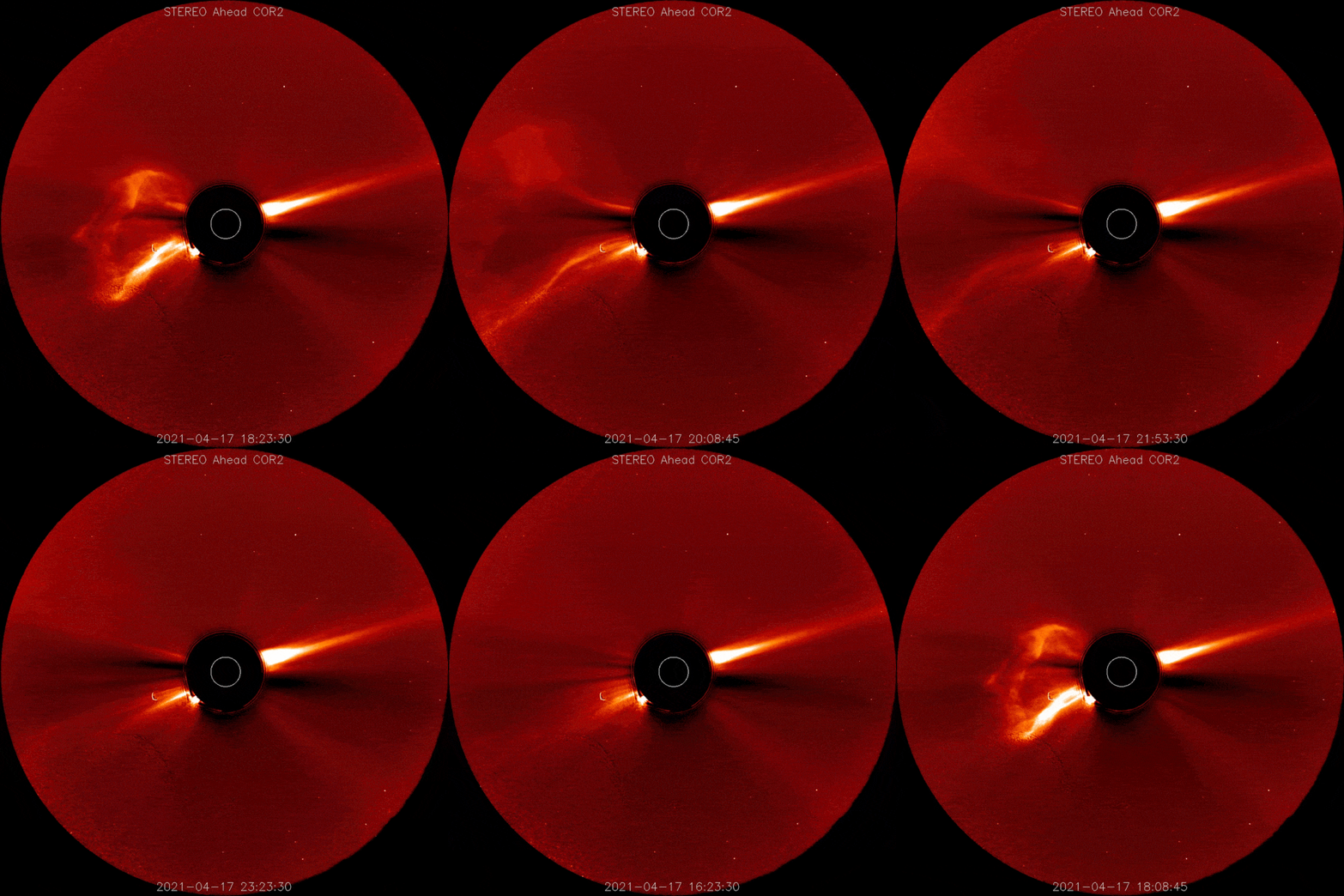
    NASA’s STEREO-A and ESA/NASA’s SOHO spacecraft detected a coronal mass ejection, or CME, leaving the Sun on April 17 at 12:36 p.m. EDT. This CME did not impact Earth but did move toward Mars, passing the planet in the late evening and early morning hours of April 21 and 22.

    The CME reached Mars two days after NASA’s Ingenuity Mars Helicopter became the first aircraft in history to make a powered, controlled flight on another planet. NASA tracks such solar eruptions because solar eruptions can trigger particle and radiation events that pose a risk to astronauts and sensitive spacecraft electronics. As astronauts venture beyond Earth’s protective magnetic field to the Moon and Mars, NASA’s Moon to Mars Space Weather Office at NASA Goddard Space Flight Center in Greenbelt, Maryland, in collaboration with the Community Coordinated Modeling Center tracks solar activity to give advanced warning to spacecraft and crewed missions.
    STEREO A Spacecraft CME April 2021

    The CME was a relatively slow one, traveling between 1.5 and 1.8 million miles an hour  (700 and 800 kilometers per second).  It caused no issues for concern and the Ingenuity team did not need to take any steps to protect the helicopter.  As we go forward, however, NASA will continue to include space weather updates as a factor when making decisions around our technology – and one day, astronauts – on Mars.

    Never miss a breakthrough: Join the SciTechDaily newsletter.
    Follow us on Google and Google News.

    Astronomy Mars NASA NASA Goddard Space Flight Center SOHO Sun
    Share. Facebook Twitter Pinterest LinkedIn Email Reddit

    Related Articles

    Unusual “Rosetta Stone” Solar Eruption Could Help Explain Mysterious Powerful Explosions on the Sun

    A New View of Small Sun Structures Allows NASA to Explore the Solar Wind Like Never Before

    U.S. Postal Service to Issue Sun Science Forever Stamps With 10 Spectacular Images From NASA’s Solar Dynamics Observatory

    Secrets Behind Sunquakes May Lurk Beneath the Solar Surface

    NASA’s Solar Dynamics Observatory Spots First Lunar Transit of 2021

    A Small, Bright Surprise: Two Views of a Sungrazing Comet

    Astronomers May Have Spotted a Nanoflare on the Sun – First Predicted 48 Years Ago to Solve a Major Mystery

    ESA/NASA Solar and Heliospheric Observatory Celebrates a Quarter-Century in Space

    How NASA & Scientists Around the World Track the Solar Cycle

    Leave A Reply Cancel Reply

    • Facebook
    • Twitter
    • Pinterest
    • YouTube

    Don't Miss a Discovery

    Subscribe for the Latest in Science & Tech!

    Trending News

    Even Occasional Binge Drinking May Triple Liver Damage Risk

    Liftoff! NASA’s Artemis II Launch Sends Astronauts Around the Moon for First Time in 50 Years

    Scientists Discover New Way To Eliminate “Zombie Cells” Driving Aging

    This New Quantum Theory Could Change Everything We Know About the Big Bang

    This One Vitamin May Help Protect Your Brain From Dementia Years Later

    Stopping Weight-Loss Drugs Like Ozempic Can Quickly Erase Heart Benefits

    A 500-Million-Year-Old Surprise Is Forcing Scientists to Rethink Spider Evolution

    Coffee and Blood Pressure: What You Need To Know Before Your Next Cup

    Follow SciTechDaily
    • Facebook
    • Twitter
    • YouTube
    • Pinterest
    • Newsletter
    • RSS
    SciTech News
    • Biology News
    • Chemistry News
    • Earth News
    • Health News
    • Physics News
    • Science News
    • Space News
    • Technology News
    Recent Posts
    • NASA’s Artemis II: Humans Just Left Earth Orbit for the First Time Since 1972
    • What Causes Chronic Pain? Scientists Identify Key Culprit in the Brain
    • Semaglutide Shows Surprising Mental Health Benefits in Massive 100,000-Person Study
    • This Little-Known Japanese Fruit Could Help Stop Lung Cancer Before It Starts
    • Scientists Uncover Giant Lava Fields From an Active Underwater Volcano
    Copyright © 1998 - 2026 SciTechDaily. All Rights Reserved.
    • Science News
    • About
    • Contact
    • Editorial Board
    • Privacy Policy
    • Terms of Use

    Type above and press Enter to search. Press Esc to cancel.