
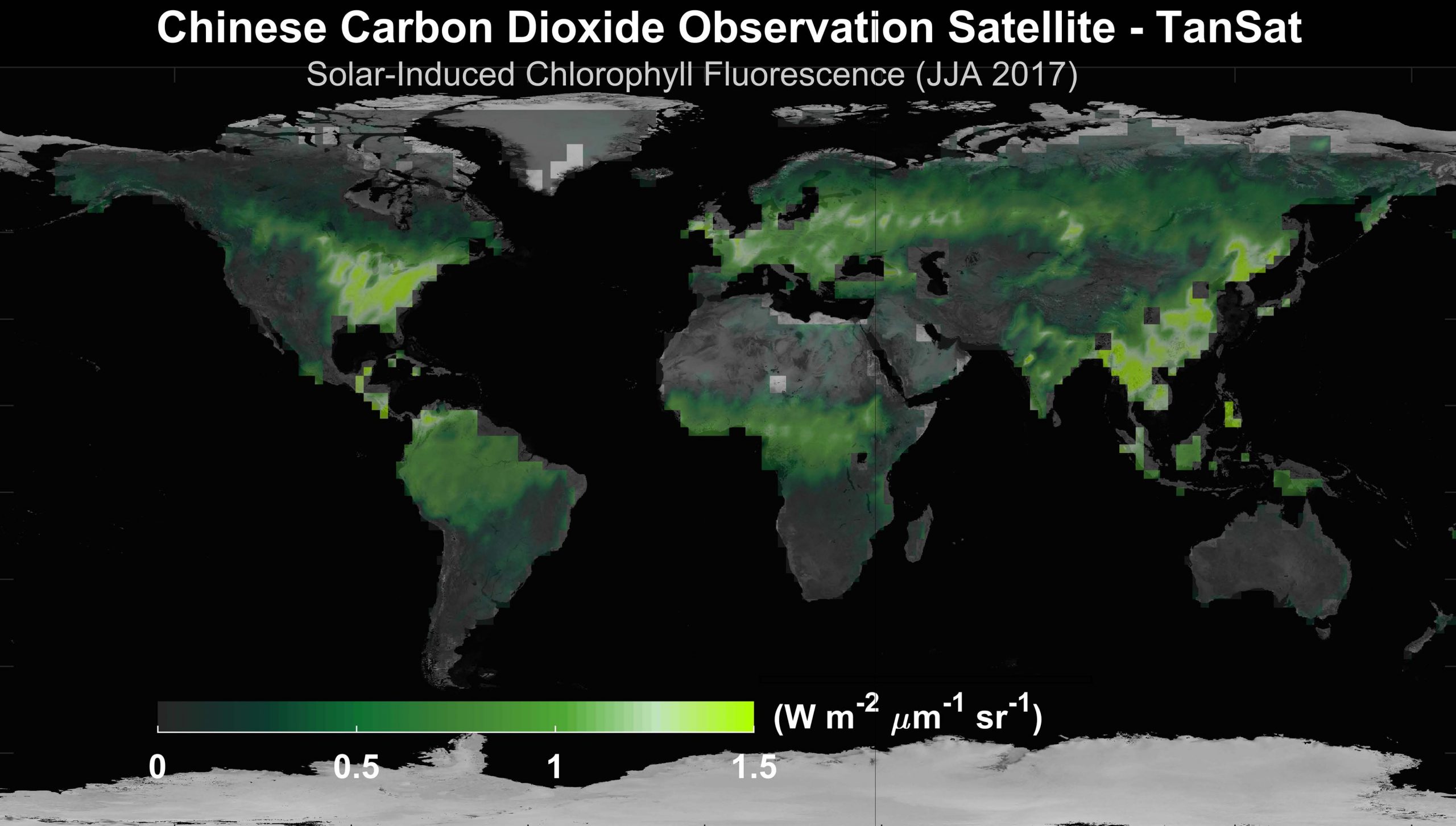
China’s TanSat refines SIF data with a new algorithm, improving carbon sink monitoring and aiding global climate goals.
Solar-induced chlorophyll fluorescence (SIF) is emitted during plant photosynthesis. SIF results from vegetation chlorophyll giving off red and infrared light wavelengths when excited by solar radiation. Measuring SIF is important because it is closely related to the terrestrial gross primary productivity (GPP), which calculates the total amount of carbon dioxide fixed through photosynthesis in a given area. According to many laboratory and field experiments, studies show that SIF can effectively improve estimations of GPP, which is necessary for global carbon sink research and carbon mitigation strategies.
China has committed to carbon neutrality by 2060. Technological upgrades and energy structure adjustments through the next four decades will be vital to reducing carbon emissions. However, the goal is even more attainable considering the large natural carbon sink provided by plants. Expanding the capacity of the terrestrial ecosystem allows natural carbon fixation to provide a more direct and efficient path toward a carbon neutral future. Therefore, scientists must assess the natural carbon sink accurately to evaluate current and forthcoming carbon neutrality implementation plans.
Supported by the Ministry of Science and Technology of China, the Chinese Academy of Sciences, and the China Meteorological Administration, the Chinese Carbon Dioxide Monitoring Satellite Mission (TanSat) was launched in December 2016. TanSat monitors global atmospheric CO2 concentrations and is capable of measuring SIF
The first TanSat global SIF map was constructed using a data-driven method based on the SVD (singular value decomposition) technique. TanSat now retrieves its SIF product from a new physical-based algorithm named IAPCAS/SIF. This algorithm is based on the CAS Institute of Atmospheric Physics Carbon Dioxide Retrieval Algorithm for Satellite Remote Sensing Platform, which maps global atmospheric CO2 distribution. The IAPCAS/SIF algorithm provides SIF emission data from two micro-windows, 757nm and 771nm, within the O2 A-band.
Challenges in Verifying Satellite-Based SIF Accuracy
Due to spatial scale differences, it is difficult to directly verify the accuracy and precision of satellite-measured SIF with SIF measured at the leaf or canopy scale. Much like satellite-based XCO2 products, SIF retrievals still need more comprehensive verification trials that assess precision for further carbon flux estimations.
“The intercomparison between SIF products by different algorithms can verify the reliability of the algorithms, and also provide ideas for subsequent algorithm optimization,” said Dr. YANG Dongxu, the principal investigator of TanSat mission.
His team compared the TanSat SIF products provided by the new IAPCAS/SIF algorithm and the data-driven (SVD) method. Considering both scale and time, results indicate that the two SIF products agree well on a global extent thought the year. While the team noticed a slight regional bias in the SIF maps, the linear correlations between the two SIF products are strong, higher than 0.73, for all seasons. Their TanSat SIF algorithm comparison is published in Advances in Atmospheric Sciences.
Researchers will analyze and use the new SIF product to better understand the terrestrial ecosystem. This includes assimilating SIF data into GPP modeling and global carbon flux estimations. Optimization of the IAPCAS/SIF algorithm will help to develop SIF products from other satellite missions, and scientists hope that exploring the comprehensive usage of SIF products will promote the quantitive research of the global carbon sink and climate change.
Reference: “A New Global Solar-induced Chlorophyll Fluorescence (SIF) Data Product from TanSat Measurements” by Lu Yao, Dongxu Yang, Yi Liu, Jing Wang, Liangyun Liu, Shanshan Du, Zhaonan Cai, Naimeng Lu, Daren Lyu, Maohua Wang, Zengshan Yin and Yuquan Zheng, 4 February 2021, Advances in Atmospheric Sciences.
DOI: 10.1007/s00376-020-0204-6
TanSat SIF products are available from the CASA (the Cooperation on the Analysis of carbon SAtellites data) TanSat data and science service.
Never miss a breakthrough: Join the SciTechDaily newsletter.
Follow us on Google and Google News.