
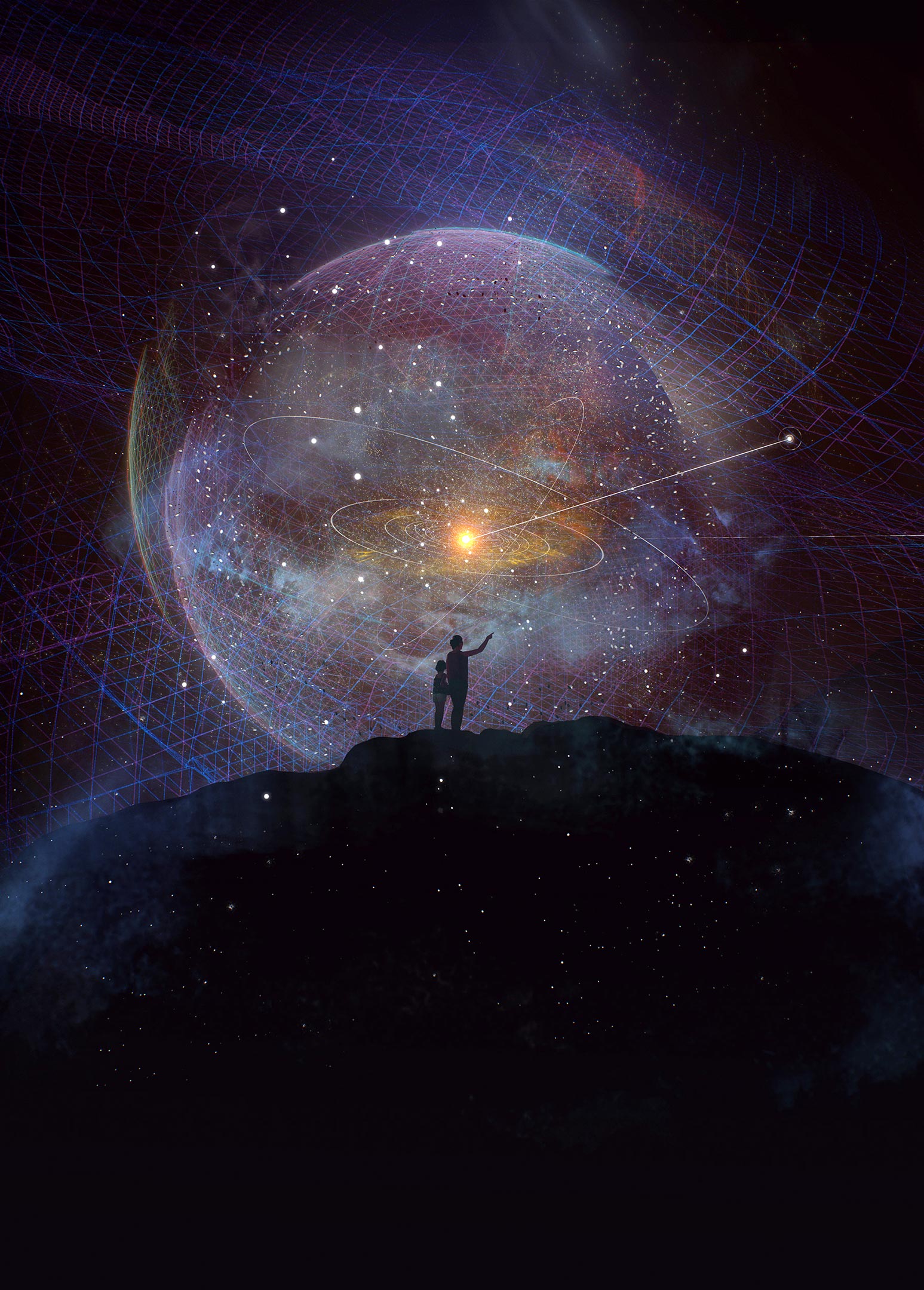
NASA’s Interstellar Probe will travel beyond Voyager’s path to study the heliosphere’s shape, cosmic rays, and the sun’s movement through the galaxy.
When the four-decades-old Voyager 1 and Voyager 2 spacecraft entered interstellar space in 2012 and 2018, respectively, scientists celebrated. These plucky spacecraft had already traveled 120 times the distance from the Earth to the sun to reach the boundary of the heliosphere, the bubble encompassing our solar system that’s affected by the solar wind. The Voyagers discovered the edge of the bubble but left scientists with many questions about how our Sun interacts with the local interstellar medium. The twin Voyagers’ instruments provide limited data, leaving critical gaps in our understanding of this region.
NASA and its partners are now planning for the next spacecraft, currently called the Interstellar Probe, to travel much deeper into interstellar space, 1,000 astronomical units (AU) from the sun, with the hope of learning more about how our home heliosphere formed and how it evolves.
“The Interstellar Probe will go to the unknown local interstellar space, where humanity has never reached before,” says Elena Provornikova, the Interstellar Probe heliophysics lead from the Johns Hopkins Applied Physics Lab (APL) in Maryland. “For the first time, we will take a picture of our vast heliosphere from the outside to see what our solar system home looks like.”
Provornikova and her colleagues will discuss the heliophysics science opportunities for the mission at the European Geosciences Union (EGU) General Assembly 2021.
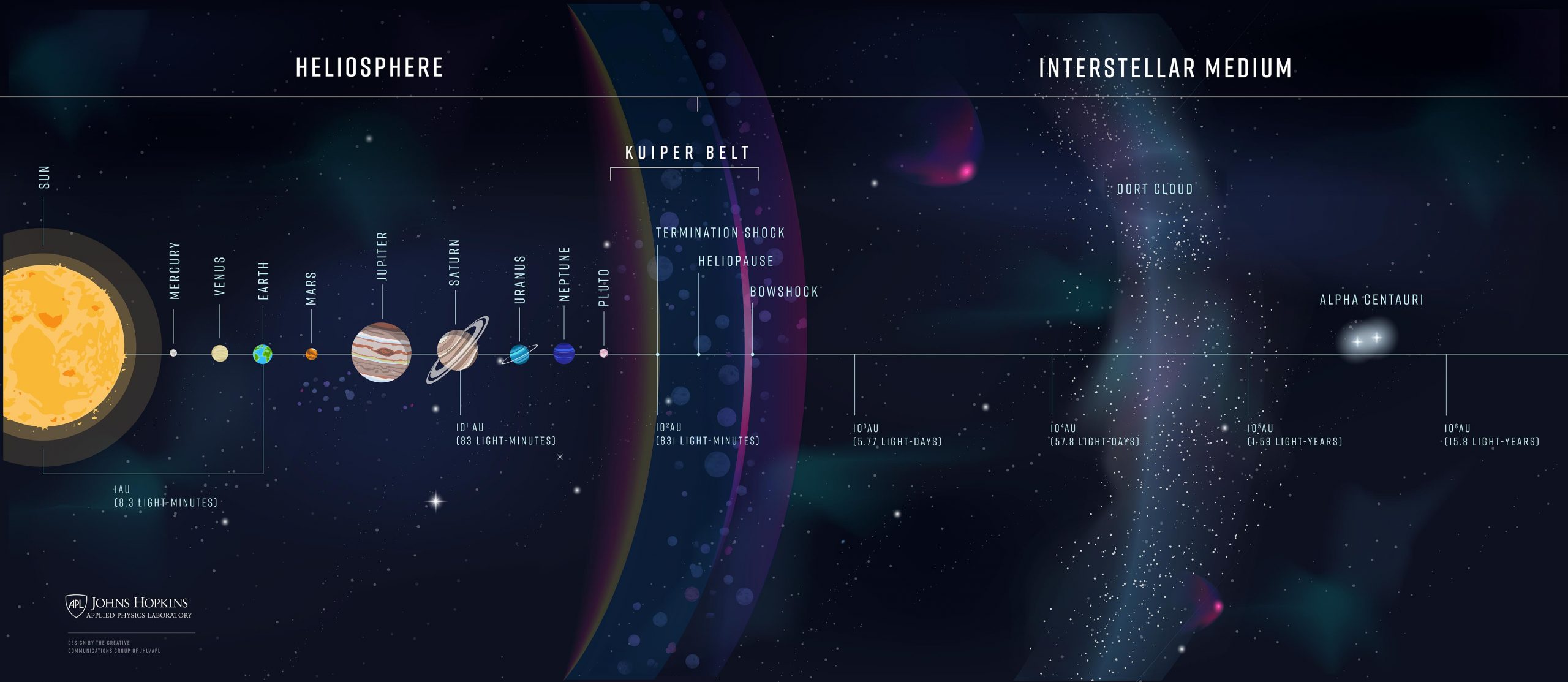
The APL-led team, which involves some 500 scientists, engineers, and enthusiasts — both formal and informal — from around the world, has been studying what types of investigations the mission should plan for. “There are truly outstanding science opportunities that span heliophysics, planetary science, and astrophysics,” Provornikova says.
Unraveling Cosmic Mysteries in Deep Space
Some mysteries the team hopes to solve with the mission include: how the sun’s plasma interacts with interstellar gas to create our heliosphere; what lies beyond our heliosphere; and what our heliosphere even looks like. The mission plans to take “images” of our heliosphere using energetic neutral atoms, and perhaps even “observe extragalactic background light from the early times of our galaxy formation — something that can’t be seen from Earth,” Provornikova says. Scientists also hope to learn more about how our sun interacts with the local galaxy, which might then offer clues as to how other stars in the galaxy interact with their interstellar neighborhoods, she says.
The heliosphere is also important because it shields our solar system from high-energy galactic cosmic rays. The sun is traveling around in our galaxy, going through different regions in interstellar space, Provornikova says. The sun is currently in what is called the Local Interstellar Cloud, but recent research suggests the sun may be moving toward the edge of the cloud, after which it would enter the next region of interstellar space — which we know nothing about. Such a change may make our heliosphere grow bigger or smaller or change the amount of galactic cosmic rays that get in and contribute to the background radiation level at Earth, she says.
This is the final year of a four-year “pragmatic concept study,” in which the team has been investigating what science could be accomplished with this mission. At the end of the year, the team will deliver a report to NASA that outlines potential science, example instrument payloads, and example spacecraft and trajectory designs for the mission. “Our approach is to lay out the menu of what can be done in such a space mission,” Provornikova says.
The mission could launch in the early 2030s and would take about 15 years to reach the heliosphere boundary — a pace that’s quick compared to the Voyagers, which took 35 years to get there. The current mission design is planned to last 50 years or more.
Reference: “Unique heliophysics science opportunities along the Interstellar Probe journey up to 1000 AU from the Sun” by Elena Provornikova, Pontus C. Brandt, Ralph L. McNutt, Jr., Robert DeMajistre, Edmond C. Roelof, Parisa Mostafavi, Drew Turner, Matthew E. Hill, Jeffrey L. Linsky, Seth Redfield, Andre Galli, Carey Lisse, Kathleen Mandt, Abigail Rymer and Kirby Runyon, 26 April 2021, EGU General Assembly 2021.
DOI: 10.5194/egusphere-egu21-10504
Never miss a breakthrough: Join the SciTechDaily newsletter.
Follow us on Google and Google News.