
Close Menu
    Facebook X (Twitter) Instagram
    SciTechDaily
    • Biology
    • Chemistry
    • Earth
    • Health
    • Physics
    • Science
    • Space
    • Technology
    Facebook X (Twitter) Pinterest YouTube RSS
    SciTechDaily
    Home»Space»Mars Global Surveyor Observes Textured Dust Storms
    Space

    Mars Global Surveyor Observes Textured Dust Storms

    By Harvard-Smithsonian Center for AstrophysicsMarch 17, 2017No Comments3 Mins Read
    Facebook Twitter Pinterest Telegram LinkedIn WhatsApp Email Reddit
    Share
    Facebook Twitter LinkedIn Pinterest Telegram Email Reddit
    Textured Dust Storms Observed by Mars Global Surveyor
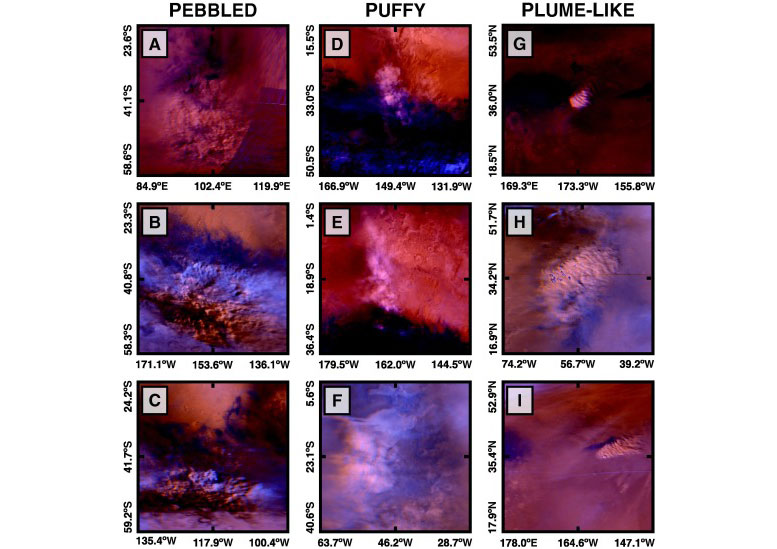
    An image from the Mars Gobal Surveyor showing a “pebbled”-type dust storm.

    Astronomers have identified three kinds of textured dust storms on Mars, and found that these textured storms have preferred seasons and locations.

    Astronomers studying Mars first noted the presence of yellow clouds on its surface in the 1870s. Today these windblown dust storms on Mars are well known, and can span local, regional, or even global in scale. Storms can display visible structures, sometimes periodic with wavelike features, or in other cases streaky or plume-like. Storms with structures are called “textured dust storms” and they result from strong winds or other meteorological effects that lift dust into the Martian atmosphere. In addition to obscuring views of the Martian surface, the dust can affect atmospheric heating and other climatic processes. These dust storms, despite having been studied for more than a century, remain rather mysterious. It is not understood, for example, how textured storms are distributed over the surface of the planet, when their frequency peaks, or how much dust is actually swept up.

    CfA astronomer Huiqun Wang and two colleagues have been using the Mars Global Surveyor (MGS) images to analyze textured dust storms. Launched in 1999, MGS has provided about four Mars-years of daily global data that are particularly suitable for studying various aspects of clouds and dust storms. The new analysis focuses on the dust storms that occurred between May 1999 and October 2006, including a global dust storm in June 2001. There were 3955 textured dust storms during these periods. The scientists manually mark the position of each textured dust storm in the MGS image, and categorize its texture into one of three new categories they have developed: pebbled textures, characterized by a granular or crinkled appearance suggestive of strong turbulence, puffy textures with a bubbling appearance and cotton-like structures analogous to cumulus clouds indicative of vertical motions, and plume-like textures composed of multiple parallel elongated features suggestive of dust being uplifted and carried downstream by strong winds.

    The scientists find that these three texture types have preferred seasons and distinctive locations; puffy storms, for example, tend to appear in the low latitudes and might therefore result from vertical convective winds there. Pebbled storms occur more frequently in the southern mid-latitudes implying that these zones are more turbulent than the northern mid/high-latitudes. The new results suggest links between storm texture type and meteorological conditions that can lead to an improved understanding of the Martian climate.

    Reference: “The Seasonal and Spatial Distribution of Textured Dust Storms Observed by Mars Global Surveyor Mars Orbiter Camera” by Laura Kulowski, Huiqun Wang and Anthony D. Toigo, 27 December 2016, Advances in Space Research.
    DOI: 10.1016/j.asr.2016.10.028

    Never miss a breakthrough: Join the SciTechDaily newsletter.
    Follow us on Google and Google News.

    Astronomy Harvard-Smithsonian Center for Astrophysics Mars Mars Global Surveyor Mission Planetary Science
    Share. Facebook Twitter Pinterest LinkedIn Email Reddit

    Related Articles

    Martian Dust Storms Can Regenerate and Sustain Themselves

    NASA Spacecraft Map Gravity on Mars, Give Best View Yet Inside Mars

    Astronomers Study Textured Dust Storms on Mars

    Curiosity’s ChemCam Laser Yields Good Results

    NASA’s Curiosity Readies for First Drive on Mars

    Color HiRISE Image of Curiosity Rover on Mars

    First 360-Degree Color Panorama From NASA’s Curiosity Mars Rover

    A Connection Between Volatiles in the Subsurface of Mars and the Impact Process

    Near Miss Asteroid – An Opportunity To Test a Rapid Response Program

    Leave A Reply Cancel Reply

    • Facebook
    • Twitter
    • Pinterest
    • YouTube

    Don't Miss a Discovery

    Subscribe for the Latest in Science & Tech!

    Trending News

    New “Nanozyme Hypothesis” Could Rewrite the Story of Life’s Origins

    Anatomy Isn’t Finished: The Human Body Still Holds Secrets

    “Pretty Close to Home”: The Hidden Earthquake Threat Beneath Seattle

    The Surprising Reason You Might Want To Sleep Without a Pillow

    Scientists Say This Natural Hormone Reverses Obesity by Targeting the Brain

    35-Million-Year-Old Mystery: Strange Arachnid Discovered Preserved in Amber

    Is AI Really Just a Tool? It Could Be Altering How You See Reality

    JWST Reveals a “Forbidden” Planet With a Baffling Composition

    Follow SciTechDaily
    • Facebook
    • Twitter
    • YouTube
    • Pinterest
    • Newsletter
    • RSS
    SciTech News
    • Biology News
    • Chemistry News
    • Earth News
    • Health News
    • Physics News
    • Science News
    • Space News
    • Technology News
    Recent Posts
    • Saturn’s Magnetic Shield Isn’t What Scientists Expected
    • Hidden Oceans of Magma Could Be Protecting Alien Life
    • After Decades of Searching, Astronomers Finally Track Down the Universe’s Missing Hydrogen
    • Scientists Capture Hidden Electron Patterns Inside Quantum Materials
    • New Study Challenges Alzheimer’s Theories: It’s Not Just About Plaques
    Copyright © 1998 - 2026 SciTechDaily. All Rights Reserved.
    • Science News
    • About
    • Contact
    • Editorial Board
    • Privacy Policy
    • Terms of Use

    Type above and press Enter to search. Press Esc to cancel.