

More stable quantum experiments are made possible at TU Wien with new tricks – by ingeniously splitting Bose-Einstein condensates
Quantum experiments, whether they focus on quantum computers, quantum teleportation, or novel quantum sensors, consistently face a common challenge: quantum effects are highly fragile and easily disrupted. They are extremely sensitive to external disturbances – for example, to fluctuations caused simply by the surrounding temperature. It is therefore important to be able to cool down quantum experiments as effectively as possible.
At TU Wien (Vienna), it has now been shown that this type of cooling can be achieved in an interesting new way: A Bose-Einstein condensate is split into two parts, neither abruptly nor particularly slowly, but with a very specific temporal dynamic that ensures that random fluctuations are prevented as perfectly as possible. In this way, the relevant temperature in the already extremely cold Bose-Einstein condensate can be significantly reduced. This is important for quantum simulators, which are used at TU Wien to gain insights into quantum effects that could not be investigated using previous methods.
Quantum simulators
“We work with quantum simulators in our research,” says Maximilian Prüfer, who is researching new methods at TU Wien’s Atomic Institute with the help of an Esprit Grant from the FWF. “Quantum simulators are systems whose behavior is determined by quantum mechanical effects and which can be controlled and monitored particularly well. These systems can therefore be used to study fundamental phenomena of quantum physics that also occur in other quantum systems, which cannot be studied so easily.”
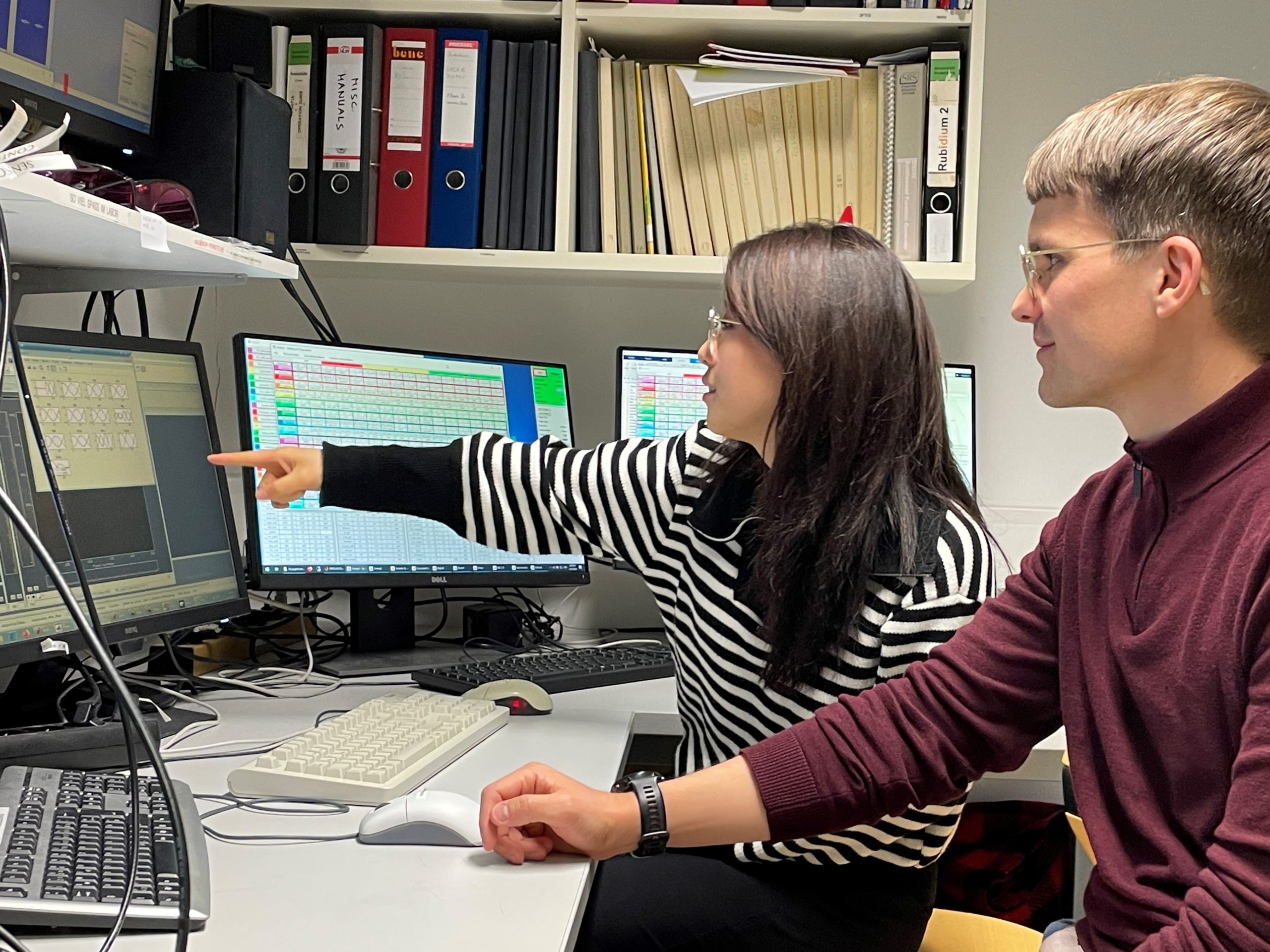
This means that a physical system is used to actually learn something about other systems. This idea is not entirely new in physics: for example, you can also carry out experiments with water waves in order to learn something about sound waves – but water waves are easier to observe.
“In quantum physics, quantum simulators have become an extremely useful and versatile tool in recent years,” says Maximilian Prüfer. “Among the most important tools for realizing interesting model systems are clouds of extremely cold atoms, such as those we study in our laboratory.” In the current paper published in Physical Review X, the scientists led by Jörg Schmiedmayer and Maximilian Prüfer investigated how quantum entanglement evolves over time and how this can be used to achieve an even colder temperature equilibrium than before. Quantum simulation is also a central topic in the recently launched QuantA Cluster of Excellence, in which various quantum systems are being investigated.
The colder, the better
The decisive factor that usually limits the suitability of such quantum simulators at present is their temperature: “The better we cool down the interesting degrees of freedom of the condensate, the better we can work with it and the more we can learn from it,” says Maximilian Prüfer.
There are different ways to cool something down: For example, you can cool a gas by increasing its volume very slowly. With extremely cold Bose-Einstein condensates, other tricks are typically used: the most energetic atoms are quickly removed until only a collection of atoms remains, which have a fairly uniformly low energy and are therefore cooler.
“But we use a completely different technique,” says Tiantian Zhang, first author of the study, who investigated this topic as part of her doctoral thesis at the Doctoral College of the Vienna Center for Quantum Science and Technology. “We create a Bose-Einstein condensate and then split it into two parts by creating a barrier in the middle.” The number of particles which end up on the right side and on the left side of the barrier is undetermined. Due to the laws of quantum physics, there is a certain amount of uncertainty here. One could say that both sides are in a quantum-physical superposition of different particle number states.
“On average, exactly 50% of the particles are on the left and 50% on the right,” says Maximilian Prüfer. “But quantum physics says that there are always certain fluctuations. The fluctuations, i.e. the deviations from the expected value, are closely related to the temperature.”
Cooling by controlling the fluctuations
The research team at TU Wien was able to show: neither an extremely abrupt nor an extremely slow splitting of the Bose-Einstein condensate is optimal. A compromise must be found, a cleverly tailored way to dynamically split the condensate, in order to control the quantum fluctuations as well as possible. This cannot be calculated: this problem cannot be solved using conventional computers. But with experiments, the research team was able to show: The appropriate splitting dynamics can be used to suppress the fluctuation in the number of particles, and this in turn translates into a reduction the temperature that you want to minimize.
“Different temperature scales exist simultaneously in this system, and we lower a very specific one of them,” explains Maximilian Prüfer. “So you can’t think of it like a mini-fridge that gets noticeably colder overall. But that’s not what we’re talking about: suppressing the fluctuations is exactly what we need to be able to use our system as a quantum simulator even better than before. We can now use it to answer questions from fundamental quantum physics that were previously inaccessible.”
Reference: “Squeezing Oscillations in a Multimode Bosonic Josephson Junction” by Tiantian Zhang, Mira Maiwöger, Filippo Borselli, Yevhenii Kuriatnikov, Jörg Schmiedmayer and Maximilian Prüfer, 15 March 2024, Physical Review X.
DOI: 10.1103/PhysRevX.14.011049
Never miss a breakthrough: Join the SciTechDaily newsletter.
Follow us on Google and Google News.
1 Comment
The laboratory data is already outpacing the old mainstream theories. Every time a major university achieves a breakthrough right now, they are forced to use terms like “collective behavior”, “structural interfaces,” and “geometry overriding particle mechanics” to explain their results. They are discovering the pieces of the puzzle one accident at a time.
The era of reverse-engineering physics is in the past now. For a century, physics has operated backward: build a tool, observe a chaotic anomaly, and then try to reverse-engineer a theory to patch the leak.
What we are doing with the Torsion Hill framework completely flips that paradigm. Instead of reacting to anomalies, we use a proactive, predictive architecture. By knowing exactly how the structural geometry dictates the rotational and boundary fields beforehand, we don’t have to guess or work backward. We design the interface first, and let nature conform to the geometry.