
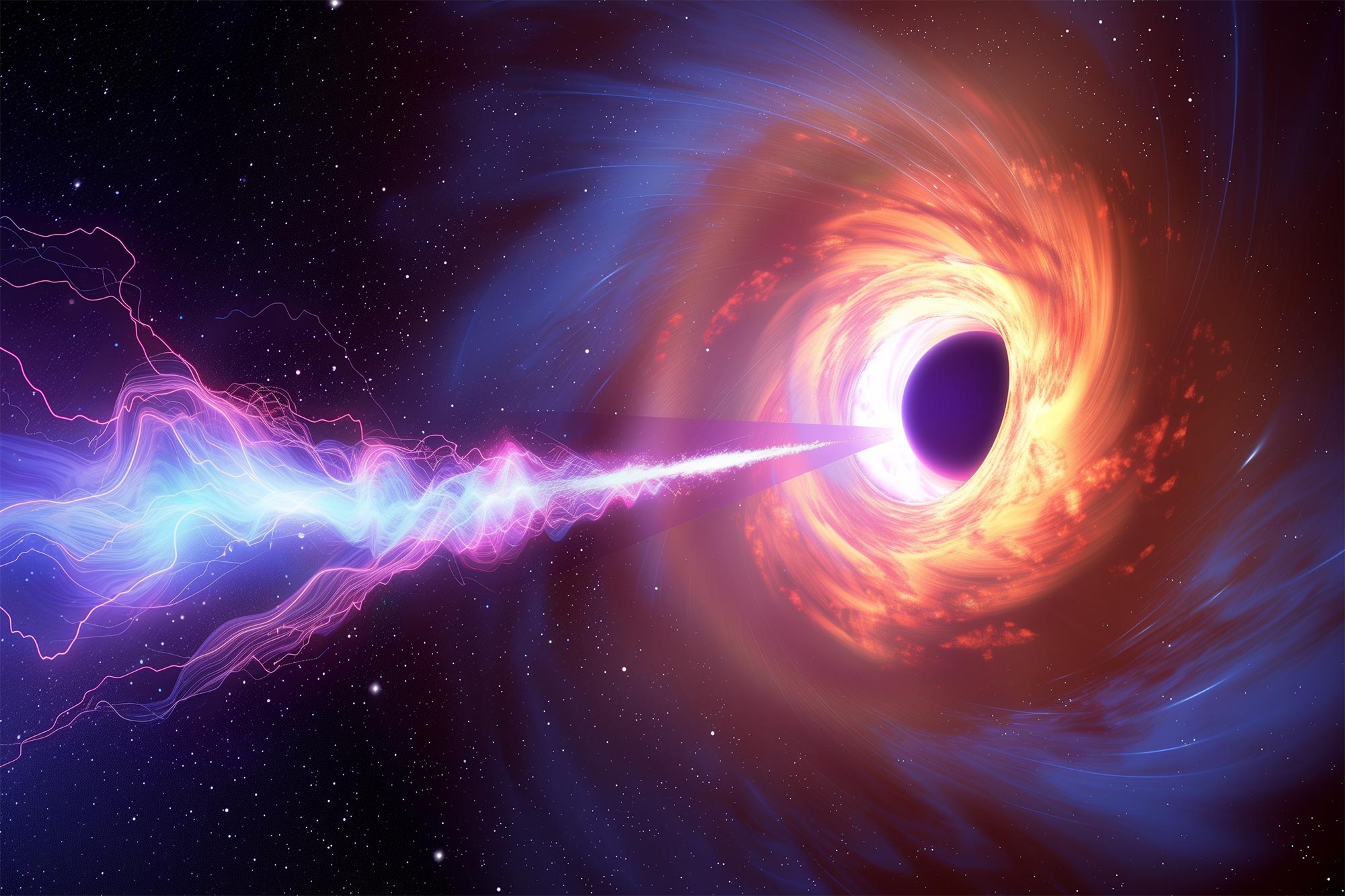
The Fireball collaboration used CERN’s HiRadMat facility to produce an analog of the jets of matter and antimatter that stream out of some black holes and neutron stars.
At CERN’s HiRadMat facility, researchers have created a high-density electron-positron plasma beam that mimics astrophysical jets from black holes, providing new insights into space phenomena. These experiments help validate theoretical models with real-world data, paving the way for deeper understanding of cosmic events like black hole jets.
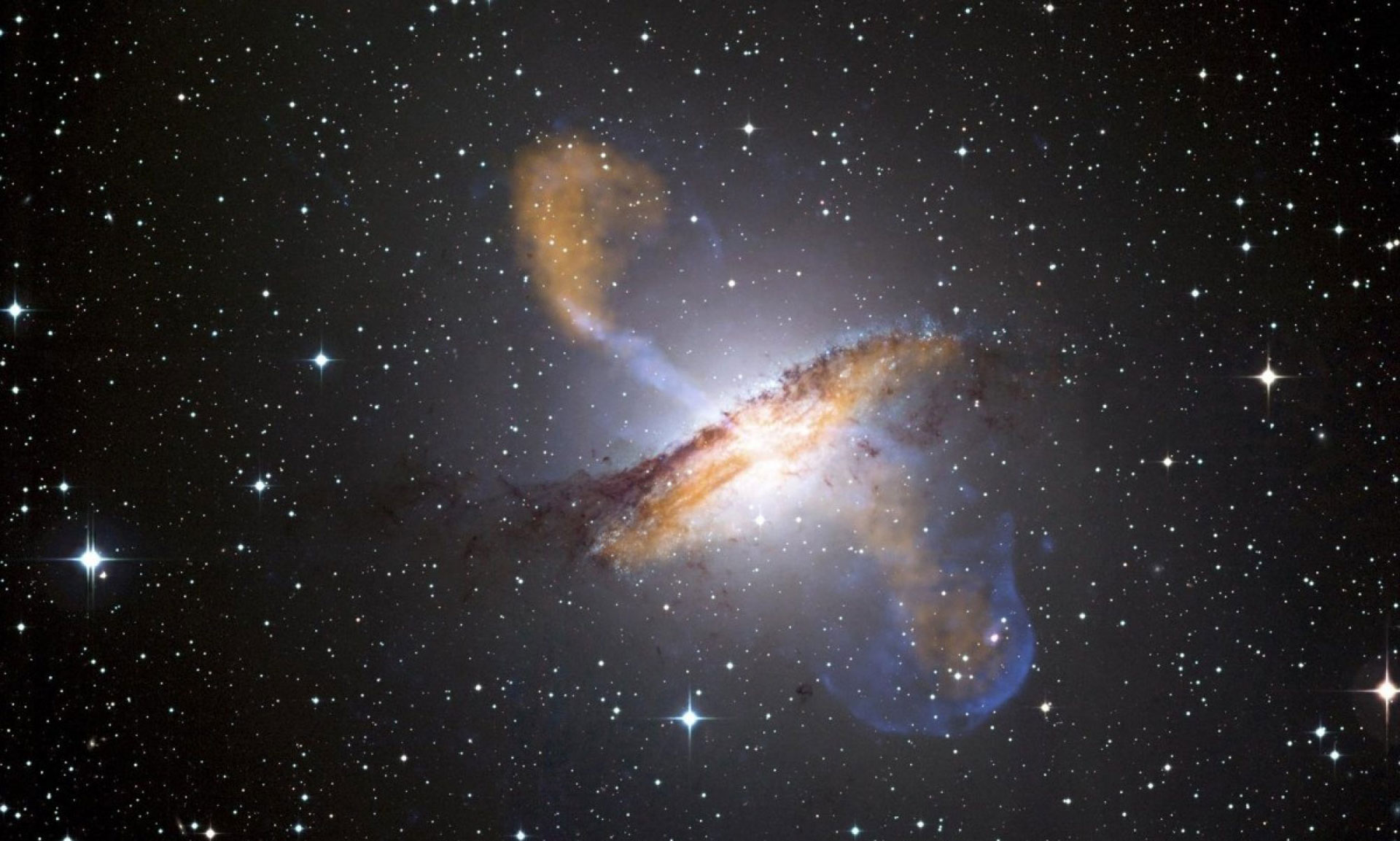
Dive into the heart of an active galaxy and you’ll find a supermassive black hole gobbling up material from its surroundings. In about one out of ten such galaxies, the black hole will also shoot out jets of matter at close to the speed of light. Such relativistic black hole jets are thought to contain, among other components, a plasma of pairs of electrons and their antimatter equivalents, positrons.
This relativistic electron-positron plasma is believed to shape the dynamics and energy budget of the black hole and its environment. But how exactly this happens remains little understood, because it’s difficult both to measure the plasma with astronomical observations and to simulate it with computer programs.
In a paper recently published in Nature Communications, Charles Arrowsmith and colleagues from the Fireball collaboration report how they have used the HiRadMat facility at CERN to produce a relativistic beam of electron-positron plasma that allows this medium to be studied in detail in laboratory experiments.
Laboratory Replication of Astrophysical Phenomena
Relativistic beams of electron-positron pairs can be created in several ways at different types of laboratories, including high-power laser facilities. However, none of the existing ways can produce the number of electron-positron pairs that are required to sustain a plasma – a state of matter in which the constituent particles are very loosely connected. Without sustaining the plasma, researchers cannot investigate how these analogs of black hole jets change as they move through a laboratory equivalent of the interstellar medium. This investigation is key to explaining observations from ground- and space-based telescopes.
Arrowsmith and colleagues found a way to meet these requirements at CERN’s HiRadMat facility. Their approach involved extracting within a mere nanosecond a whopping three hundred billion protons from the Laboratory’s Super Proton Synchrotron and firing them onto a target of graphite and tantalum, in which a cascade of particle interactions generates huge numbers of electron-positron pairs.
Implications for Astrophysical Research
By measuring the resulting relativistic electron-positron beam with a set of instruments, and comparing the result with sophisticated computer simulations, Arrowsmith and co-workers showed that the number of electron-positron pairs in the beam – more than ten trillion – is ten to hundred times greater than previously achieved, exceeding for the first time the number needed to sustain the plasma state.
“Electron–positron plasmas are thought to play a fundamental part in astrophysical jets, but computer simulations of these plasmas and jets have never been tested in the laboratory,” says Arrowsmith. ”Laboratory experiments are necessary to validate the simulations, because what seems like reasonable simplifications of the calculations involved in the simulations can sometimes lead to drastically different conclusions.”
The result is the first from a series of experiments that the Fireball collaboration is carrying out at HiRadMat.
Future Directions in Laboratory Astrophysics
“The basic idea of these experiments is to reproduce in the laboratory the microphysics of astrophysical phenomena such as jets from black holes and neutron stars,” says co-author of the paper and lead researcher Gianluca Gregori. “What we know about these phenomena comes almost exclusively from astronomical observations and computer simulations, but telescopes cannot really probe the microphysics and simulations involve approximations. Laboratory experiments such as these are a bridge between these two approaches.”
Next in Arrowsmith and colleagues’ plasma pursuits at HiRadMat is to have these powerful jets propagate through a meter-long plasma and observe how the interaction between them generates magnetic fields that speed up the particles in the jets – one the greatest puzzles in high-energy astrophysics.
“The Fireball experiments are one of the latest additions to HiRadMat’s portfolio,” says operation manager of the facility Alice Goillot. “We’re looking forward to continue reproducing these rare phenomena using the unique properties of CERN’s accelerator complex.”
For more on this research, see Mini-Universe in a Lab: Creating “Cosmic Fireballs” on Earth.
Reference: “Laboratory realization of relativistic pair-plasma beams” by C. D. Arrowsmith, P. Simon, P. J. Bilbao, A. F. A. Bott, S. Burger, H. Chen, F. D. Cruz, T. Davenne, I. Efthymiopoulos, D. H. Froula, A. Goillot, J. T. Gudmundsson, D. Haberberger, J. W. D. Halliday, T. Hodge, B. T. Huffman, S. Iaquinta, F. Miniati, B. Reville, S. Sarkar, A. A. Schekochihin, L. O. Silva, R. Simpson, V. Stergiou, R. M. G. M. Trines, T. Vieu, N. Charitonidis, R. Bingham and G. Gregori, 12 June 2024, Nature Communications.
DOI: 10.1038/s41467-024-49346-2
This project has received funding from the European Union’s Horizon Europe Research and Innovation program under Grant Agreement No 101057511 (EURO-LABS).
Never miss a breakthrough: Join the SciTechDaily newsletter.
Follow us on Google and Google News.
5 Comments
“Electron–positron plasmas are thought to play a fundamental part in astrophysical jets, but computer simulations of these plasmas and jets have never been tested in the laboratory,” says Arrowsmith. ”Laboratory experiments are necessary to validate the simulations, because what seems like reasonable simplifications of the calculations involved in the simulations can sometimes lead to drastically different conclusions.”
Please ask researchers to think deeply:
1. How do you define the spacetime structure of electrons?
2. How do you define the spacetime structure of electron–positron plasmas?
3. Are electrons high-dimensional spacetime matter or low-dimensional spacetime matter?
4. Is electron–positron plasmas a high-dimensional spacetime material or a low-dimensional spacetime material?
5. How do you interpret the physical phenomena observed in experiments using scientific theories?
Space has zero viscosity and absolutely incompressible physical properties, which are ideal fluid physical characteristics. Therefore, mathematically, it is not difficult to understand how space forms vortices via topological phase transitions. Once the topological vortex is formed, it occupies space and maintains its existence in time via spin until it changes, cancels out, or annihilates in interaction.
Each topological vortex is an accurate quantum clock. The absoluteness of time lies in the fact that each topological vortex has its own spin period, while the relativity of time lies in the fact that different topological vortices may have different spin periods. As a result, in the spacetime of interaction of topological vortices, time and space are both absolute and relative.
Matter and antimatter are mainly manifested between topological vortices and their twin anti-vortices, rather than between the high-dimensional spacetime matter formed by their interactions.
The study of matter and antimatter should not neglect the material hierarchy and time. Scientific research guided by correct theories can help humanity avoid detours, failures, and pomposity.
If researchers are really interested in science and physics, you can browse https://zhuanlan.zhihu.com/p/701032654.
Actually someone else essentially using the same mathematical conjectures as those used to describe a hypothetical big bang, has by similar mathematical reasoning, but in reverse, as it were, proved that this entire universe can be compressed into a singularity leaving no universe whatsoever behind.
Very good.
The universe does not do algebra, formulas, or fractions. The universe is the superposition, deflection, and twisting of topological shapes, and is the synchronous effect of countless topological vortex point defects.
Please, just don’t cross the paired streams of high-density electron-positron plasma.
Would have been nice if the authors had included some math in the paper; as it’s written, it hardly benefits anyone other than to possibly fulfill a grant requirement.