
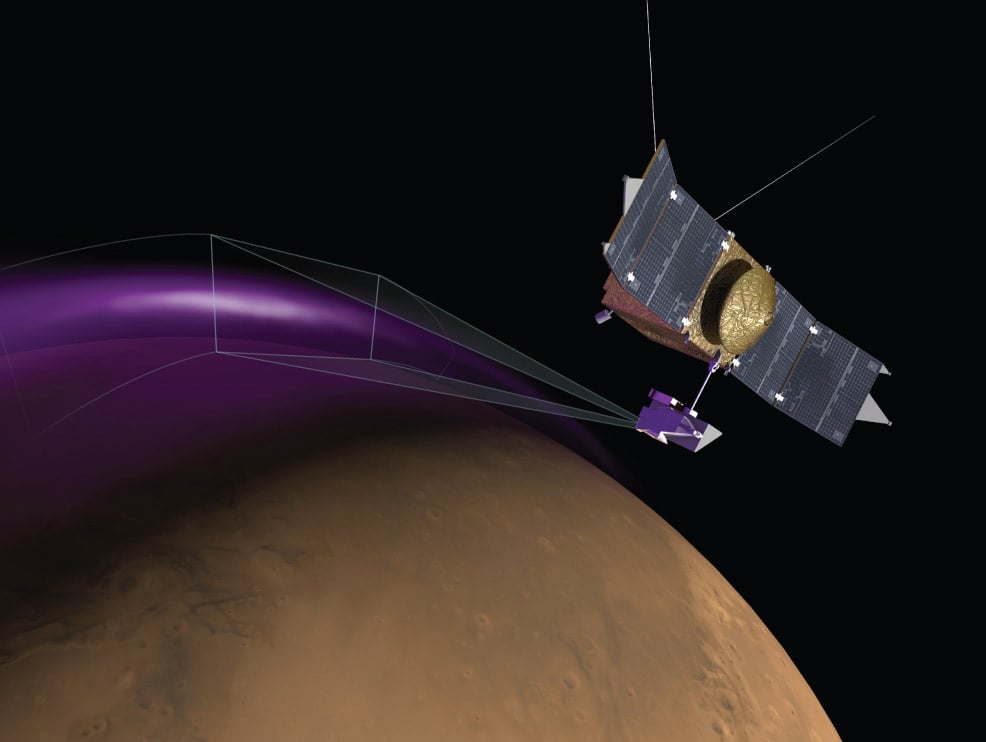
New research being presented at the 46th Lunar and Planetary Science Conference details the discovery of an unexplained high-altitude dust cloud and aurora that reaches deep into the Martian atmosphere.
NASA’s Mars Atmosphere and Volatile Evolution (MAVEN) spacecraft has observed two unexpected phenomena in the Martian atmosphere: an unexplained high-altitude dust cloud and aurora that reaches deep into the Martian atmosphere.
The presence of the dust at orbital altitudes from about 93 miles (150 kilometers) to 190 miles (300 kilometers) above the surface was not predicted. Although the source and composition of the dust are unknown, there is no hazard to MAVEN and other spacecraft orbiting Mars.
“If the dust originates from the atmosphere, this suggests we are missing some fundamental process in the Martian atmosphere,” said Laila Andersson of the University of Colorado’s Laboratory for Atmospherics and Space Physics (CU LASP), Boulder, Colorado.
The cloud was detected by the spacecraft’s Langmuir Probe and Waves (LPW) instrument, and has been present the whole time MAVEN has been in operation. It is unknown if the cloud is a temporary phenomenon or something long lasting. The cloud density is greatest at lower altitudes. However, even in the densest areas, it is still very thin. So far, no indication of its presence has been seen in observations from any of the other MAVEN instruments.
Possible sources for the observed dust include dust wafted up from the atmosphere; dust coming from Phobos and Deimos, the two moons of Mars; dust moving in the solar wind away from the sun; or debris orbiting the sun from comets. However, no known process on Mars can explain the appearance of dust in the observed locations from any of these sources.
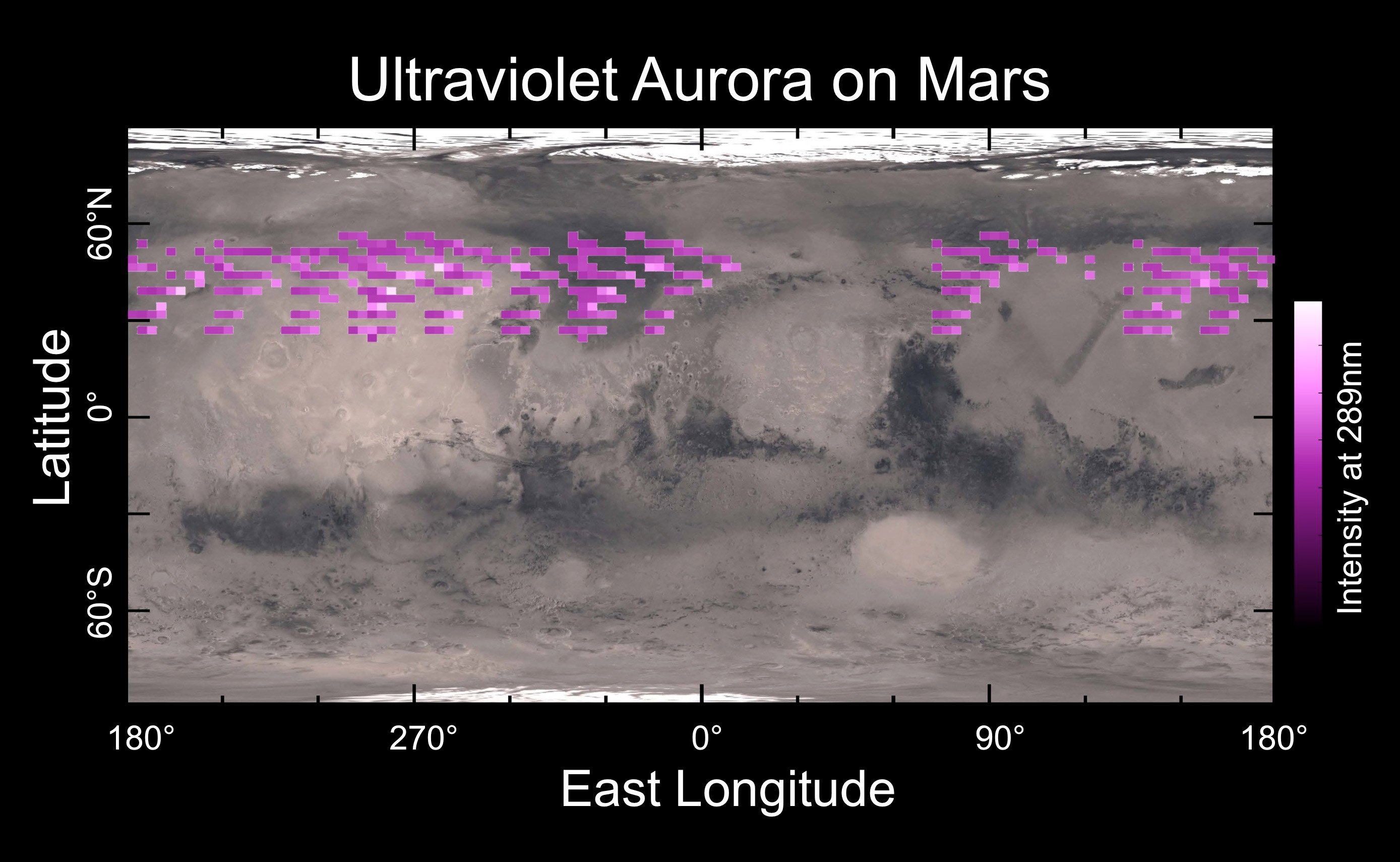
MAVEN’s Imaging Ultraviolet Spectrograph (IUVS) observed what scientists have named “Christmas lights.” For five days just before December 25, MAVEN saw a bright ultraviolet auroral glow spanning Mars’ northern hemisphere. Aurora, known on Earth as northern or southern lights, is caused by energetic particles like electrons crashing down into the atmosphere and causing the gas to glow.
“What’s especially surprising about the aurora we saw is how deep in the atmosphere it occurs – much deeper than at Earth or elsewhere on Mars,” said Arnaud Stiepen, IUVS team member at the University of Colorado. “The electrons producing it must be really energetic.”
The source of the energetic particles appears to be the sun. MAVEN’s Solar Energetic Particle instrument detected a huge surge in energetic electrons at the onset of the aurora. Billions of years ago, Mars lost a global protective magnetic field like Earth has, so solar particles can directly strike the atmosphere. The electrons producing the aurora have about 100 times more energy than you get from a spark of house current, so they can penetrate deeply in the atmosphere.
The findings are being presented at the 46th Lunar and Planetary Science Conference in The Woodlands, Texas.
MAVEN was launched to Mars on November 18, 2013, to help solve the mystery of how the Red Planet lost most of its atmosphere and much of its water. The spacecraft arrived at Mars on September 21, and is four months into its one-Earth-year primary mission.
“The MAVEN science instruments all are performing nominally, and the data coming out of the mission are excellent,” said Bruce Jakosky of CU LASP, Principal Investigator for the mission.
MAVEN is part of the agency’s Mars Exploration Program, which includes the Opportunity and Curiosity rovers, the Mars Odyssey and Mars Reconnaissance Orbiter spacecraft currently orbiting the planet.
NASA’s Mars Exploration Program seeks to characterize and understand Mars as a dynamic system, including its present and past environment, climate cycles, geology, and biological potential. In parallel, NASA is developing the human spaceflight capabilities needed for its journey to Mars or a future round-trip mission to the Red Planet in the 2030s.
MAVEN’s principal investigator is based at the University of Colorado’s Laboratory for Atmospheric and Space Physics, and NASA’s Goddard Space Flight Center in Greenbelt, Maryland, manages the MAVEN project. Partner institutions include Lockheed Martin, the University of California at Berkeley, and NASA’s Jet Propulsion Laboratory.
Never miss a breakthrough: Join the SciTechDaily newsletter.
Follow us on Google and Google News.