
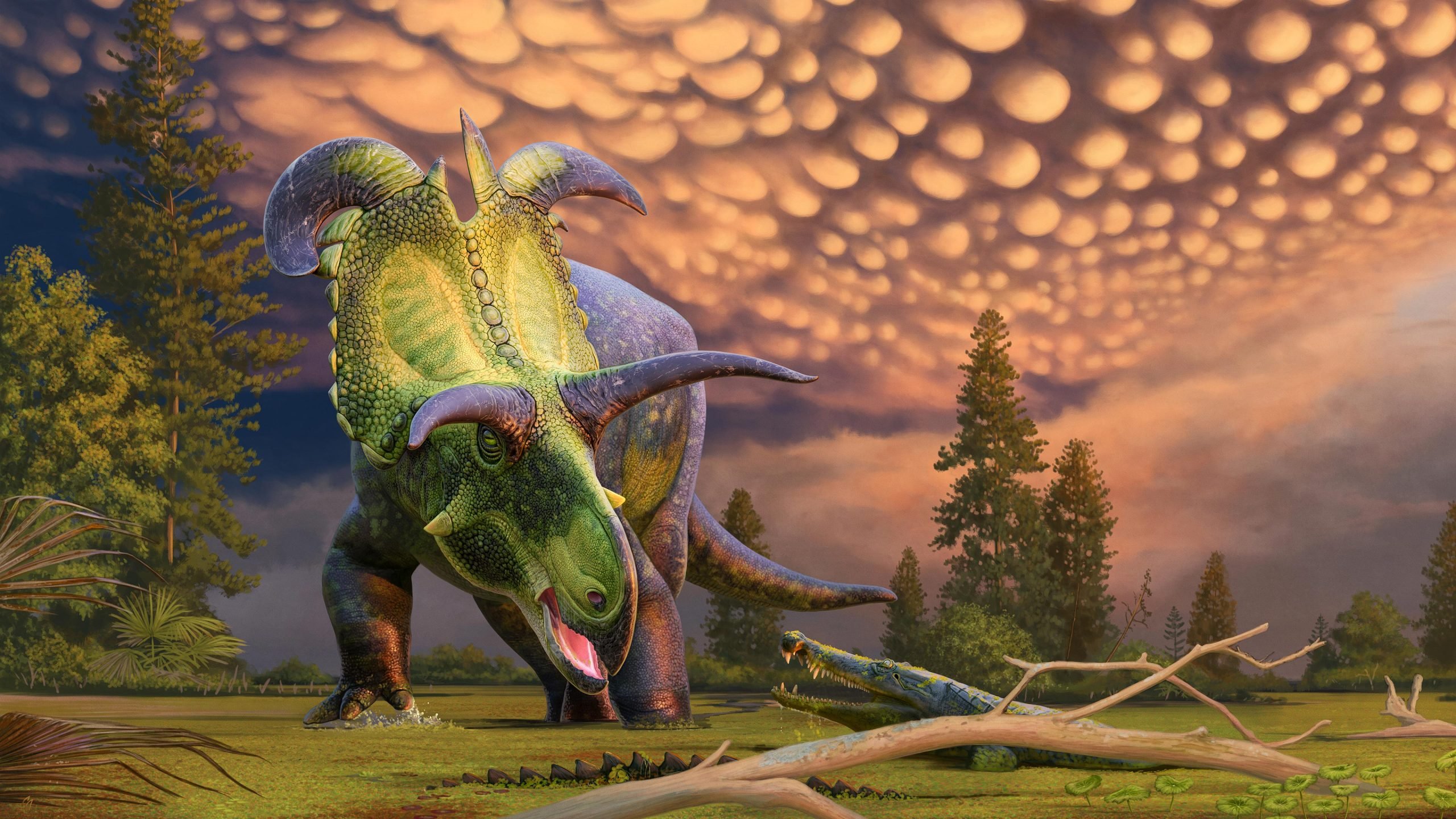
The newly discovered Lokiceratops rangiformis features distinctive horns and a caribou-like frill, representing a significant addition to the diversity of North American centrosaurine dinosaurs. Unearthed in Montana and now housed in Denmark, this species offers a glimpse into the rich ecological dynamics of Cretaceous North America.
What do you get when you cross Norse mythology with a 78-million-year-old ancestor to the Triceratops? Answer: Lokiceratops rangiformis, a plant-eating dinosaur with a very fancy set of horns.
The new dinosaur was identified and named by Colorado State University affiliate faculty member Joseph Sertich and University of Utah Professor Mark Loewen. The dinosaur’s name, announced on June 20 in the scientific journal PeerJ, translates roughly to “Loki’s horned face that looks like a caribou.”
Unique Features of Lokiceratops
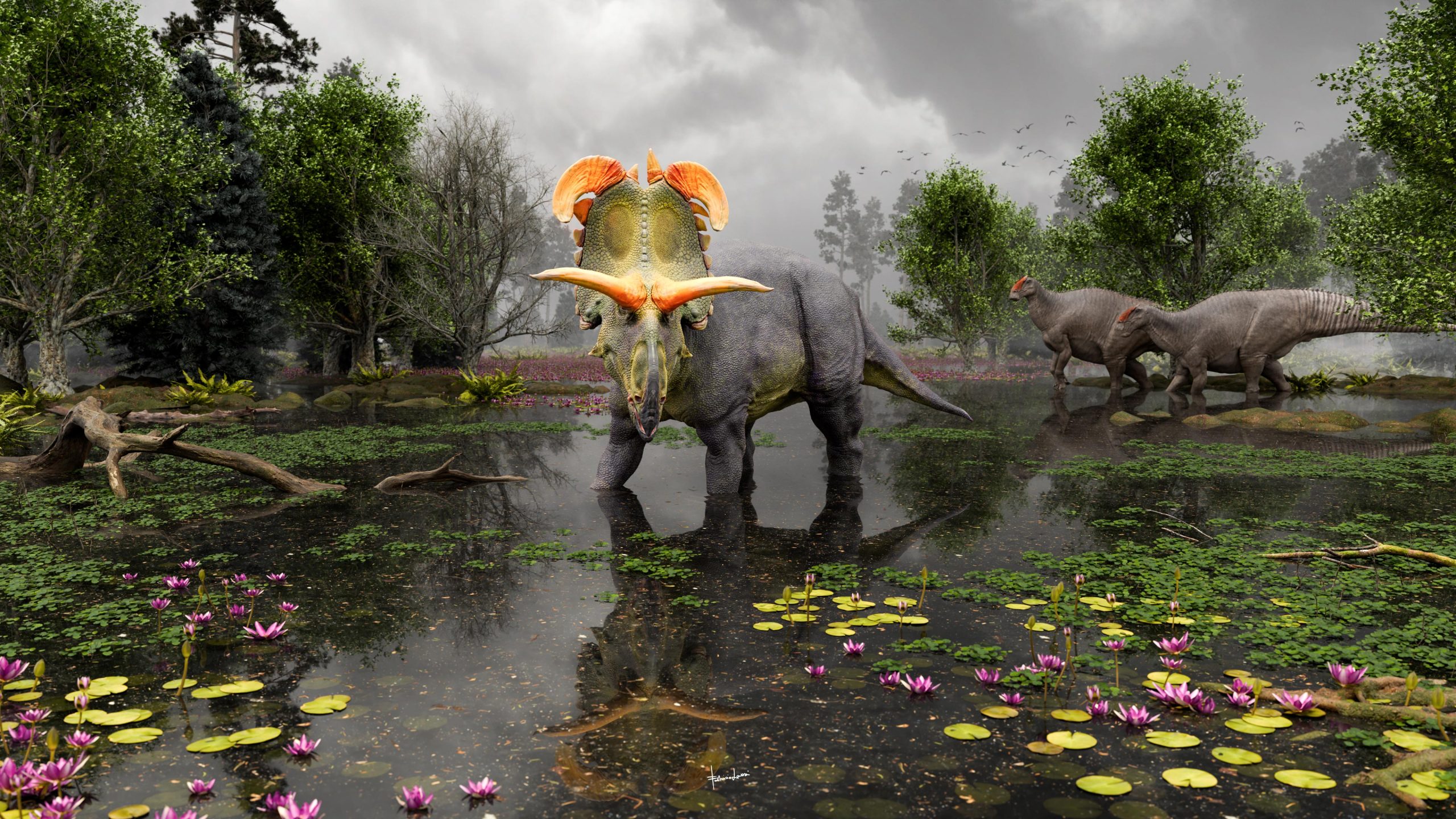
Loewen and Sertich, co-lead authors of the PeerJ study, dubbed the new species Lokiceratops (lo-Kee-sare-a-tops) rangiformis (ran-ɡi-FOHR-mees) because of the unusual, curving blade-like horns on the back of its frill – the shield of bone at the back of the skull – and the asymmetrical horns at the peak of the frill, reminiscent of caribou antlers.
“The dinosaur now has a permanent home in Denmark, so we went with a Norse god, and in the end, doesn’t it just really look like Loki with the curving blades?” Loewen said, referring to the trickster god’s weapon of choice.
Loewen, a paleontologist at the Natural History Museum of Utah, and Sertich, a paleontologist with the Smithsonian Tropical Research Institute, are both scientific consultants for the Museum of Evolution in Denmark, Lokiceratops’ new home.
“It’s one of those stories with a happy ending, where it didn’t go to somebody’s mansion,” Sertich said. “It ended up in a museum, where it will be preserved forever so people can study it and enjoy visiting it.”
New Dinosaur Discovery
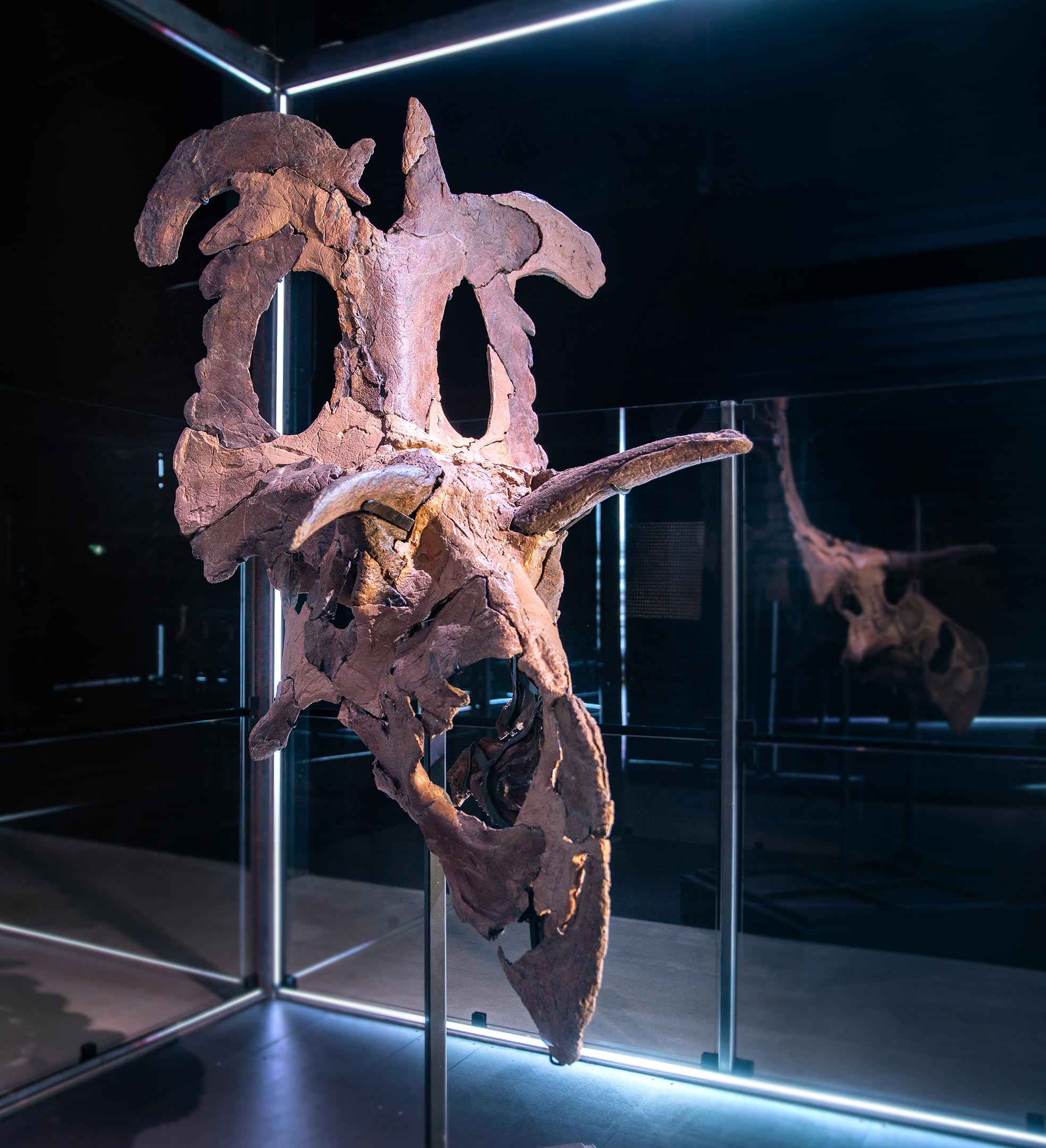
Lokiceratops was discovered in 2019 in the badlands of northern Montana, two miles (3.2 kilometers) south of the U.S.-Canada border. Sertich and Loewen helped reconstruct the dinosaur from fragments the size of dinner plates and smaller. Once they had pieced the skull together, they realized the specimen was a new type of dinosaur.
Estimated to be 22 feet (6.7 meters) long and weigh 11,000 pounds (5 metric tonnes), Lokiceratops is the largest dinosaur from the group of horned dinosaurs called centrosaurines ever found in North America. It has the largest frill horns ever seen on a horned dinosaur and lacks the nose horn that is characteristic among its kin.
Centrosaurines are a subgroup of ceratopsid dinosaurs, distinguished by their distinctive horns and frills. They lived during the Late Cretaceous period and are known for their elaborate skull decorations, which were likely used in social displays and defense. Fossils of centrosaurines have been primarily found in North America.
“This new dinosaur pushes the envelope on bizarre ceratopsian headgear, sporting the largest frill horns ever seen in a ceratopsian,” Sertich said in a press release announcing the dinosaur’s unveiling at the Natural History Museum of Utah, where a replica is displayed. “These skull ornaments are one of the keys to unlocking horned dinosaur diversity and demonstrate that evolutionary selection for showy displays contributed to the dizzying richness of Cretaceous ecosystems.”
Sertich likened dinosaur horns to feathers on birds. Birds use feather colors and patterns to differentiate their own species among other, similar species of birds.
“We think that the horns on these dinosaurs were analogous to what birds are doing with displays,” Sertich said. “They’re using them either for mate selection or species recognition.”
What Loki’s Horns Tell Us About Dinosaurs
Lokiceratops was excavated from the same rock layer as four other dinosaur species, indicating that five different dinosaurs lived side by side 78 million years ago in the swamps and coastal plains along the eastern shore of Laramidia, the western landmass of North America created when a seaway divided the continent. Three of these species were closely related but not found outside the region.
“It’s unheard-of diversity to find five living together, similar to what you would see on the plains of East Africa today with different horned ungulates,” Sertich said.
Unlike the broad range of large wild mammals that roam the U.S. West today, such as elk, these ancient animals were geographically limited, he added. Loki’s discovery provides evidence that these species evolved rapidly within a small area, a process sometimes seen in birds.
By the time Triceratops came onto the scene 12 million years later, regional differences had been homogenized into just two species of horned dinosaurs from Canada to Mexico – possibly in response to a more homogenous climate, Sertich said.
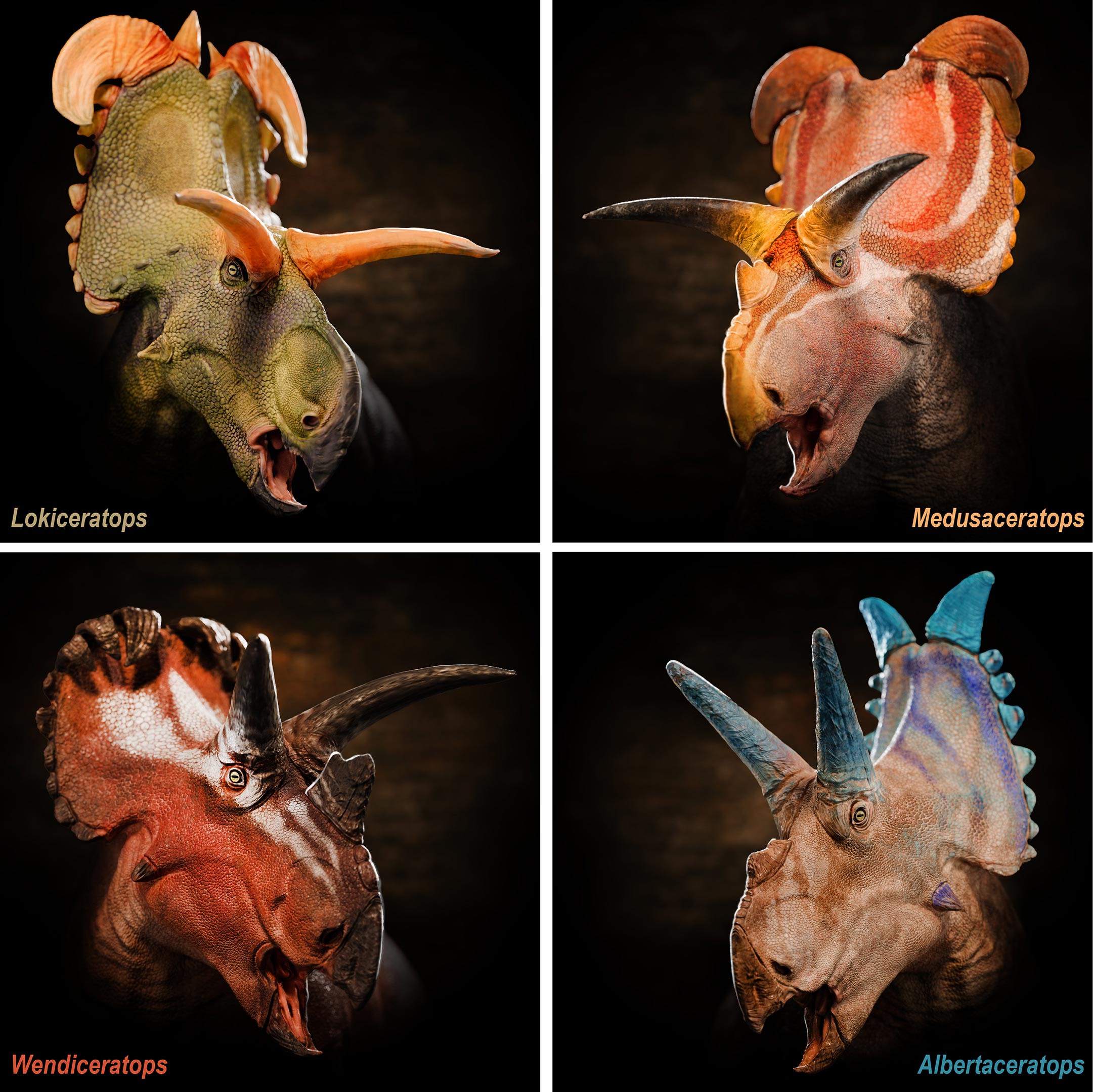
The study shows that dinosaur diversity has been underestimated and presents the most complete family tree of horned dinosaurs to date.
“Lokiceratops helps us understand that we only are scratching the surface when it comes to the diversity and relationships within the family tree of horned dinosaurs,” Loewen said.
For more on this discovery, see Remarkable New Dinosaur Unearthed in the Ancient Swamps of Montana.
Reference: “Lokiceratops rangiformis gen. et sp. nov. (Ceratopsidae: Centrosaurinae) from the Campanian Judith River Formation of Montana reveals rapid regional radiations and extreme endemism within centrosaurine dinosaurs” 20 June 2024, PeerJ.
DOI: 10.7717/peerj.17224
Never miss a breakthrough: Join the SciTechDaily newsletter.
Follow us on Google and Google News.
9 Comments
Birds are not dinosaur only gator is a dinosaur the last surviving spinosauridae dinosaur you have to become a thecodont before you become a dinosaur .thecodont means crocodilian teeth like these animal t.rex Nile crocodile .clearly horns osteoderm skin are not for thermoregulation only subadult and adult has it.siamese crocodile Cuban crocodile has horn the fossil mesoeucrocodylia shieldcroc has frill because it’s a dinosaur .clearly this is for armor and display
Triceratop has 2 horn like Cuban crocodile Siamese crocodile voay the suborbital common in predator bipedal dinosaur that why it is found in modern crocodilian it is not found in bird velociraptor because it’s flightless bird that had a flying ancestor .in modern crocodilian it is not over the eye it is lost in spinosaurus because eye are now on top of skull aquatic feature like today spinosauridae modern crocodilian baryonyx has a suborbital because it’s a primitive mesoeucrocodylia
Some Nile crocodile has horn .modern crocodilian is the most advance dinosaur ever the king dinosaur
What about the two dinosaurs running for the November election?
I am not a voter
Modern crocodilian do have horn near the eyes the spectacled caiman I saw it on YouTube they have 4 horn 2 is fake these are lynx type horn the really dinosaur horn is beside the eye because they have flat skull so impossible to have dinosaur type suborbital horn and eyes are on top of the skull if skull was not flat it is a match so horn reappear most modern crocodilian horn is near the ears the dwarf crocodile allso has lynx horns
Spectacled caiman fake horn the lynx cat horn is on top of the eye probaly will never fossilize because it is not on any skull bone the dinosaur horn is on skull bone .modern crocodilian and dinosaur horn are on different skull bone.nile crocodile horn are small and not all Nile crocodile have horn
So spectacled caiman is using the fake horn and turning into dinosaur horn they say these crocodilian horn link to dinosaur horn then why grow back the true horn
Final found gator type mesoeucrocodylia with pneumatic bone like dinosaur I am not finish clearly this has it this pneumatic bone beyond the skull they cliam only dinosaur birds has allso found in pseudosuchus trailestes