
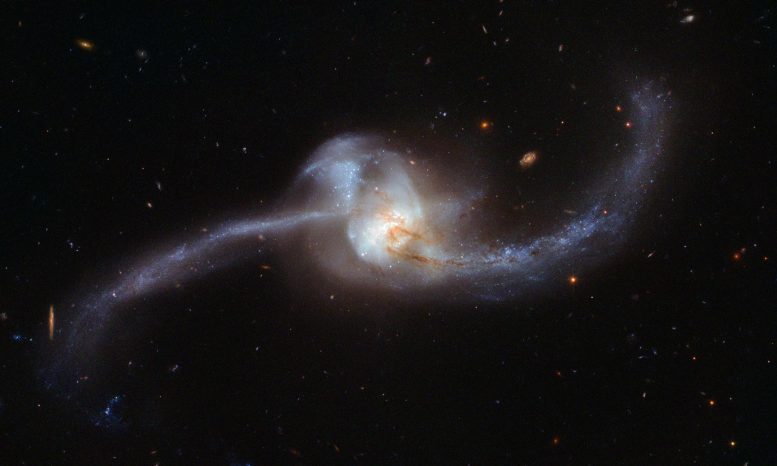
Over thirty years ago, the Infrared Astronomy Satellite discovered that the universe contained many extremely luminous galaxies, some more than a thousand times brighter than our own Milky Way, but which are practically invisible at optical wavelengths. These galaxies are powered by bursts of star formation buried deep within clouds of dust and gas. The dust absorbs ultraviolet light while radiating at infrared wavelengths. In many cases, the hyperactivity was triggered by a collisional encounter between galaxies that facilitated the collapse of interstellar gas into new stars.
Collisions between galaxies are common. Indeed, most galaxies have probably been involved in one or more encounters during their lifetimes, making these interactions an important phase in galaxy evolution and the formation of stars in the universe. The Milky Way, for example, is bound by gravity to the Andromeda galaxy and is approaching it at a speed of about 50 kilometers per second; we are expected to meet in another billion years or so. In the local universe, about five percent of galaxies are currently in a merger, and mergers usually can be easily identified by the visible morphological distortions they produce such as tidal tails sweeping out from the galactic discs.
Not all infrared luminous galaxies show such distortions, however, and the issue of identifying (and classifying) mergers becomes especially problematic for studies of earlier cosmic epochs when the star formation rates were much higher than today, and when the merger rate of galaxies was also higher. (Moreover, such systems are preferentially discovered in deep galaxy surveys precisely because they are so luminous.) But galaxies in the distant cosmos are too remote to detect spatial signatures like tidal arms (at least with current telescopes). It is possible that other processes besides merger-induced star formation are lighting up some of these bright galaxies, for example accreting supermassive black holes can emit copious amounts of ultraviolet radiation. Because of such cases, estimates of star formation in the early universe based on luminosity measurements alone could be incorrect.
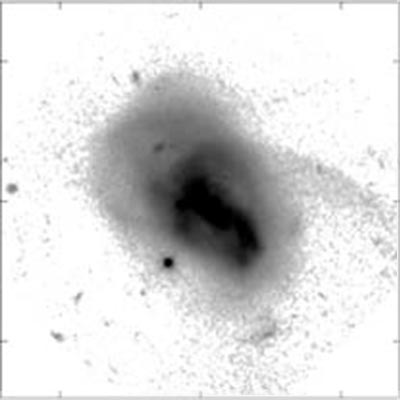
CfA astronomer Lars Hernquist is a pioneer in the development of computer simulations of merging galaxies. Several years ago he and a team of colleagues produced a massive new simulation of the formation and evolution of galaxies in the universe, called Illustris. In a new paper based on Ilustris simulated images of merger galaxies, the astronomers present a way to help identify when imaged systems are mergers. They created about one million synthetic Hubble and James Webb Space Telescope images from their simulated mergers, and then looked for common morphological indicators of merging. They developed an algorithm that successfully identified mergers at roughly a seventy percent level of completeness out to distances of as much as eighty-five billion light-years (the current distance value), corresponding to light dating from the epoch about 2 billion years after the big bang. Results from the algorithm indicated that spatial features associated with strong central concentrations (or bulges) were most important for selecting past mergers, while double nuclei and asymmetries were most important for selecting future mergers (that is, sometime in the next 250 million years). The new algorithm will be particularly valuable when applied to future Webb images of very distant mergers.
Reference: “Automated Distant Galaxy Merger Classifications from Space Telescope Images using the Illustris Simulation” by Gregory F. Snyder, Vicente Rodriguez-Gomez, Jennifer M. Lotz, Paul Torrey, Amanda C.N. Quirk, Lars Hernquist, Mark Vogelsberger and Peter E. Freeman, 13 April 2019, MNRAS.
DOI: 10.1093/mnras/stz1059
Never miss a breakthrough: Join the SciTechDaily newsletter.
Follow us on Google and Google News.
1 Comment
Your post is awesome this will be definitely help us, thanks