
Close Menu
    Facebook X (Twitter) Instagram
    SciTechDaily
    • Biology
    • Chemistry
    • Earth
    • Health
    • Physics
    • Science
    • Space
    • Technology
    Facebook X (Twitter) Pinterest YouTube RSS
    SciTechDaily
    Home»Space»Method Proposed to Protect Earth From Asteroid Impact: Tethered Diversion
    Space

    Method Proposed to Protect Earth From Asteroid Impact: Tethered Diversion

    By SpringerJune 18, 2020No Comments3 Mins Read
    Facebook Twitter Pinterest Telegram LinkedIn WhatsApp Email Reddit
    Share
    Facebook Twitter LinkedIn Pinterest Telegram Email Reddit
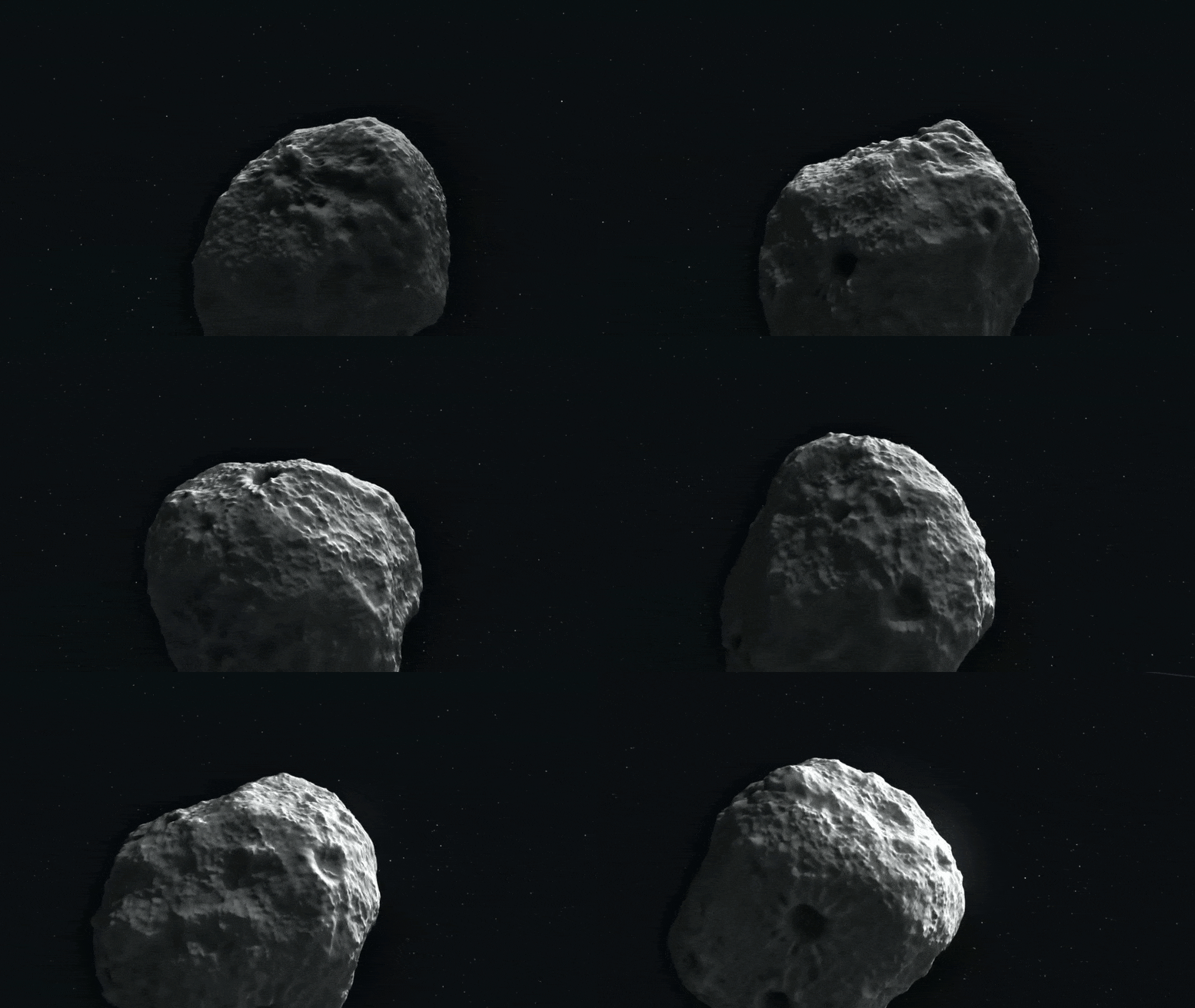
    Asteroid Rotating
    To avert the possibility of  Potentially Hazardous Asteroids colliding with the earth, researchers propose implementing a tether-assisted system.

    The use of a tether assisted system could prevent an asteroid impacting Earth without the risk of fragmentation.

    Our planet exists within the vicinity of thousands of Near-Earth Objects (NEOs), some of which –  Potentially Hazardous Asteroids (PHAs)  –  carry the risk of impacting Earth causing major damage to infrastructure and loss of life. Methods to mitigate such a collision are highly desirable. A new paper published in EPJ Special Topics, authored by Flaviane Venditti, Planetary Radar Department, Arecibo Observatory, University of Central Florida, Arecibo, suggests the use of a tether-assisted system to prevent PHA impact.

    The method suggested by Venditti and her colleagues involves using the tether –  previously suggested for other uses, such as space/lunar elevators and tethered satellite system  –  to connect the threatening PHA to another, smaller, asteroid, thus changing the center of mass of the two and hopefully raising the PHA to a safer orbit.

    Each potential PHA impact mitigation method carries with it, its own set of benefits and risks. A considerable risk associated with ‘high-impact’ mitigation techniques, such as the detonation of explosives at the surface of the PHA, is fragmentation. This makes methods which gradually alter the orbit of a PHA, and thus prevent the break up of such an object, look like a less risky prospect. The tether system carries with it little risk of causing fragmentation and smaller pieces of the PHA falling to earth, something which could itself cause widespread damage.

    Using the asteroid Bennu as a test subject, the team used computer simulations to calculate the dynamics of such a tether system for a variety of different initial conditions, concluding that it would be feasible for use as a planetary defense system. The team also suggests that the system could be of use in both the study and potential mining of NEOs and other asteroids.

    One of the likely drawbacks of such a method is the fact that it could require a longer lead time than many high impact methods that quickly deliver kinetic energy to a PHA to knock it out of orbit. Thus, the continued cataloging of such objects is needed if such a method is ever to be viable.

    Reference: “Dynamics of tethered asteroid systems to support planetary defense” by Flaviane C. F. Venditti, Luis O. Marchi, Arun K. Misra, Diogo M. Sanchez and Antonio F. B. A. Prado, 29 May 2020, The European Physical Journal Special Topics.
    DOI: 10.1140/epjst/e2020-900183-y

    Never miss a breakthrough: Join the SciTechDaily newsletter.
    Follow us on Google and Google News.

    Asteroid Springer
    Share. Facebook Twitter Pinterest LinkedIn Email Reddit

    Related Articles

    Billionaires and Futurists Plan Space Missions to Mine Asteroids for Metals

    Dawn Images Shine New Light on Vesta

    New WISE Atlas of Entire Infrared Sky Contains Over 18,000 Images

    Magnetic Anomalies on Moon

    Amino Acids Found in Meteorites that Experienced High Temperatures

    Bus-Sized Asteroid Barely Misses Earth

    Scientists Believe Water Ice May Exist on the Giant Asteroid Vesta

    NASA Probe Takes Close-Up Photos of Giant Vesta Asteroid

    3D Video Offers A Tour Over Asteroid Vesta

    Leave A Reply Cancel Reply

    • Facebook
    • Twitter
    • Pinterest
    • YouTube

    Don't Miss a Discovery

    Subscribe for the Latest in Science & Tech!

    Trending News

    Your Blood Pressure Reading Could Be Wrong Because of One Simple Mistake

    Astronomers Stunned by Ancient Galaxy With No Spin

    Physicists May Be on the Verge of Discovering “New Physics” at CERN

    Scientists Solve 320-Million-Year Mystery of Reptile Skin Armor

    Scientists Say This Daily Walking Habit May Be the Secret to Keeping Weight Off After Dieting

    New Therapy Rewires the Brain To Restore Joy in Depression Patients

    Giant Squid Detected off Western Australia in Stunning Deep-Sea Discovery

    Popular Sugar-Free Sweetener Linked to Liver Disease, Study Warns

    Follow SciTechDaily
    • Facebook
    • Twitter
    • YouTube
    • Pinterest
    • Newsletter
    • RSS
    SciTech News
    • Biology News
    • Chemistry News
    • Earth News
    • Health News
    • Physics News
    • Science News
    • Space News
    • Technology News
    Recent Posts
    • Scientists Discover “Hidden” Materials That Could Transform Clean Energy and Batteries
    • Scientists Just Measured an Energy Pulse Smaller Than a Trillionth of a Billionth of a Joule
    • 540-Million-Year-Old Fossils Reveal a Huge Surprise About Early Life on Earth
    • Scientists Create “Living” Materials That Crawl, Walk, and Dig on Their Own
    • Dante’s Inferno May Secretly Be About a Planet-Destroying Asteroid Strike
    Copyright © 1998 - 2026 SciTechDaily. All Rights Reserved.
    • Science News
    • About
    • Contact
    • Editorial Board
    • Privacy Policy
    • Terms of Use

    Type above and press Enter to search. Press Esc to cancel.