
Close Menu
    Facebook X (Twitter) Instagram
    SciTechDaily
    • Biology
    • Chemistry
    • Earth
    • Health
    • Physics
    • Science
    • Space
    • Technology
    Facebook X (Twitter) Pinterest YouTube RSS
    SciTechDaily
    Home»Earth»Microbial Oasis Discovered Under Atacama Desert in Chile
    Earth

    Microbial Oasis Discovered Under Atacama Desert in Chile

    By SciTechDailyFebruary 27, 2012No Comments2 Mins Read
    Facebook Twitter Pinterest Telegram LinkedIn WhatsApp Email Reddit
    Share
    Facebook Twitter LinkedIn Pinterest Telegram Email Reddit
    atacama-desert
    The Atacama Desert in Chile

    Researchers have discovered a veritable microbial oasis, under the Atacama Desert in Chile. The region is known for the Atacama Large Millimeter/submillimeter Array (ALMA), but the discovery of a hypersaline subsurface microbial habitat, associated with halite-, nitrate-, and perchlorate-containing salts, lying at a depth of 2 m (6.6 ft) in the driest desert on Earth will give scientists more reasons to visit the region.

    It was named a microbial oasis because the microorganisms were developing in the habitat rich in salts and other hygroscopic compounds. The researchers, led by Victor Parro, published their findings in the journal Astrobiology.
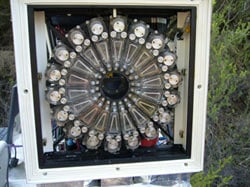
    SOLID-detectorTo find this oasis, researchers used a Signs of Life Detector (SOLID), which was developed by the team for future missions on Mars. At the core of SOLID, there’s a biochip called LDChip, which includes up to 450 antibodies to identify biological material, such as sugars, DNA, and proteins.

    They’ve confirmed the presence of underground archaea and bacteria in the Atacama Desert and some of the microorganisms were brought back to life in the lab when supplied with water.

    If there are similar traces of life on Mars, instruments such as SOLID could detect them.

    Reference: “A Microbial Oasis in the Hypersaline Atacama Subsurface Discovered by a Life Detector Chip: Implications for the Search for Life on Mars” by Victor Parro, Graciela de Diego-Castilla, Mercedes Moreno-Paz, Yolanda Blanco, Patricia Cruz-Gil, José A. Rodríguez-Manfredi, David Fernández-Remolar, Felipe Gómez, Manuel J. Gómez, Luis A. Rivas, Cecilia Demergasso, Alex Echeverría, Viviana N. Urtuvia, Marta Ruiz-Bermejo, Miriam García-Villadangos, Marina Postigo, Mónica Sánchez-Román, Guillermo Chong-Díaz and Javier Gómez-Elvira, 20 December 2011, Astrobiology.
    DOI: 10.1089/ast.2011.0654

    Never miss a breakthrough: Join the SciTechDaily newsletter.
    Follow us on Google and Google News.

    Astrobiology Atacama Desert Chile Desert Environment Life Detection Mars Microbial Saline
    Share. Facebook Twitter Pinterest LinkedIn Email Reddit

    Related Articles

    Three Years Later, the Search for Life on Mars Continues

    Earth’s Oldest Stromatolites and New Prospects for the Search for Life on Mars

    Search for Extra-Terrestrial Life Takes Mars Scientists on Expedition to Australia

    Antarctica Is Home to the World’s Largest Wetland

    Cloud Forests are at Risk of Destruction from Global Warming

    Storing Carbon Emissions in Deep Saline Aquifers

    Antarctic Ecosystems Threatened by Invasive Alien Species and Climate Change

    New Models Hone Picture of Climate Impact on Earth

    ESA’s Mars Express MARSIS Radar Explores Martian Oceans

    Leave A Reply Cancel Reply

    • Facebook
    • Twitter
    • Pinterest
    • YouTube

    Don't Miss a Discovery

    Subscribe for the Latest in Science & Tech!

    Trending News

    Just Two Days on a Vegan Diet Triggered Unexpected Changes in the Liver

    Antarctica’s “Doomsday Glacier” Could Raise Sea Levels Twice As Much as Scientists Feared

    Snakebites Are Far Deadlier Than We Thought, New Study Reveals

    Scientists Studied 865 Humpback Whales and Found They Grow Faster Than Expected

    Archaeologists May Have Just Discovered the World’s Oldest Shipwreck

    Researchers Find That Arthritis May Leave a Hidden Memory in Your Joints

    These Giant-Headed Ants Are Breaking a Fundamental Rule of Biology

    Scientists Discover a Hidden Cholesterol Switch That Could Change How We Treat Heart Disease

    Follow SciTechDaily
    • Facebook
    • Twitter
    • YouTube
    • Pinterest
    • Newsletter
    • RSS
    SciTech News
    • Biology News
    • Chemistry News
    • Earth News
    • Health News
    • Physics News
    • Science News
    • Space News
    • Technology News
    Recent Posts
    • Scientists Discover That Eating Peanuts Every Day May Help Protect the Aging Brain
    • From 54% to 100%: Scientists Reveal a Potential Breakthrough in Quantum Technology
    • After 150 Years, Scientists May Have Solved the Mystery of Westminster Abbey’s Roman Coffin
    • Scientists Discover Mysterious 150,000-Year-Old Bone From an Extinct Human Relative in Chinese Cave
    • Scientists Trap a Rare-Earth Metal in a Molecular Cage, Unlocking a Strange New State
    Copyright © 1998 - 2026 SciTechDaily. All Rights Reserved.
    • Science News
    • About
    • Contact
    • Editorial Board
    • Privacy Policy
    • Terms of Use

    Type above and press Enter to search. Press Esc to cancel.