
Close Menu
    Facebook X (Twitter) Instagram
    SciTechDaily
    • Biology
    • Chemistry
    • Earth
    • Health
    • Physics
    • Science
    • Space
    • Technology
    Facebook X (Twitter) Pinterest YouTube RSS
    SciTechDaily
    Home»Physics»MicroBooNE Physics Experiment Detects Its First Neutrino Candidates
    Physics

    MicroBooNE Physics Experiment Detects Its First Neutrino Candidates

    By Jim Shelton, Yale UniversityNovember 2, 2015No Comments2 Mins Read
    Facebook Twitter Pinterest Telegram LinkedIn WhatsApp Email Reddit
    Share
    Facebook Twitter LinkedIn Pinterest Telegram Email Reddit
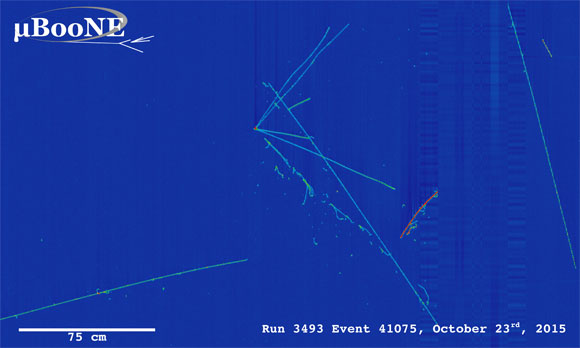
    The First Neutrino Event Candidates in MicroBooNE
    This image shows an event display from the first accelerator-born neutrino candidates spotted with the MicroBooNE detector.

    MicroBooNE started receiving its very first neutrino beam from the Fermilab Booster accelerator on October 15, 2015. On November 2, 2015, sceiietnsts released the first neutrino event candidates that their automated neutrino event reconstruction identified.

    Halloween has come and gone, but Yale physicist Bonnie Fleming still has ghosts in her machine.

    On October 15, Fleming and colleagues at the MicroBooNE physics experiment in Illinois detected their first neutrino candidates, which are also known as ghost particles. It represents a milestone for the project, involving years of hard work and a 40-foot-long particle detector that is filled with 170 tons of liquid argon.

    “It’s nine years since we proposed, designed, built, assembled, and commissioned this experiment,” said Fleming, a professor of physics and also MicroBooNE’s co-spokesperson. “That kind of investment makes seeing first neutrinos incredible.”

    The project announced its progress November 2. MicroBooNE is based at the Fermilab research facility, located just outside of Chicago.

    Neutrinos are subatomic particles that carry no electric charge and travel through the universe almost entirely unaffected by natural forces. They are considered a fundamental building block of matter. This year’s Nobel Prize in physics, in fact, was awarded to researchers studying neutrino oscillation.

    The MicroBooNE experiment aims to study how neutrinos interact and change within a distance of 500 meters. The detector will help scientists reconstruct the results of neutrino collisions as finely detailed, three-dimensional images. MicroBooNE findings also will be relevant for the forthcoming Deep Underground Neutrino Experiment (DUNE), which will examine neutrino transitions over longer distances.

    Liquid argon is crucial to the process. It is 40% more dense than water, and neutrinos are more likely to interact with it. When a neutrino hits the nucleus of an argon atom in the detector, its collision creates a spray of subatomic particle debris. Tracking these particles allows scientists to reveal the type and properties of the neutrino that produced them.

    “Future neutrino experiments will use this technology,” said Sam Zeller, MicroBooNE co-spokesperson and a physicist at Fermilab. “We’re learning a lot from this detector. It’s important not just for us, but for the whole physics community.”

    Never miss a breakthrough: Join the SciTechDaily newsletter.
    Follow us on Google and Google News.

    Fermi National Accelerator Laboratory MicroBooNE Particle Physics Yale University
    Share. Facebook Twitter Pinterest LinkedIn Email Reddit

    Related Articles

    Particle Physics Breakthrough: Scientists Report First-of-Its-Kind Neutrino Measurement

    Mysterious Physics Still Unexplained: MicroBooNE Experiment Shows No Hint of Sterile Neutrino

    Huge Blast Deep Beneath Earth’s Surface Kicks Off DUNE Excavation

    The Cold Eyes of DUNE – Particle Physicists’ Cryogenic “Traps” for Ghostly Particles

    ACME Collaboration Sets Size Limit for Undiscovered Subatomic Particles

    Magneto-Optical Trapping of Strontium Monofluoride

    Discovery of Rare Decay Puts Standard Model to Stringent Test

    Final Results on the Higgs Particle From Tevatron

    Fermilab Narrows the Gap Between the Masses of Neutrinos and Antineutrinos

    Leave A Reply Cancel Reply

    • Facebook
    • Twitter
    • Pinterest
    • YouTube

    Don't Miss a Discovery

    Subscribe for the Latest in Science & Tech!

    Trending News

    Just 10 Minutes a Day: Scientists Say This Ancient Chinese Practice Shows Powerful Blood Pressure Benefits

    Scientists Say This Popular Food Could Help Your Body Get Rid of Microplastics

    For the First Time, ChatGPT Has Solved an Unproven Math Problem in Geometry

    This Popular Supplement May Actually Slow Biological Aging, Scientists Reveal

    Can a Common Vitamin Fight the Most Aggressive Brain Cancer?

    Scientists Discover How to Stop Vision Loss Before It Starts

    The Mediterranean Isn’t Safe: Scientists Warn of Inevitable Tsunami

    Scientists Say Washing Dishes With a Sponge Has a Concerning Side Effect

    Follow SciTechDaily
    • Facebook
    • Twitter
    • YouTube
    • Pinterest
    • Newsletter
    • RSS
    SciTech News
    • Biology News
    • Chemistry News
    • Earth News
    • Health News
    • Physics News
    • Science News
    • Space News
    • Technology News
    Recent Posts
    • Ancient Carbon Is Flooding Arctic Rivers As Permafrost Melts Faster
    • Scientists Finally Capture Mysterious Molecule That’s Eluded Detection for 70 Years
    • Scientists Want Your Brain to Study Autism. Here’s Why
    • Something Is Warping Saturn’s Magnetic Field and It’s Not What You Think
    • Coffee and Blood Pressure: What You Need To Know Before Your Next Cup
    Copyright © 1998 - 2026 SciTechDaily. All Rights Reserved.
    • Science News
    • About
    • Contact
    • Editorial Board
    • Privacy Policy
    • Terms of Use

    Type above and press Enter to search. Press Esc to cancel.